
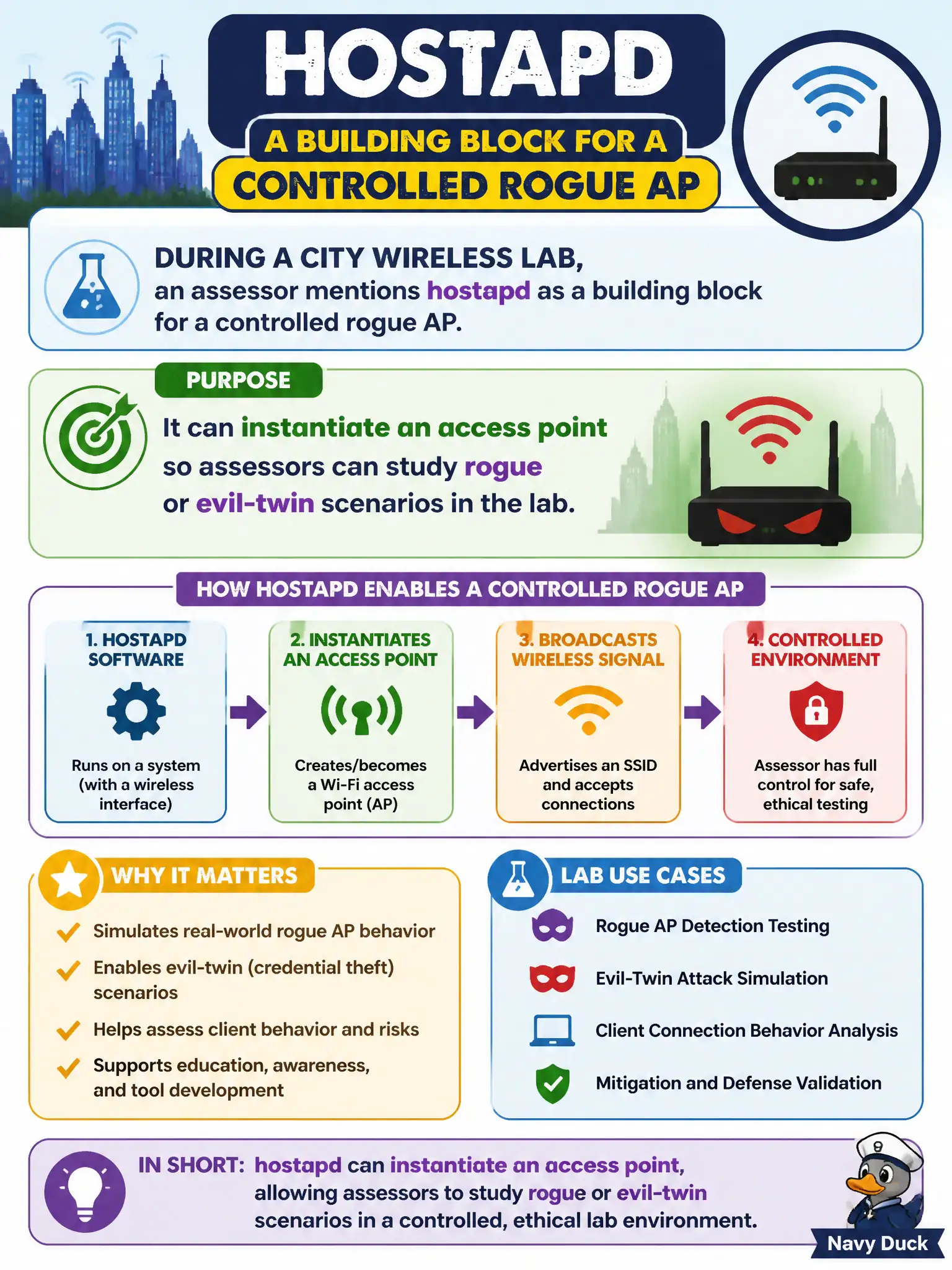
During a city wireless lab, an assessor mentions hostapd as a building block for a controlled rogue AP. What purpose does hostapd serve in that context?
Select an answer to reveal the explanation.
Short Explanation
hostapd is the software that can turn a capable interface into an AP—handy when you need a lab rogue, not a report cover sheet. Assessors use it to stand up controlled evil-twin style setups and watch what happens. It does not brick radios or replace your whole wired DHCP plant.
Full Explanation
hostapd serves as a building block that can instantiate an access point so assessors can study rogue or evil-twin scenarios in the municipal lab. Its purpose class is AP/authenticator instantiation for controlled tests—not report templates, chipset destruction, or replacing campus DHCP architecture. Civic labs use hostapd under RoE to understand attraction and portal classes safely.
'It is only a Word document template for the final OSWP-style PDF report' fails because hostapd is not a Word document template for the final OSWP-style PDF report. 'It permanently bricks Wi-Fi chipsets so they cannot leave managed mode' fails because it does not permanently brick Wi-Fi chipsets so they cannot leave managed mode. 'It replaces DHCP on the wired core so no wireless clients need an AP' fails because it does not replace DHCP on the wired core so no wireless clients need an AP.
Exam caveat: lab rogue instantiation still needs authorization, isolation, and non-production SSIDs when required. Operational check: stand up hostapd only on approved civic lab hardware/channels, label the SSID as a test network when policy demands, collect learning objectives evidence, and shut it down after the exercise. Keep configs in the engagement repo with access control. In municipal wireless operations, record the rationale in the engagement notes so future assessors know which control or technique class was chosen and which failure modes the rejected options would create for city services.