
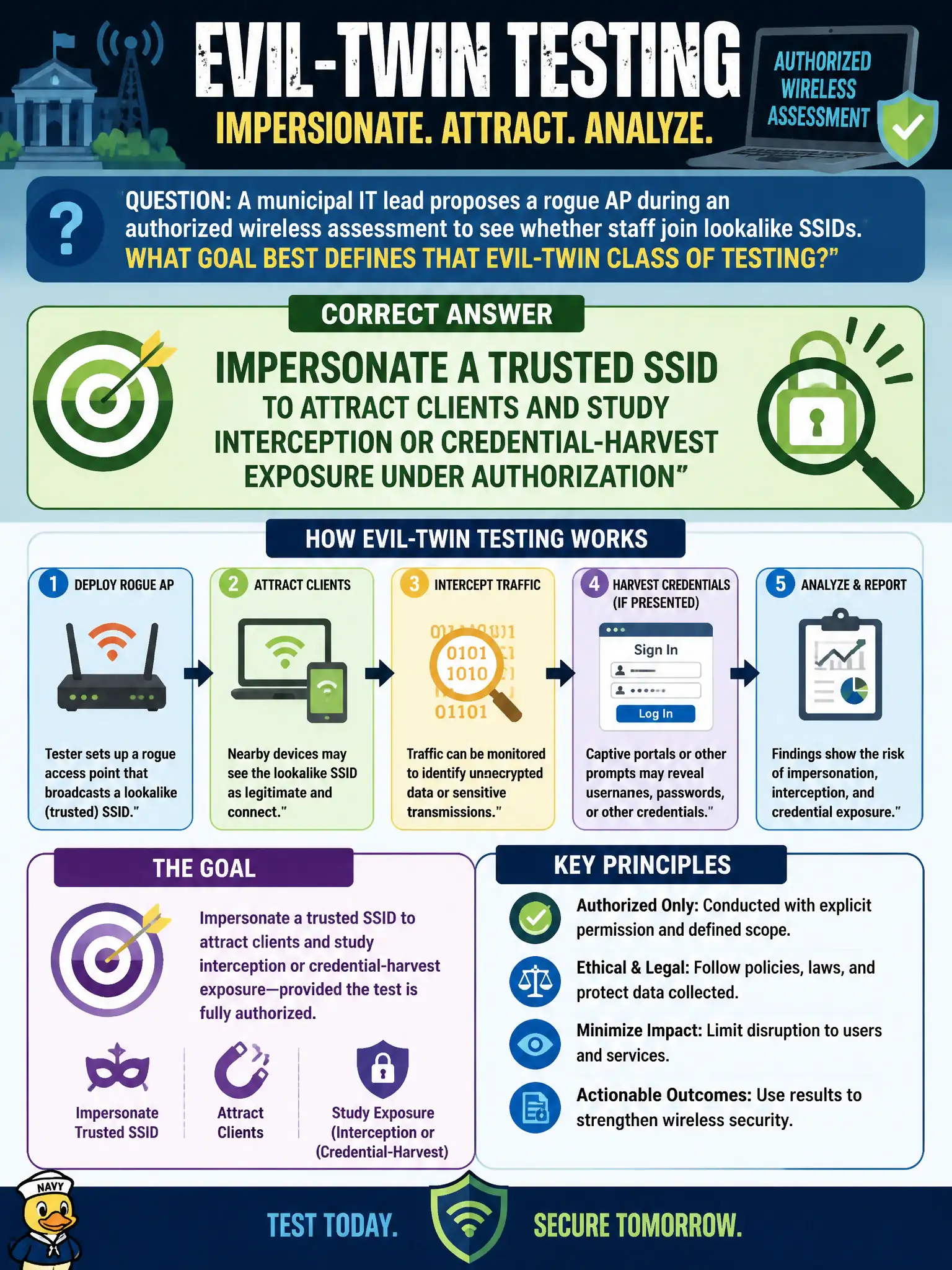
A municipal IT lead proposes a rogue AP during an authorized wireless assessment to see whether staff join lookalike SSIDs. What goal best defines that evil-twin class of testing?
Select an answer to reveal the explanation.
Short Explanation
An evil twin is the Wi-Fi version of a lookalike storefront with the same neon sign. In an authorized test, you stand up a rogue that copies a trusted SSID so you can see who walks in—and whether traffic or logins can be scooped up. Mounting torque, flipping the city to WEP, or banning monitor mode miss the whole point.
Full Explanation
A municipal IT lead proposing a rogue AP during an authorized wireless assessment is defining an evil-twin class goal: impersonate a trusted SSID to attract clients and study interception or credential-harvest exposure under authorization. The purpose is human and client-behavior risk measurement inside RoE—not facilities mounting torque, WEP downgrades, or disabling monitor mode. Civic purple-team charters should state that goal explicitly.
'Measure only ceiling-tile AP mounting torque against the vendor install guide' fails because evil-twin testing is not a ceiling-tile mounting-torque exercise. 'Replace the city's WPA3-SAE passphrase with WEP for performance benchmarking' fails because it is not an excuse to replace the city's WPA3-SAE passphrase with WEP for benchmarking. 'Disable monitor mode so assessors can only browse the guest portal as normal users' fails because it does not mean disabling monitor mode so assessors only browse as normal users.
Exam caveat: rogue-AP tests require clear authorization, RF containment, and stop conditions. Operational check: write RoE for the municipal evil-twin window, clone only approved SSIDs, limit power/placement, monitor for unintended clients, and tear down immediately after the test. Capture evidence of joins without retaining unnecessary personal data. In municipal wireless operations, record the rationale in the engagement notes so future assessors know which control or technique class was chosen and which failure modes the rejected options would create for city services.