
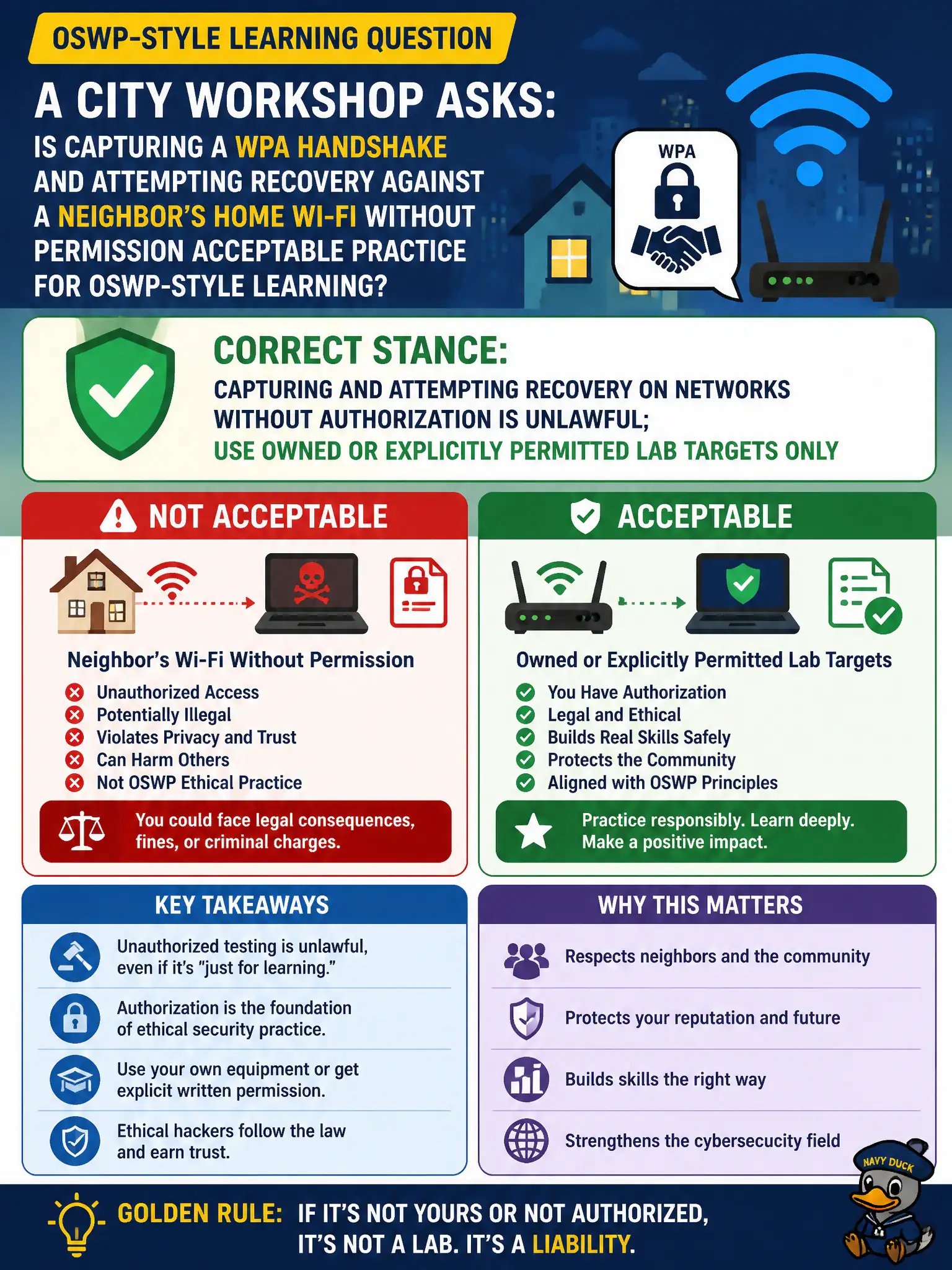
A city workshop asks whether capturing a WPA handshake and attempting recovery against a neighbor's home Wi-Fi without permission is acceptable practice for OSWP-style learning. What is the correct stance?
Select an answer to reveal the explanation.
Short Explanation
Neighbor Wi-Fi is not a free lab just because beacons are loud. No ownership, no written say-so—no capture, no cracking. Practice on gear you own or networks the owner explicitly authorized.
Full Explanation
Capturing handshakes and attempting recovery against a neighbor's home Wi-Fi without permission is unlawful for OSWP-style learning; use owned or explicitly permitted lab targets only. Broadcast SSIDs are not an invitation to attack. Municipal assessors practicing near city hall still need authorization for each BSS in scope—RF proximity is not consent.
'Home Wi-Fi is always fair game if the SSID is broadcast in the clear' fails because home Wi-Fi is not fair game merely because the SSID is broadcast in the clear. 'Handshake capture is legal everywhere; only associating with the AP requires permission' fails because handshake capture is not legal everywhere with association as the only restricted step. 'Municipal assessors may practice on any residential BSS within radio range of city hall' fails because municipal assessors may not practice on any residential BSS within radio range of city hall.
Exam caveat: lab legality is a first principle—methodology skill never overrides authorization. Operational check: build a civic practice environment with owned APs or written lab permission, label in-scope BSSIDs, and refuse any demo on unknown residential networks. Include an authorization reminder in every municipal wireless training charter. In municipal wireless operations, record the rationale in the engagement notes so future assessors know which control or technique class was chosen and which failure modes the rejected options would create for city services.