
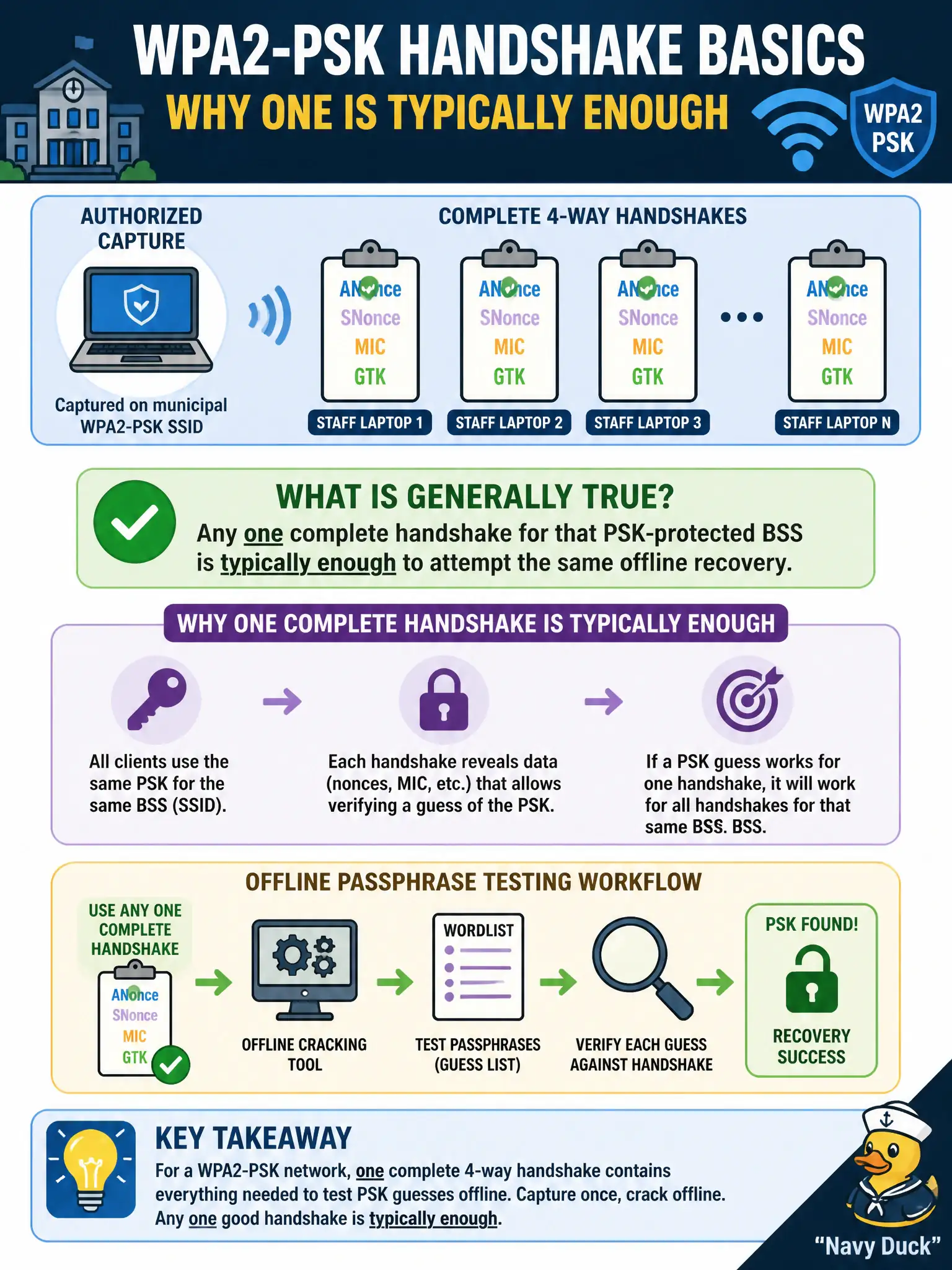
An authorized capture of a municipal WPA2-PSK SSID includes complete 4-way handshakes from several staff laptops. For offline passphrase testing against that shared PSK, what is generally true?
Select an answer to reveal the explanation.
Short Explanation
One solid handshake is the ticket—shared PSK means the same secret sits behind each client's dance. You do not need a parade of cracked clients or a beacon-only shortcut. Extra handshakes are redundancy, not separate master passwords.
Full Explanation
When an authorized capture of a municipal WPA2-PSK SSID includes complete 4-way handshakes from several stations, any one complete handshake for that PSK-protected BSS is typically enough to attempt the same offline recovery, because the long-term PSK/PMK context is shared across Personal clients on that SSID. Extra handshakes may help redundancy, but assessors should not believe they need every client before starting the cracker. Scope remains that BSS—not every neighbor on the channel.
'Every client's handshake must be cracked separately because each uses a different master passphrase' fails because clients on the same Personal BSS do not each use a different master passphrase requiring separate cracks. 'Only the AP's beacon frames are needed; client handshakes are optional once the SSID is known' fails because beacon frames alone are not a substitute for client handshake material once the SSID is known. 'Handshakes from different clients invalidate each other and must be discarded before cracking' fails because handshakes from different clients on the same PSK BSS do not invalidate each other.
Exam caveat: one complete handshake still means complete and correctly targeted—not a single EAPOL fragment. Operational check: pick a validated complete handshake for the in-scope civic BSSID, export once, begin offline testing, and keep spare handshakes only as backup evidence. Do not expand cracking into other SSIDs merely because they appear in the same file. In municipal wireless operations, record the rationale in the engagement notes so future assessors know which control or technique class was chosen and which failure modes the rejected options would create for city services.