
A municipal standard requires WPA3-Personal (SAE) for temporary guest pop-up SSIDs. What security benefit is the standard mainly buying versus legacy WPA2-PSK guests?
Select an answer to reveal the explanation.
Short Explanation
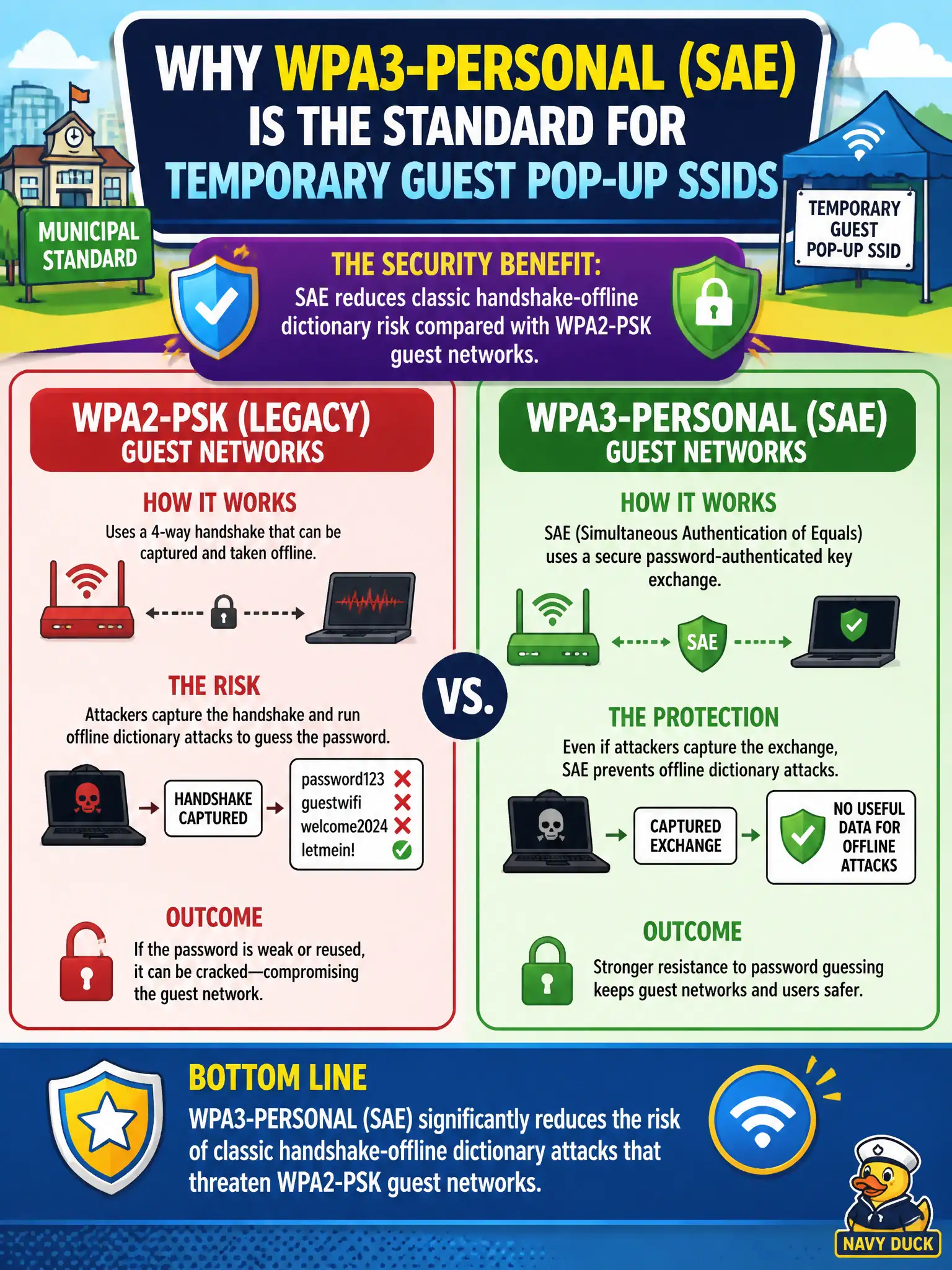
Guest pop-ups on WPA2-PSK are classic take-home dictionary bait after a handshake. SAE tightens that offline story for Personal mode. The city is buying resistance to the old capture-and-crack path—not open Wi-Fi and not free certificates.
Full Explanation
A municipal standard requiring WPA3-Personal (SAE) for temporary guest pop-up SSIDs aims at a clear security benefit: SAE reduces classic handshake-offline dictionary risk compared with WPA2-PSK guest networks. City event and pop-up Wi-Fi historically used weak shared passphrases; SAE changes that offline attack narrative even though other wireless risks can remain. Assessors should explain the protocol-class improvement without claiming zero residual risk.
'SAE guest SSIDs remove the need for any passphrase because authentication becomes open.' fails because SAE guest SSIDs do not become open authentication without a passphrase. 'SAE automatically issues unique per-user certificates without an Enterprise AAA backend.' fails because SAE does not automatically issue unique per-user certificates without an Enterprise AAA backend. 'SAE forces all guests onto WEP shared-key authentication for compatibility.' fails because SAE does not force guests onto WEP shared-key authentication for compatibility.
Exam caveat: SAE guest SSIDs can still be misconfigured, still attract evil twins, and still need RoE-scoped testing of other surfaces. Operational check: inventory pop-up SSIDs for WPA2-PSK versus WPA3-SAE, align technique classes to the mode in use, and recommend SAE or Enterprise for temporary civic guest networks that previously relied on short shared secrets. Note remaining open/rogue risks separately in the municipal report. In municipal wireless operations, record the rationale in the engagement notes so future assessors know which control or technique class was chosen and which failure modes the rejected options would create for city services.