
A student confuses online password guessing against a live municipal AP with offline handshake cracking. What distinction should stick?
Select an answer to reveal the explanation.
Short Explanation
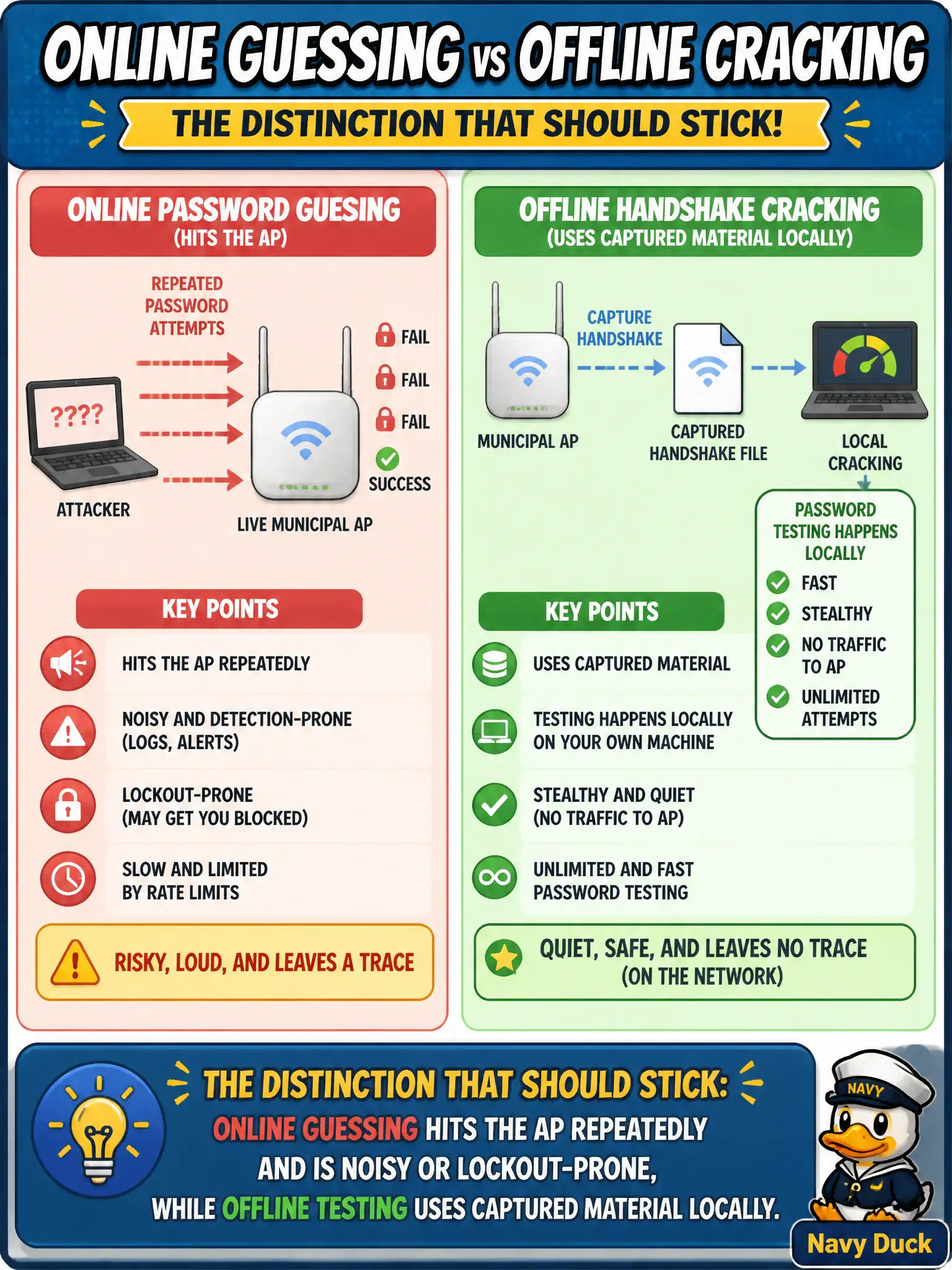
Online guessing knocks on the AP’s door over and over—noisy and lockout-friendly. Offline cracking works the captured handshake on your own box like picking a photographed lock at the kitchen table. Same passphrase goal, totally different traffic and risk profile.
Full Explanation
Students often confuse online password guessing against a live municipal AP with offline handshake cracking. Online guessing repeatedly submits candidates toward live infrastructure and is noisy or lockout-prone, while offline testing uses captured handshake or hash material locally on the assessor's machine. Civic RoE nearly always prefer offline Personal recovery after authorized capture because it avoids hammering the AP for each dictionary line and stays tied to obtained material.
'Online and offline attacks are identical because both always use the same AP CPU cycles.' fails because online and offline modes are not identical and do not always burn the same AP CPU cycles. 'Offline cracking requires sending each guess as a new association to the AP.' fails because offline cracking does not require sending each guess as a new association to the AP. 'Online guessing is silent RF and never appears in logs, unlike offline GPU work.' fails because online guessing is not the silent path—offline GPU work is local, while live guessing is what tends to show up as noisy attempts.
Exam caveat: offline still requires a complete, correctly targeted capture—quiet does not mean capture-optional. Operational check: classify the planned municipal technique as online versus offline before execution, prefer offline dictionary work against authorized captures for WPA2-PSK, and escalate only RoE-approved live tests with monitoring. Log which mode was used in the engagement diary. In municipal wireless operations, record the rationale in the engagement notes so future assessors know which control or technique class was chosen and which failure modes the rejected options would create for city services.