
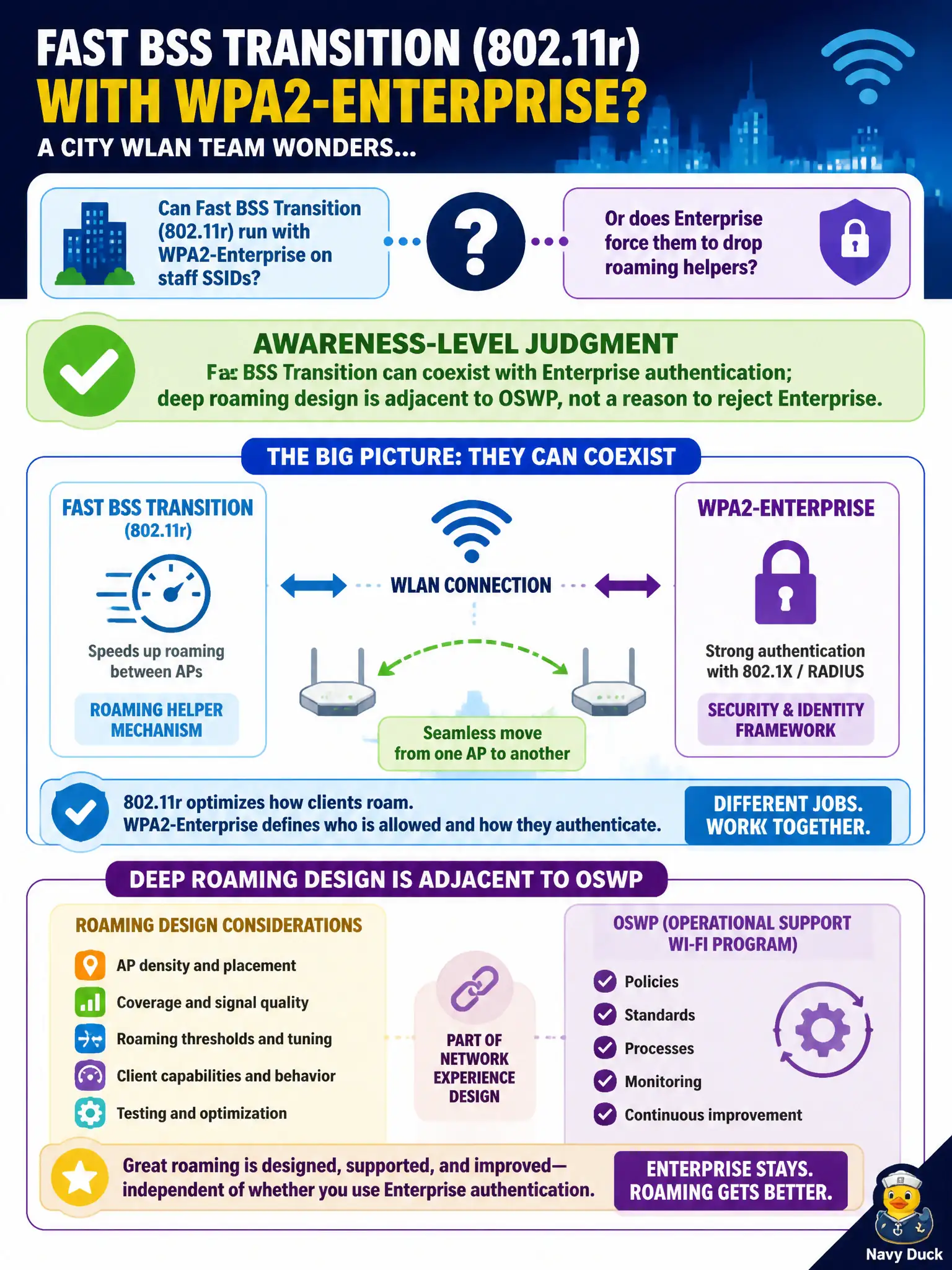
A city WLAN team wonders whether Fast BSS Transition (802.11r) can run with WPA2-Enterprise on staff SSIDs, or whether Enterprise forces them to drop roaming helpers. What awareness-level judgment should the assessor give?
Select an answer to reveal the explanation.
Short Explanation
Enterprise and Fast BSS Transition are not mortal enemies—city staff SSIDs can use both. OSWP cares that you know Enterprise can coexist with roaming helpers, not that you design CWSP-depth FT blueprints. Do not rip out 802.1X just to chase a roaming checkbox.
Full Explanation
Fast BSS Transition (802.11r) can coexist with WPA2-Enterprise on staff SSIDs; deep roaming design is adjacent to OSWP and is not a reason to reject Enterprise authentication for municipal staff networks. Enterprise Wi-Fi does not permanently forbid Fast Transition features, so cities need not stay on Personal PSK merely to roam. Fast Transition is not limited to open guest portals and can apply to authenticated staff networks when designed correctly. OSWP does not require disabling 802.1X before any roaming feature is discussed. Exam caveat: roaming helpers introduce their own configuration complexity, but that complexity is separate from the decision to use Enterprise for accountability and stronger auth. Operational check: if civic users report roam delays, engage WLAN engineers on 802.11r or related features while keeping 802.1X and certificate hygiene intact rather than downgrading to a shared PSK for convenience. For municipal and campus engagements, keep the finding language tied to authorized scope, name the building or SSID class affected, and state the residual risk to residents or staff if the rejected option had been chosen. Re-validate after the next change window that the selected control still matches inventory, monitoring, and RoE abort criteria used by the city wireless program.