
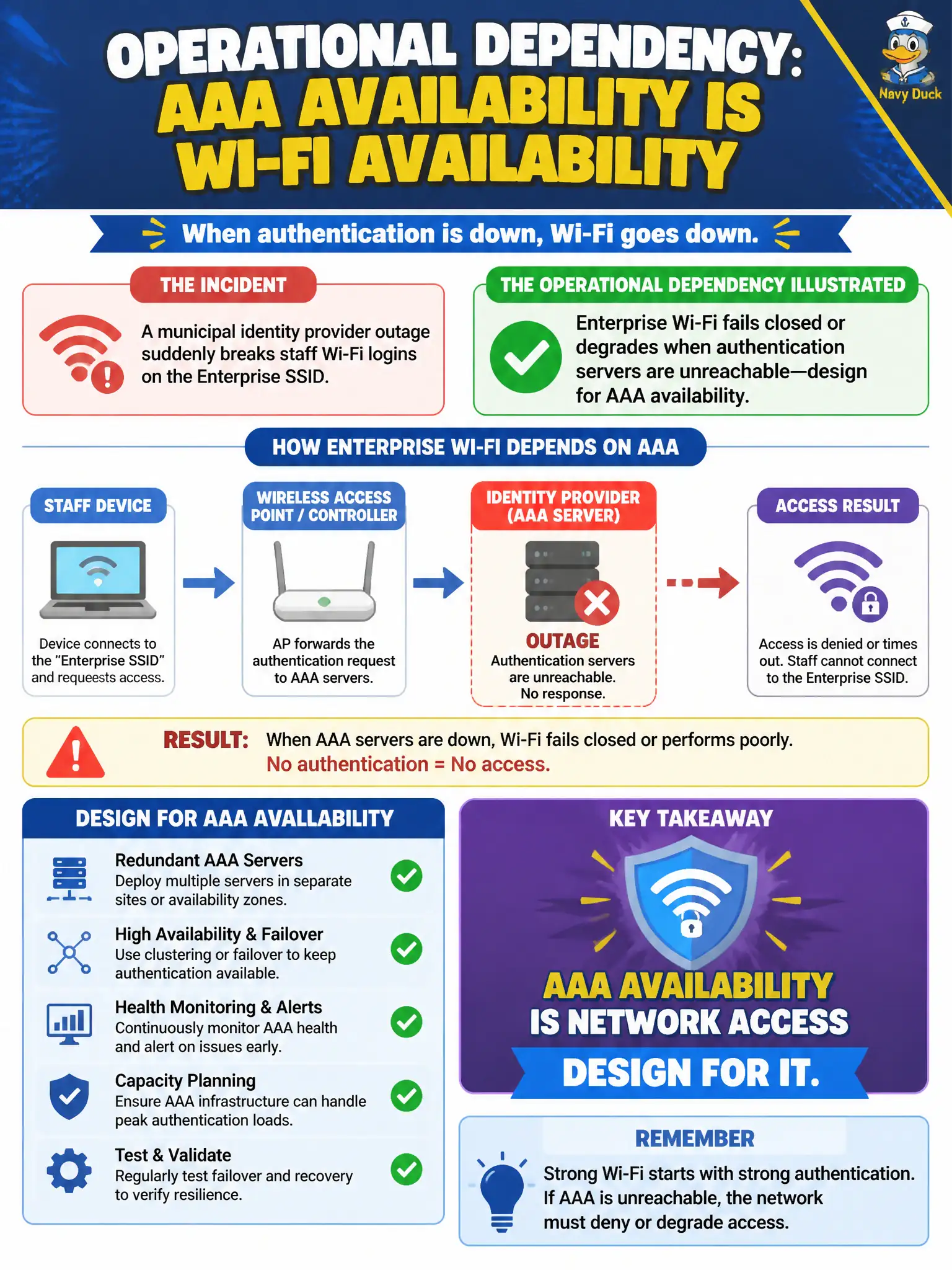
A municipal identity provider outage suddenly breaks staff Wi-Fi logins on the Enterprise SSID. What operational dependency does that incident illustrate?
Select an answer to reveal the explanation.
Short Explanation
When the city IdP or RADIUS path dies, Enterprise Wi-Fi usually locks the door or limps. Build AAA availability; do not assume passwords live in AP NVRAM or that WPS saves the day.
Full Explanation
When a municipal identity provider outage suddenly breaks staff Wi-Fi logins on the Enterprise SSID, the incident illustrates that Enterprise Wi-Fi depends on authentication-server reachability and typically fails closed or degrades when AAA is unreachable—design must include AAA availability. Enterprise Wi-Fi does not store every user password in AP NVRAM so IdP reachability never matters. Fail-open to an unauthenticated VLAN on RADIUS timeout is not a default design to celebrate and is usually undesirable for staff networks. Enterprise Wi-Fi does not depend only on local WPS PIN caches during directory outages. Exam caveat: high availability for RADIUS and dependencies is part of wireless resilience, not an optional AAA footnote. Operational check: review civic AAA redundancy, test controlled RADIUS failure in a maintenance window, and document expected client behavior for help desks before the next IdP outage. For municipal and campus engagements, keep the finding language tied to authorized scope, name the building or SSID class affected, and state the residual risk to residents or staff if the rejected option had been chosen. Re-validate after the next change window that the selected control still matches inventory, monitoring, and RoE abort criteria used by the city wireless program.