
While surveying a county WLAN, an assessor starts deep-diving DTIM and beacon interval quirks before recording crypto mode or clients. What prioritization correction fits OSWP-style goals?
Select an answer to reveal the explanation.
Short Explanation
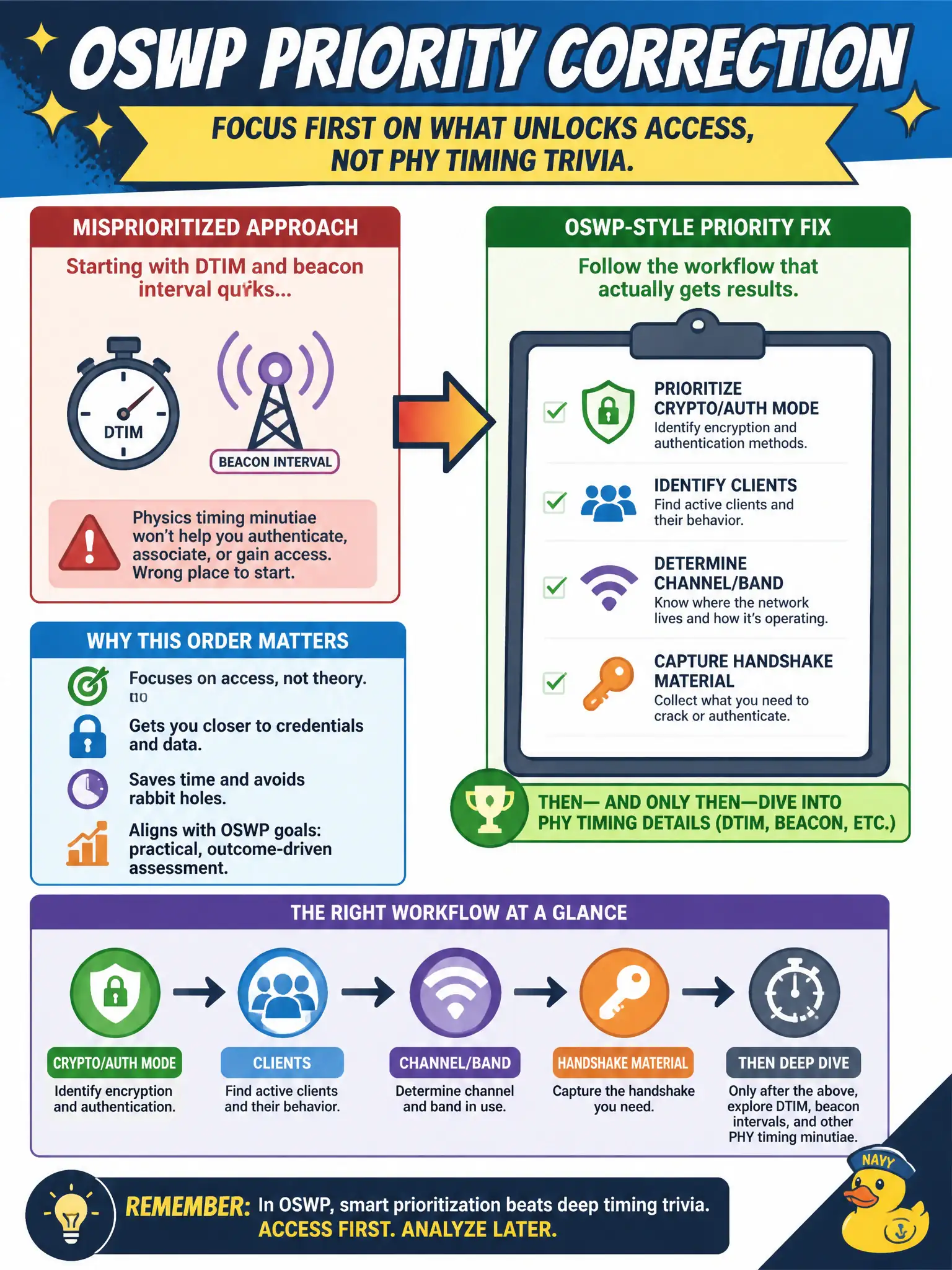
OSWP-style recon is after locks, clients, and channels—not a dissertation on DTIM trivia first. Jot the security-relevant fields, then geek out on PHY if time remains. Priorities keep timed assessments honest.
Full Explanation
OSWP-style municipal goals prioritize crypto/auth mode, clients, channel/band, and handshake material before deep PHY timing minutiae such as DTIM and beacon-interval quirks. Those first-order facts determine methodology and evidence quality; DTIM tuning notes rarely change whether a Personal offline path or Enterprise path applies. New assessors who deep-dive PHY trivia first lose time on timed civic engagements. Saying DTIM tuning always outranks encryption mode when documenting targets fails by concept: encryption/auth mode drives attack class selection more than DTIM. Claiming beacon interval notes replace identifying BSSID and SSID fails by concept: identity fields are foundational. Asserting client presence is irrelevant until every PHY timing field is characterized fails by concept: clients often matter earlier for handshake opportunity. Exam caveat: PHY details can matter in specialized performance troubleshooting engagements—but that is a different scope than core wireless attack-lab assessment skills. Operational check: fill the target sheet with SSID, BSSID, channel/band, ENC/AUTH, and client presence first; capture handshake material next; only then optionally annotate DTIM/beacon interval if the municipal owner asked for RF performance commentary.