
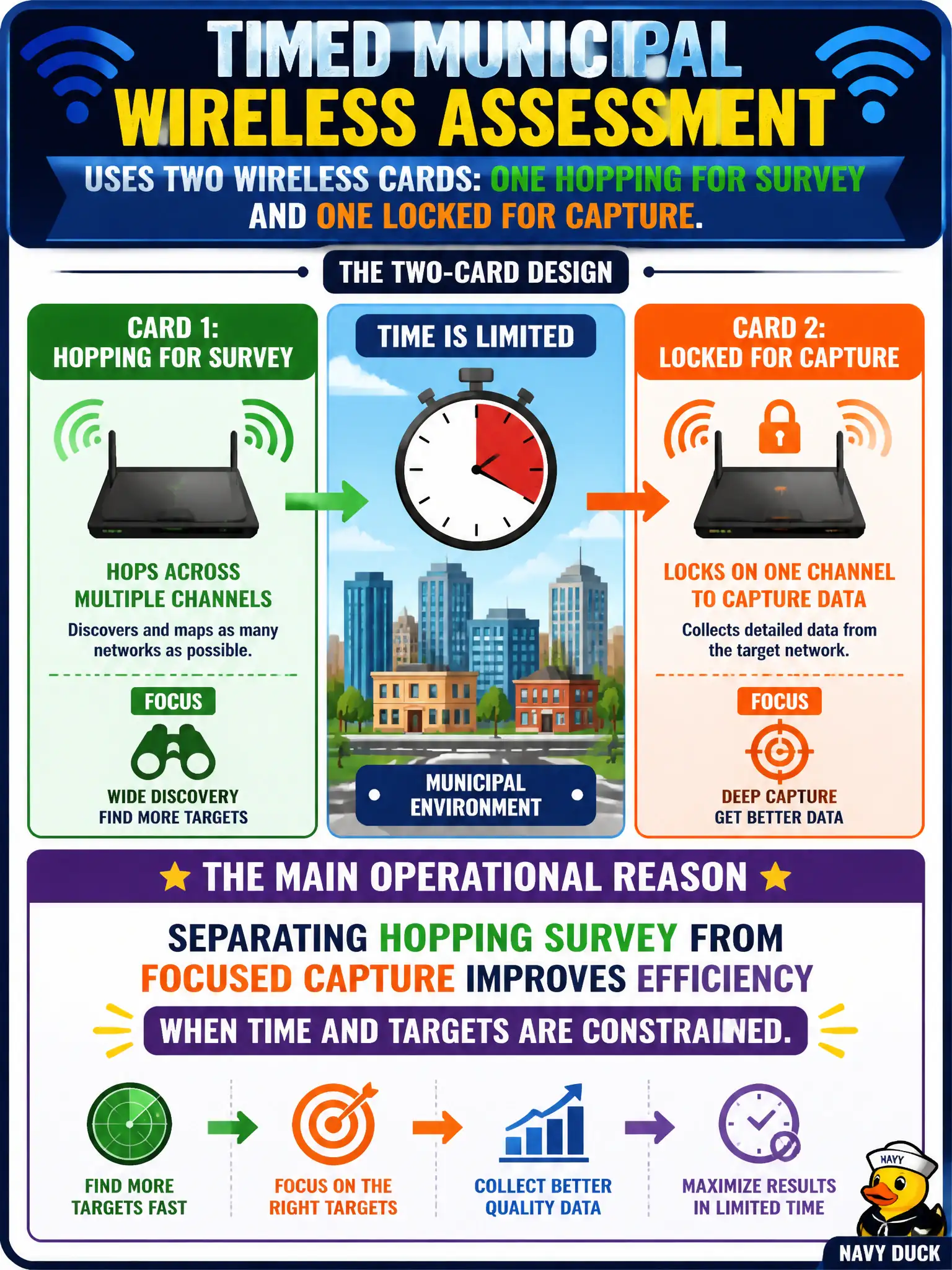
A timed municipal wireless assessment uses two wireless cards: one hopping for survey and one locked for capture. What is the main operational reason for that design?
Select an answer to reveal the explanation.
Short Explanation
One radio wanders the mall looking for stores; the other sits still at the target register. Split survey and capture so you do not miss handshake frames while channel-hopping. Timed city gigs love that dual-card workflow.
Full Explanation
Using two wireless cards—one hopping for survey and one locked for capture—improves efficiency on timed municipal assessments by letting discovery continue while a focused interface stays on a target channel for handshake completeness. Separation of roles reduces the tradeoff inherent in asking one radio to hop and lock simultaneously. Saying two cards are required by 802.11 to decode any WPA2 beacon fails by concept: one capable radio can receive beacons; dual cards are operational convenience, not a protocol mandate. Claiming the second card replaces written RoE fails by concept: hardware count never substitutes for authorization. Asserting hopping and locked capture on one shared interface always yields identical completeness fails by concept: one interface cannot optimally do both at once, which is why dual-card designs exist. Exam caveat: both cards remain under the same RoE—extra radios are not extra scope. Operational check: assign card A to hopping survey, card B to the chosen municipal AP channel, confirm B captures continuous beacons/EAPOL, and synchronize notes so survey hits feed the locked capture queue quickly under time pressure. In civic practice, write the decision and the verification command into the engagement notes so another assessor can repeat the check on the next shift without rediscovering the same pitfall under time pressure.