
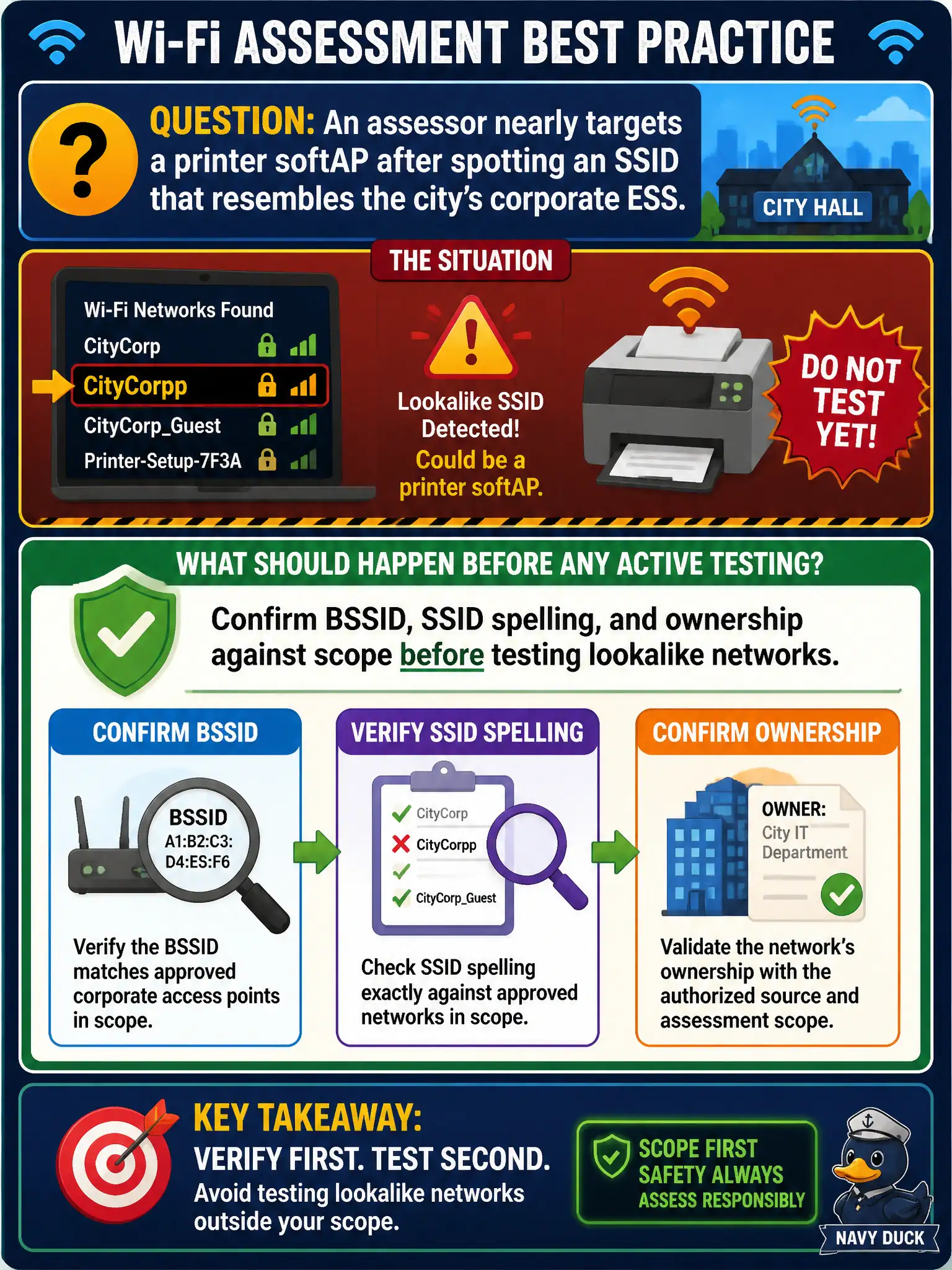
An assessor nearly targets a printer softAP after spotting an SSID that resembles the city's corporate ESS. What should happen before any active testing?
Select an answer to reveal the explanation.
Short Explanation
Lookalike names are common—printers love shipping with their own little SSID. Check the BSSID and the owner list before you poke anything. Guessing from the name alone is how you hit the wrong network.
Full Explanation
Before any active testing against a lookalike SSID that resembles the city’s corporate ESS—such as a printer softAP—the assessor must confirm BSSID, SSID spelling, and ownership against scope. Similar names are a classic trap that can pull testing onto devices the municipality does not own or did not authorize. Stop and verify first. Beginning injection immediately because similar SSIDs always share the same owner fails by concept: similarity is not ownership. Cracking the softAP first as a shortcut into the corporate ESS fails by concept: a printer softAP is a different BSS and may be out of scope; it is not a portal into the ESS by assumption. Assuming every open printer radio is an authorized evil-twin training target fails by concept: training targets must be explicitly designated. Exam caveat: document lookalikes as observations; only escalate to active tests when the asset owner confirms inclusion. Operational check: compare the suspicious SSID/BSSID to the corporate controller inventory, contact the owner if unclear, add or exclude it in the RoE annex, and only then schedule authorized tests. In civic practice, write the decision and the verification command into the engagement notes so another assessor can repeat the check on the next shift without rediscovering the same pitfall under time pressure.