
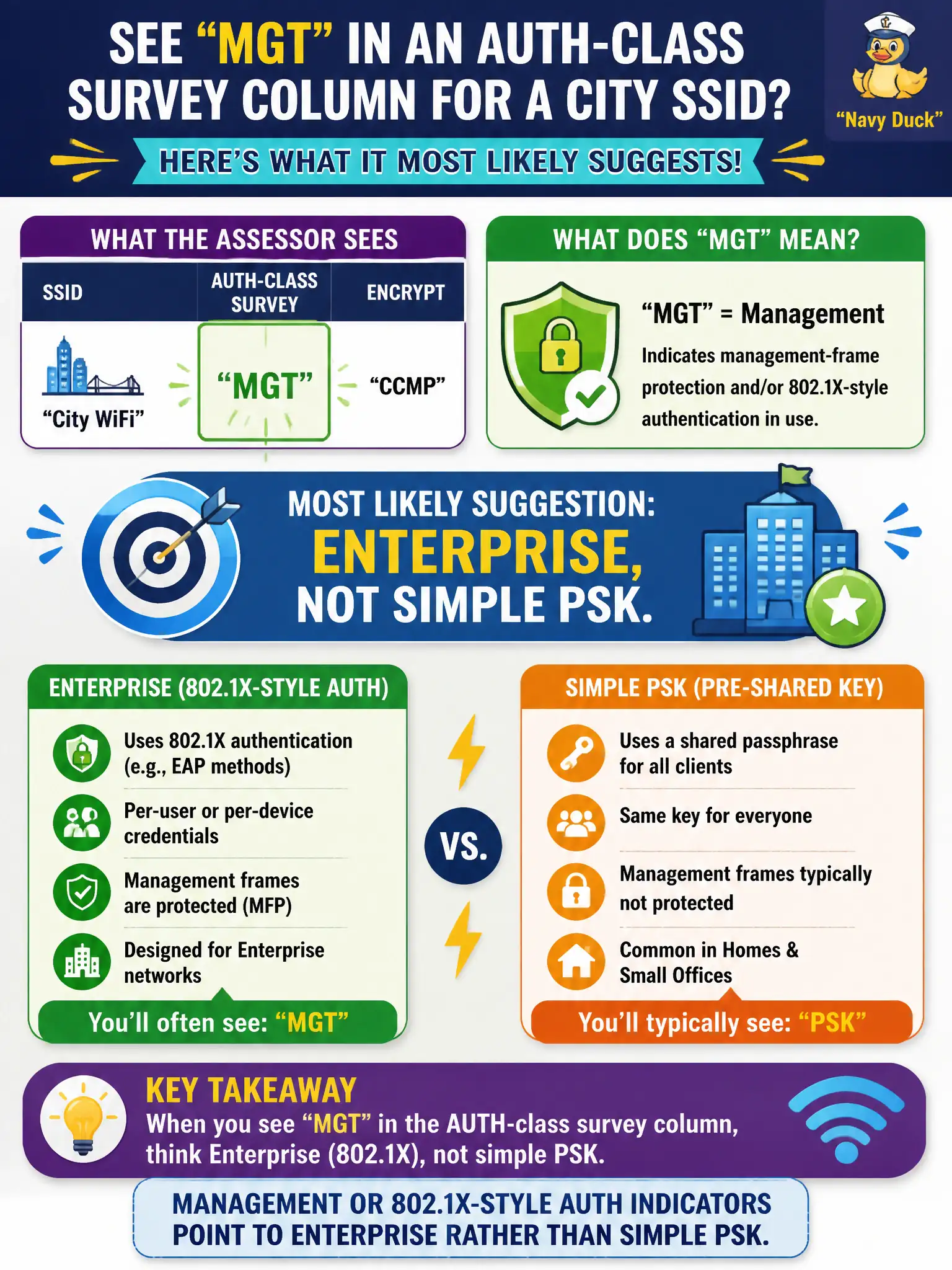
An assessor sees MGT in an AUTH-class survey column for a city SSID. What does that indicator most likely suggest?
Select an answer to reveal the explanation.
Short Explanation
MGT in the auth column is the survey’s way of saying “this looks Enterprise/802.1X,” not a cheap PSK guest network. Do not plan a Personal-only playbook from that clue.
Full Explanation
An MGT (or management/802.1X-style) indicator in an AUTH-class survey column for a city SSID most likely points to Enterprise authentication rather than simple Personal PSK. That classification steers methodology away from offline dictionary attacks against a PSK and toward Enterprise-oriented analysis themes such as EAP methods and certificate trust. Civic assessors must not mis-file an 802.1X BSS as a PSK target. Treating MGT as open with no authentication / Personal PSK fails by concept: MGT signals managed/802.1X-class auth, the opposite of open or simple PSK. Saying the AP only supports WEP shared-key and cannot use 802.1X fails by concept: MGT points toward 802.1X-era enterprise, not WEP-only. Claiming MGT means the radio is permanently muted fails by concept: auth-mode labels are not mute switches. Exam caveat: confirm with RSN IE AKM suites—survey column abbreviations can vary by tool version, so cross-check beacons before declaring Enterprise. Operational check: note MGT/Enterprise AUTH for the municipal SSID, capture a beacon to verify AKM, update the target profile to Enterprise methodology, and avoid wasting lab time on PSK crackers against that BSS. In civic practice, write the decision and the verification command into the engagement notes so another assessor can repeat the check on the next shift without rediscovering the same pitfall under time pressure.