
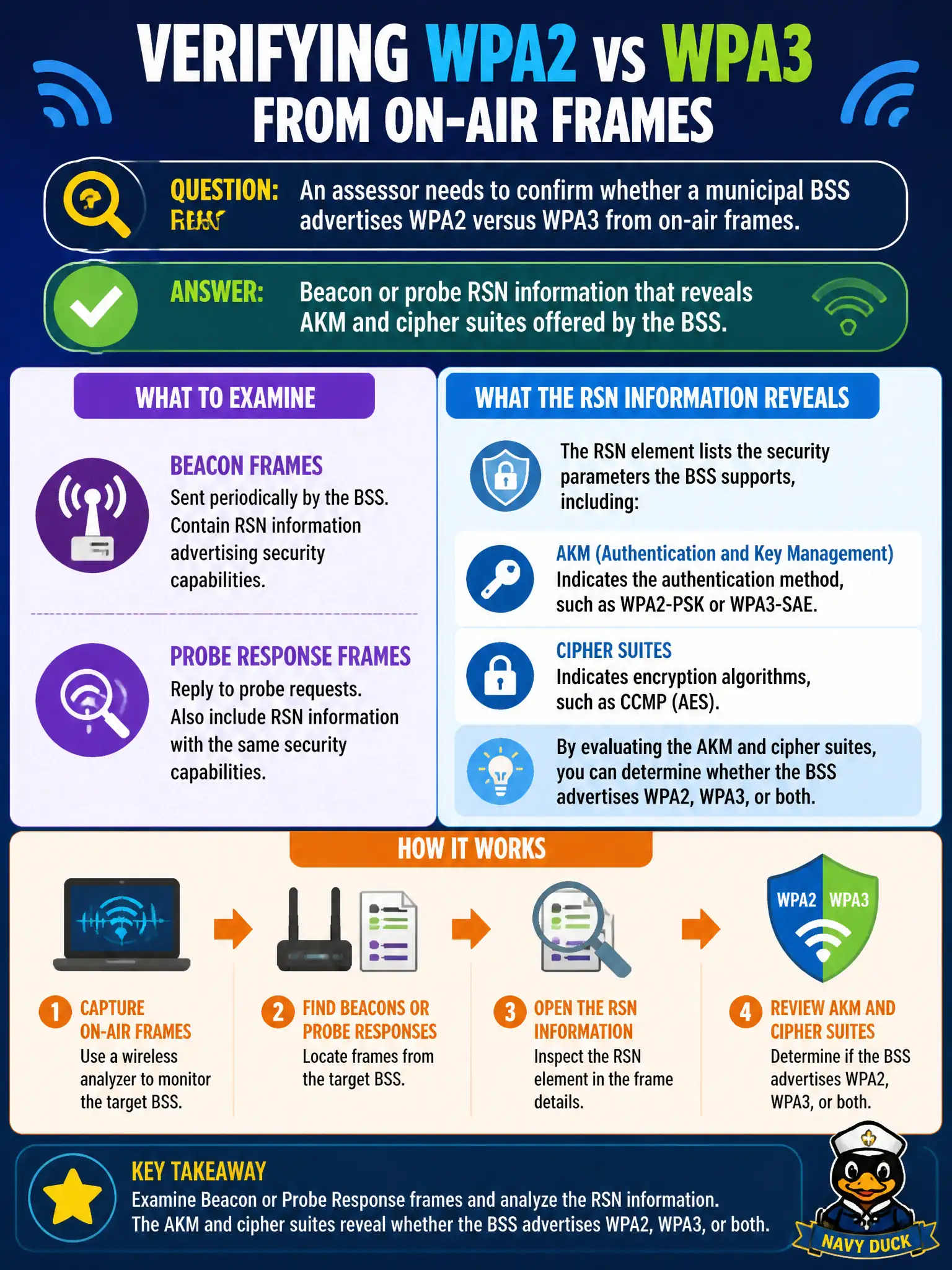
An assessor needs to confirm whether a municipal BSS advertises WPA2 versus WPA3 from on-air frames. What should be examined?
Select an answer to reveal the explanation.
Short Explanation
Want WPA2 vs WPA3 clues? Read the RSN bits in beacons and probes—AKM and ciphers live there. CAD drawings and DHCP trivia will not tell you the suite.
Full Explanation
To confirm whether a municipal BSS advertises WPA2 versus WPA3 from on-air frames, examine beacon or probe response RSN information elements that reveal AKM and cipher suites. Those IEs are the authoritative advertisement of what the BSS offers: for example AKMs associated with PSK versus SAE versus 802.1X-class enterprise. Civic assessors trust dissected management frames over facilities drawings or unrelated wired DHCP clues when classifying wireless crypto generations for the report. Examining only DHCP options on a wired printer VLAN fails by concept: printer DHCP does not advertise the AP’s wireless AKM suite. Using AP mounting height from CAD drawings fails by concept: physical height is unrelated to crypto suite advertisement. Multiplying associated clients by channel width as a crypto fingerprint fails by concept: that arithmetic invents a nonsense fingerprint and ignores the RSN IE where the answer actually lives. Exam caveat: transition modes may advertise multiple AKMs (WPA2/WPA3 mixed)—report every suite offered, not a single assumed generation, and align techniques to what is actually present under RoE. Operational check: capture beacons from the target BSSID, open the RSN IE in Wireshark or tshark, record AKM and pairwise/group cipher suites, classify WPA2 versus WPA3 versus mixed, and select only authorized test methods that match that advertisement for the municipal engagement.