
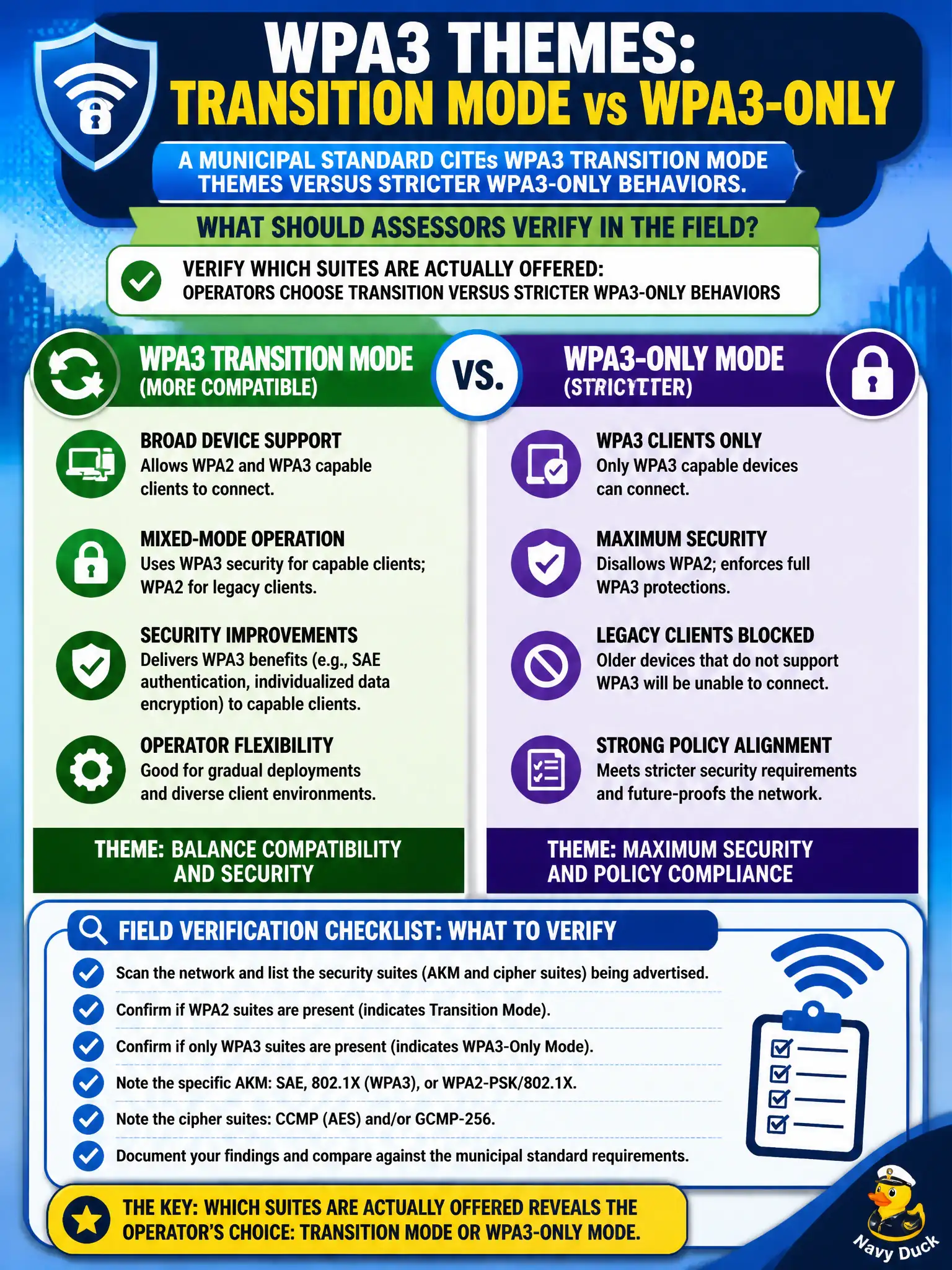
A municipal standard cites WPA3 Transition Mode themes versus stricter WPA3-only behaviors. What should assessors verify in the field?
Select an answer to reveal the explanation.
Short Explanation
Transition Mode is the both-doors-open hallway; WPA3-only is locking the old door. Assessors must look at what the AP actually advertises, not the slide-deck slogan. Labels lie when beacons still offer yesterday's suites.
Full Explanation
WPA3 Transition Mode versus stricter WPA3-only behavior is an operator configuration choice reflected in which suites and AKMs are advertised. Assessors verifying municipal standards in the field must inspect what the AP actually offers—not assume Transition Mode always disables every WPA2 suite, nor dismiss it as a mere UI skin. Evidence lives in beacons and successful client negotiations. Claiming Transition Mode always disables every WPA2 suite even when legacy scanners remain in scope contradicts the purpose of transition. Saying it never changes advertised AKMs is false. Requiring WEP group ciphers in WPA3-only mode for emergency roaming invents a dangerous dependency. Exam caveat: Transition can preserve WPA2-PSK attack surfaces—document them explicitly. Operational check: Capture RSN advertisements for the city SSID, list WPA2 versus WPA3 AKMs present, and compare against the written standard’s transition versus WPA3-only mandate. In civic WLAN stewardship, keep authorization boundaries explicit, prefer the least disruptive technique class allowed by RoE, and record BSSID, channel, band, and security mode beside every conclusion so another assessor can reproduce the observation.