
A city explores SAE-PK and related modern WPA3 Personal enhancements at awareness depth. What should planners understand?
Select an answer to reveal the explanation.
Short Explanation
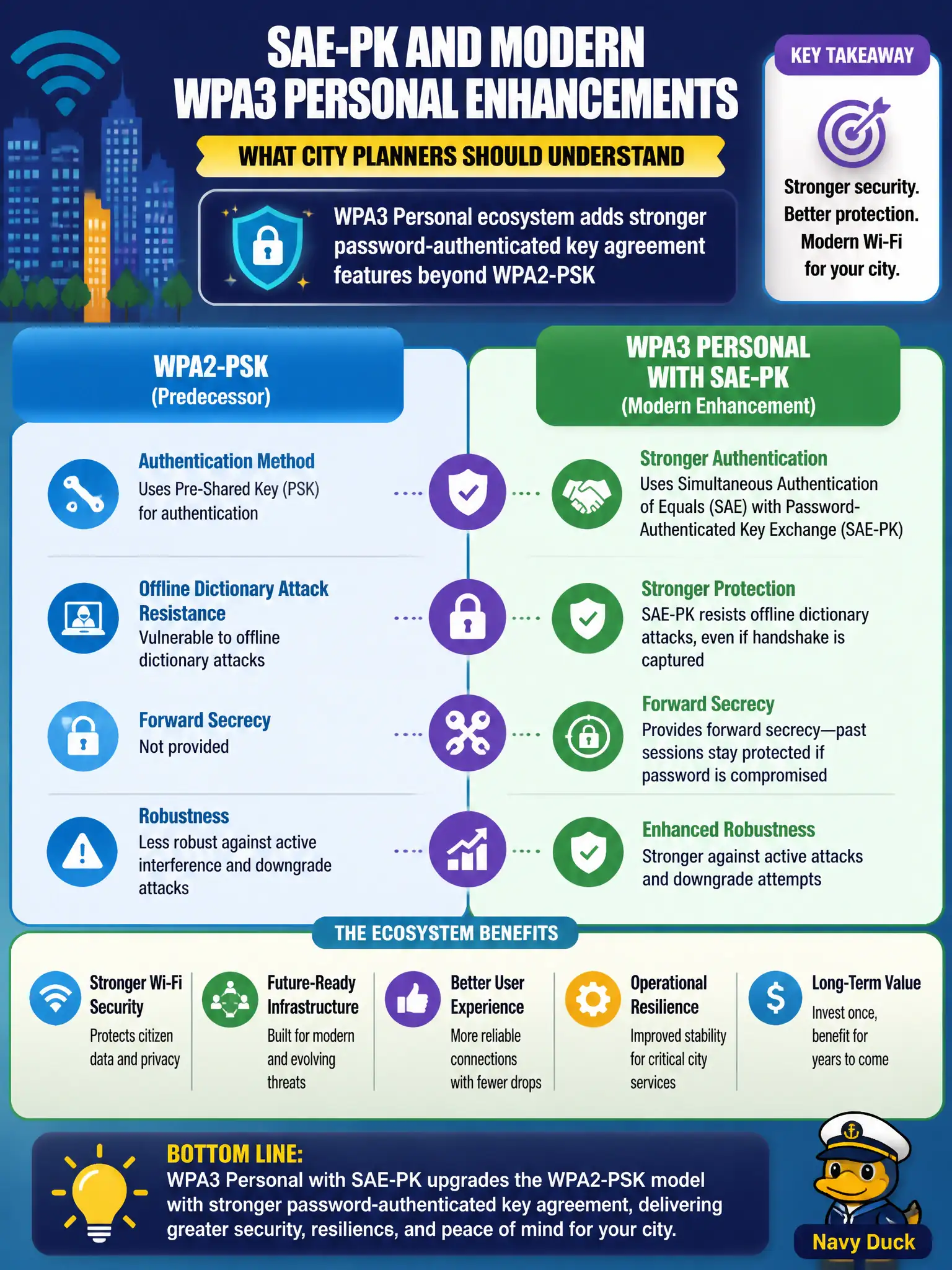
WPA3 Personal is not just 'WPA2 with a new sticker'—SAE and friends harden how passwords become session keys. SAE-PK-class extras are modern tools in that Personal toolbox. Planners should expect stronger password-authenticated key agreement, not a free pass to skip design work.
Full Explanation
WPA3-Personal and related enhancements such as SAE-PK awareness topics strengthen password-authenticated key agreement beyond classic WPA2-PSK handshake assumptions. City planners exploring these features should understand they improve Personal-mode security properties and deployment options without magically eliminating all passphrases or forcing every guest phone onto 802.1X certificates. Awareness depth means correct class placement, not vendor slogan memorization. Calling SAE-PK only a rebrand of WEP shared-key authentication for IoT meters is wrong. Saying WPA3 Personal extras remove all need for passphrases on every municipal SSID overclaims. Asserting SAE-PK forces every guest phone onto 802.1X certificates before DHCP conflates Personal enhancements with Enterprise onboarding. Exam caveat: Validate client and AP support before promising SAE-PK citywide. Operational check: In a lab, compare WPA2-PSK versus WPA3-Personal/SAE advertisements and client join behavior, documenting which enhancement flags actually negotiate. In civic WLAN stewardship, keep authorization boundaries explicit, prefer the least disruptive technique class allowed by RoE, and record BSSID, channel, band, and security mode beside every conclusion so another assessor can reproduce the observation.