
A student claims 'WPA2 is unbreakable' after reading about AES-CCMP. What nuance should the municipal mentor emphasize for Personal mode?
Select an answer to reveal the explanation.
Short Explanation
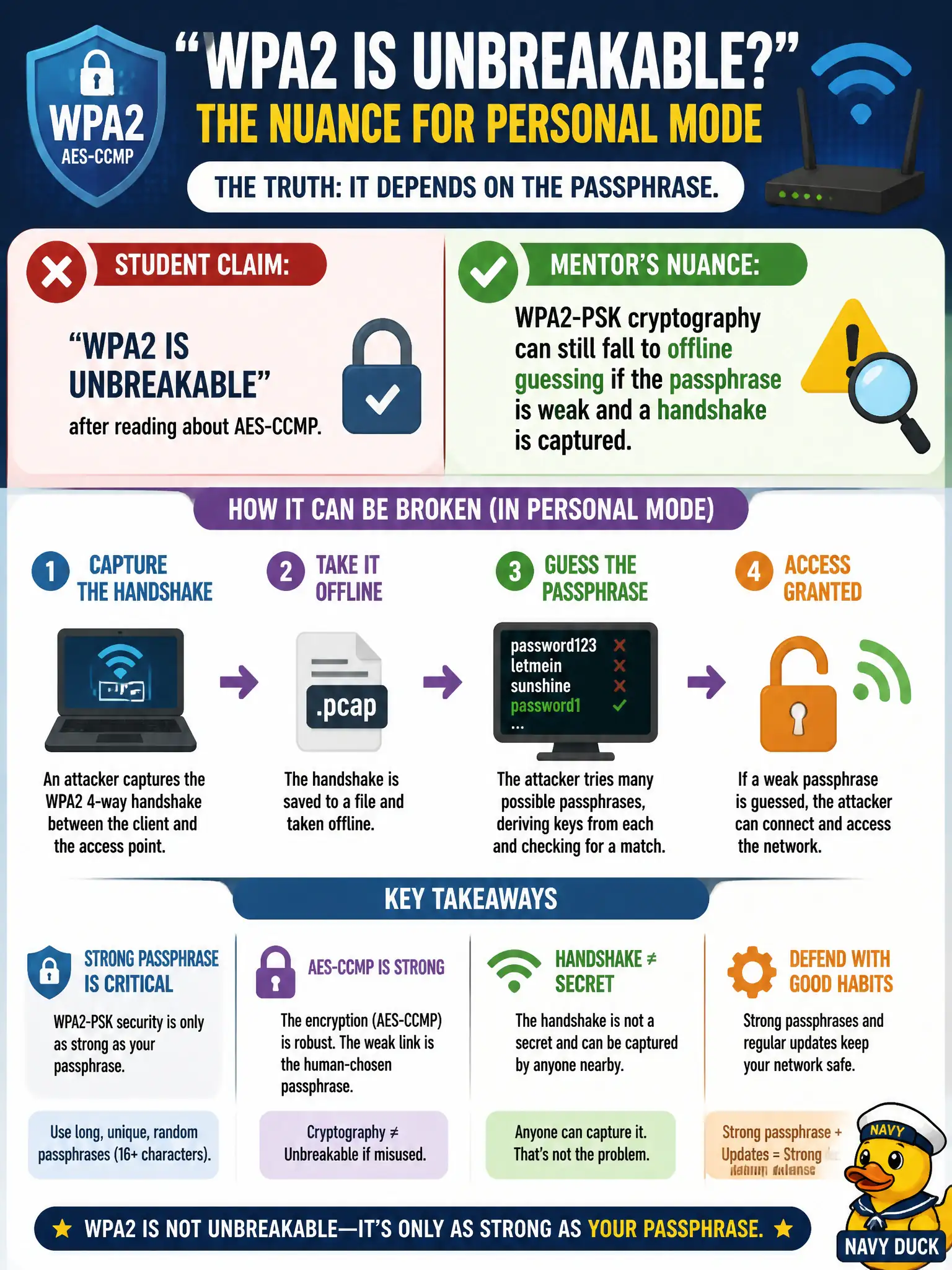
AES-CCMP is strong steel, but the passphrase is still the combination on the lock. Capture a handshake and a weak city Wi-Fi password becomes an offline guessing game. 'Unbreakable' forgets that humans pick terrible secrets.
Full Explanation
AES-CCMP as a cipher is strong, but WPA2-Personal still depends on passphrase secrecy. If an assessor captures a handshake and the passphrase is weak, offline guessing can recover it and undermine the “unbreakable” claim. Municipal mentors should teach students that Personal-mode risk is often passphrase entropy plus capture opportunity, not a magical break of AES itself. Saying WPA2-PSK cannot be attacked offline under any passphrase length is false. Claiming CCMP integrity failures automatically rotate the PSK every hour invents a control that is not standard behavior. Asserting WPA2 Personal is immune because TKIP MIC counters stop dictionary attacks misapplies legacy TKIP concepts to PSK offline attacks. Exam caveat: Prefer long random PSKs or Enterprise; treat short English passphrases as practically recoverable given a handshake. Operational check: In an authorized lab, capture a WPA2-PSK handshake for a deliberately weak test passphrase and demonstrate offline recovery class tooling success, then contrast with a high-entropy PSK. In civic WLAN stewardship, keep authorization boundaries explicit, prefer the least disruptive technique class allowed by RoE, and record BSSID, channel, band, and security mode beside every conclusion so another assessor can reproduce the observation.