
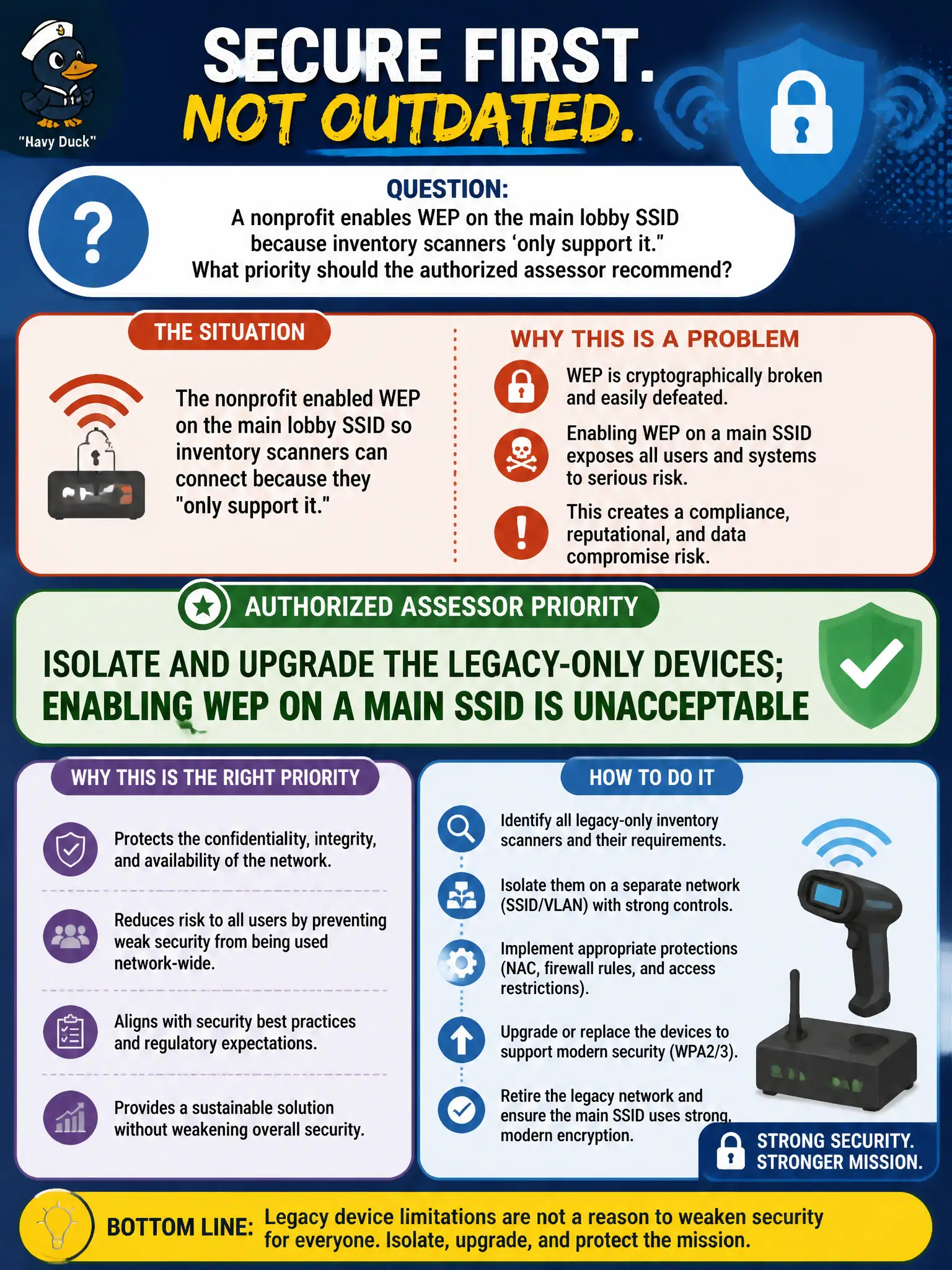
A nonprofit enables WEP on the main lobby SSID because inventory scanners 'only support it.' What priority should the authorized assessor recommend?
Select an answer to reveal the explanation.
Short Explanation
Do not light the whole lobby on fire because one old scanner needs a candle. Park those relics on an isolated island and plan the upgrade. Turning WEP on for everyone is how 'temporary' becomes a breach headline.
Full Explanation
Enabling WEP on a nonprofit’s main lobby SSID because inventory scanners “only support it” prioritizes convenience over a broken cryptographic baseline for everyone else. The authorized assessor should recommend isolating and upgrading or replacing legacy-only devices—possibly on a tightly contained SSID or wired drop—rather than poisoning the primary lobby network with WEP. Longer WEP keys and hiding the SSID do not fix the cipher. Leaving WEP on the primary SSID with a longer shared key retains structural weakness. Hiding the SSID so WEP becomes confidential to neighbors confuses obscurity with cryptography. Bridging the WEP SSID into staff VLANs so scanners “inherit Enterprise policies” extends exposure into sensitive segments. Exam caveat: Compatibility pressure is common; still write WEP-on-primary as a high-priority finding. Operational check: Inventory scanner capabilities, propose an isolated remediation SSID or wired path, and verify the main lobby SSID advertises modern RSN only after cutover. In civic WLAN stewardship, keep authorization boundaries explicit, prefer the least disruptive technique class allowed by RoE, and record BSSID, channel, band, and security mode beside every conclusion so another assessor can reproduce the observation.