
A city guest design uses per-user PSK (PPSK-class) instead of one café-style passphrase. What contrast should the assessor highlight versus classic single PSK?
Select an answer to reveal the explanation.
Short Explanation
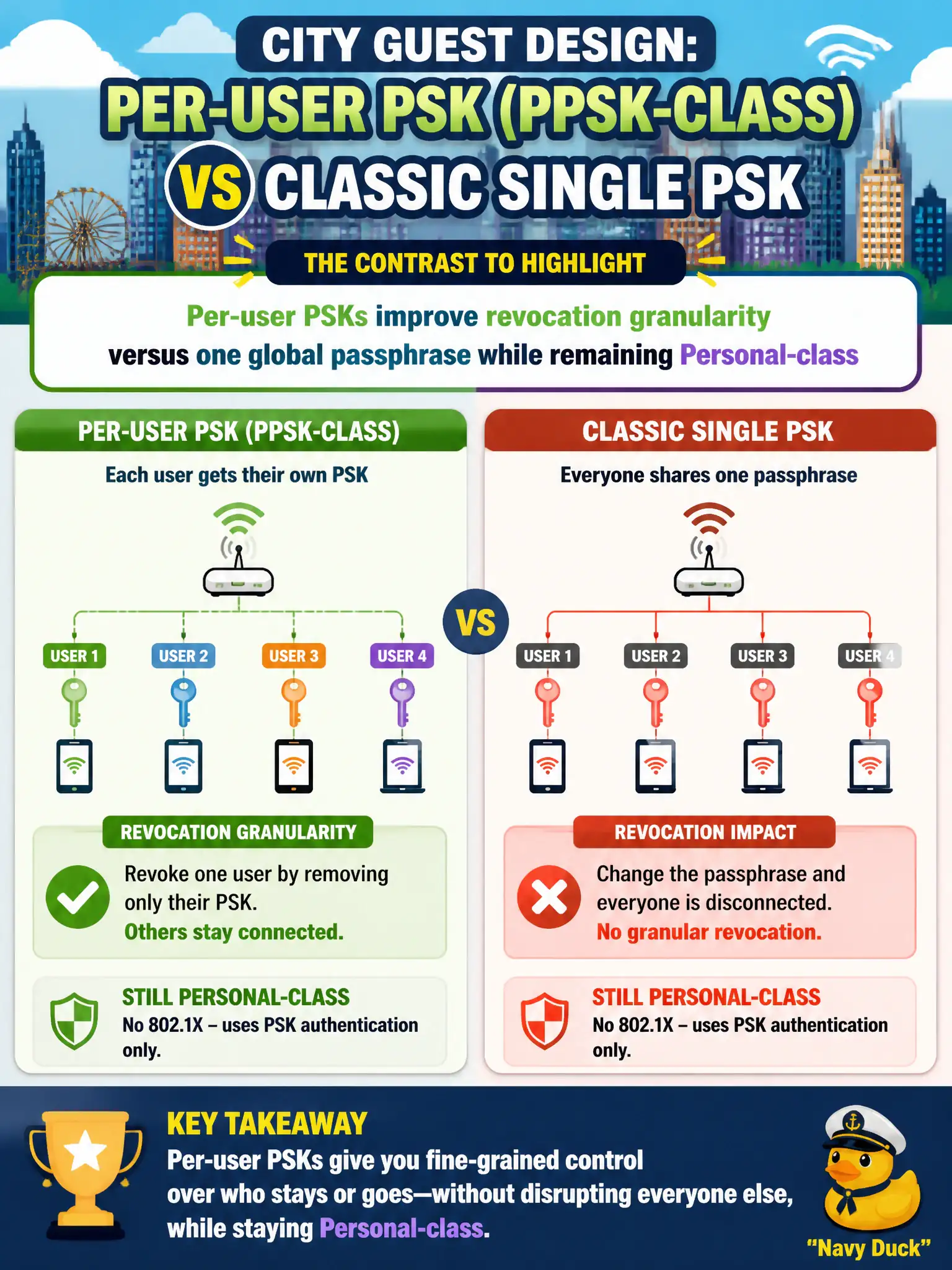
One shared guest password is a master house key taped to the lobby wall—lose one, rekey everyone. Per-user PSKs hand out individual keys so you can revoke Alice without rewriting Bob's sticker. It is still Personal-class, just less blunt.
Full Explanation
Per-user PSK (PPSK-class) designs issue distinct passphrases to individuals or devices while remaining in the Personal/PSK family rather than true 802.1X Enterprise. Versus one café-style global passphrase, they improve revocation granularity: one compromised user secret can be retired without rotating everyone. City guest designers should highlight that benefit without claiming RADIUS Enterprise equivalence. Saying per-user PSKs convert the SSID into true 802.1X Enterprise with RADIUS accounting oversells the model. Claiming they eliminate pairwise ciphers on broadcast frames confuses key distribution with cipher necessity. Asserting they are identical to SAE-PK and require WPA3-only hardware exclusively oversimplifies vendor features. Exam caveat: PPSK still inherits Personal-class trust and operational models; document vendor specifics carefully. Operational check: On a pilot guest SSID, revoke one PPSK identity and confirm that user cannot join while others continue, then contrast the procedure with a global PSK rotation. In civic WLAN stewardship, keep authorization boundaries explicit, prefer the least disruptive technique class allowed by RoE, and record BSSID, channel, band, and security mode beside every conclusion so another assessor can reproduce the observation.