
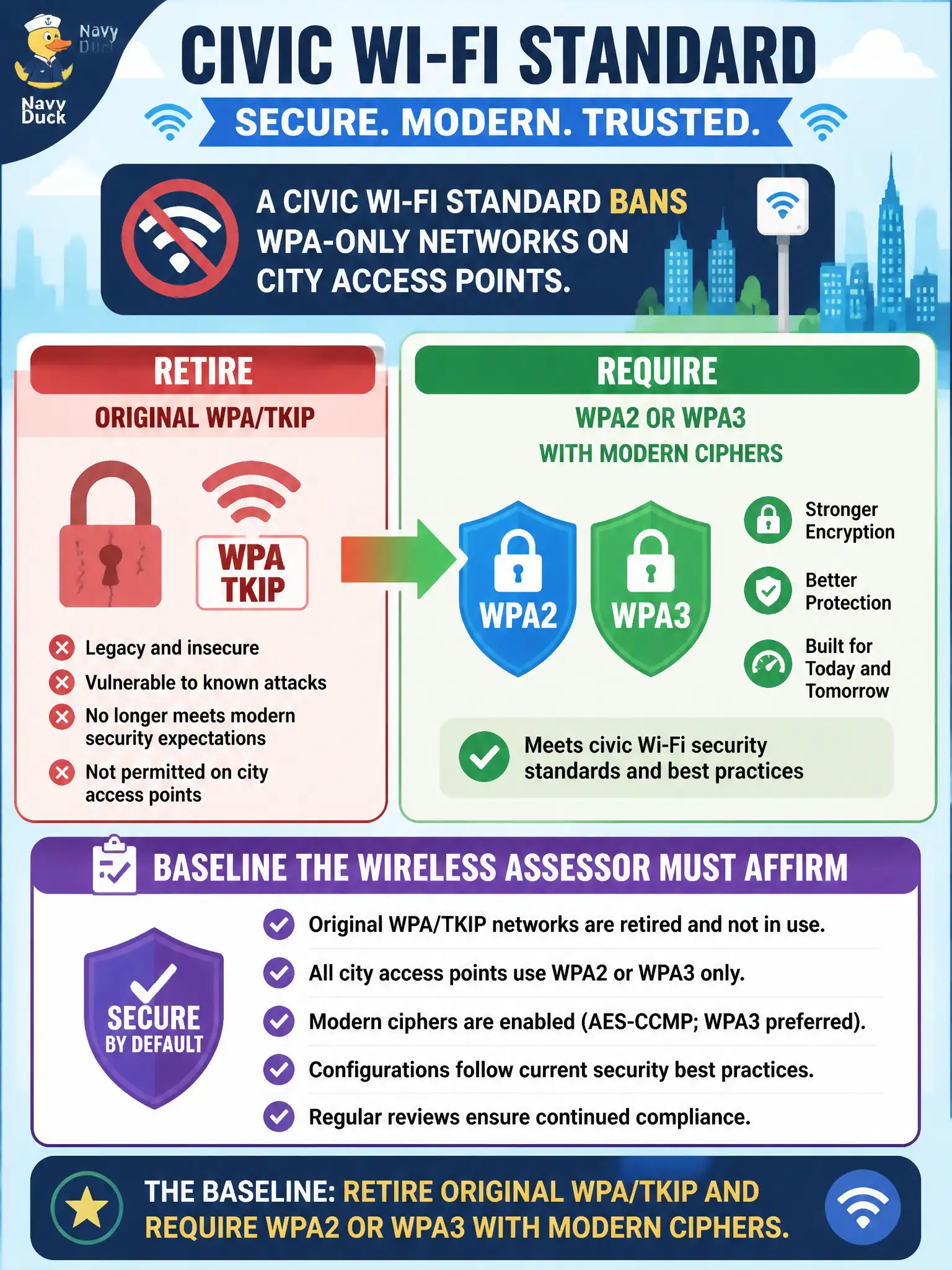
A civic Wi-Fi standard bans WPA-only networks on city access points. What baseline should the wireless assessor affirm?
Select an answer to reveal the explanation.
Short Explanation
Old WPA with TKIP is the rusty padlock the city already banned—pretty label, weak guts. Assessors should push WPA2/WPA3 with modern ciphers, not nostalgia modes. If a device still needs TKIP, isolate it; do not keep the whole civic BSS on retirement hardware.
Full Explanation
Original WPA with TKIP was an interim design and is obsolete for production municipal WLANs. Civic standards that ban WPA-only profiles correctly force WPA2 (CCMP/AES) or WPA3 as the encryption baseline. Assessors should affirm retirement of classic WPA/TKIP on city access points and flag remaining TKIP/WPA-only advertisements as deprecated configuration rather than acceptable compatibility exceptions on primary SSIDs. Keeping classic WPA/TKIP enabled for legacy scanners on staff SSIDs preserves a weak baseline. Treating WEP as acceptable with monthly passphrase rotation retains broken crypto. Relying on hidden SSIDs instead of modern ciphers substitutes obscurity for real RSN controls. Exam caveat: Mixed modes that still offer TKIP can be negotiated by clients—verify what is actually advertised, not only the policy PDF. Operational check: Survey city APs for WPA/TKIP-only or TKIP-capable suites and open remediation tickets to enforce WPA2/WPA3 CCMP or stronger baselines. In civic WLAN stewardship, keep authorization boundaries explicit, prefer the least disruptive technique class allowed by RoE, and record BSSID, channel, band, and security mode beside every conclusion so another assessor can reproduce the observation.