
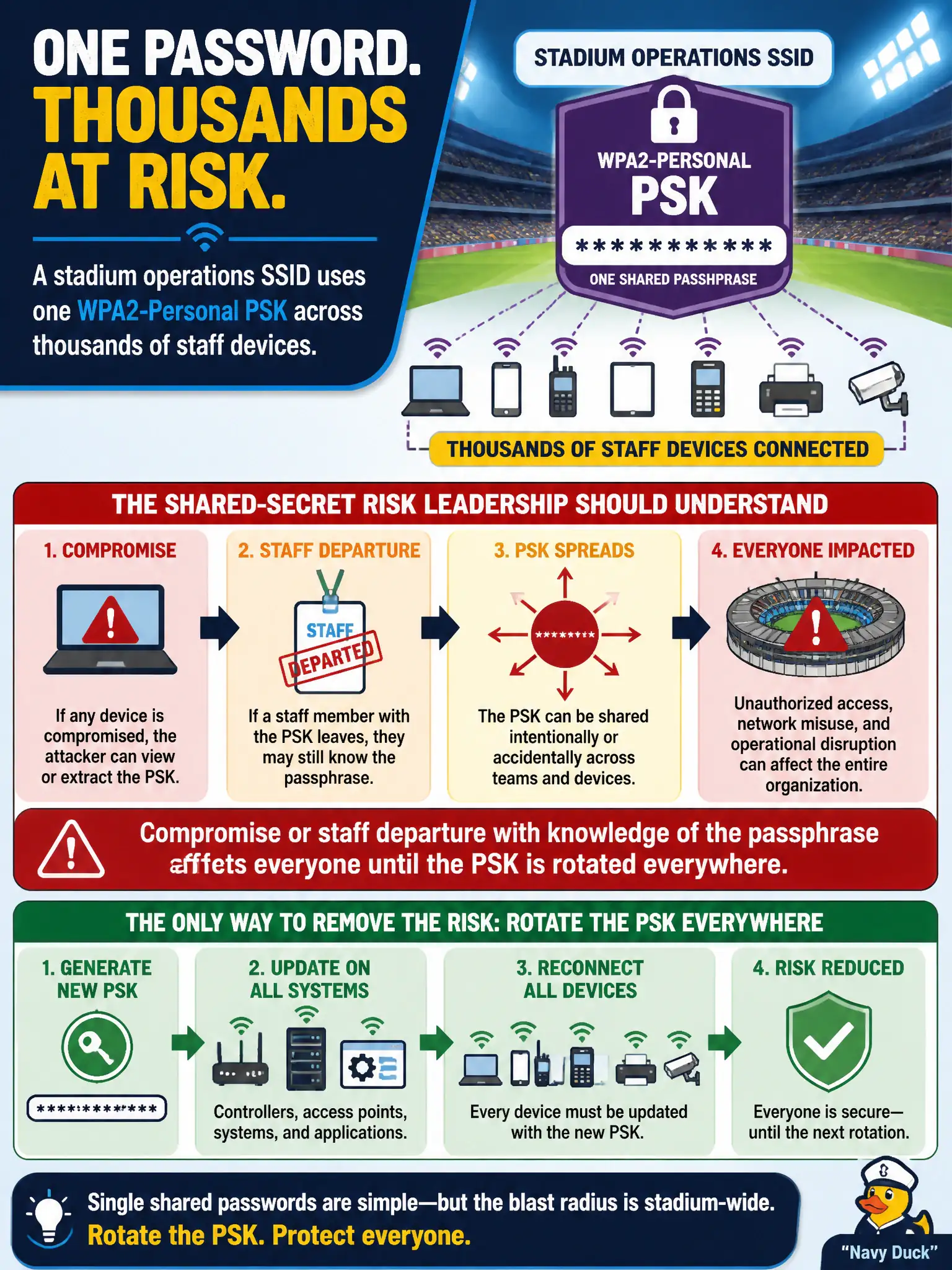
A stadium operations SSID uses one WPA2-Personal PSK across thousands of staff devices. What shared-secret risk should leadership understand?
Select an answer to reveal the explanation.
Short Explanation
One password for the whole stadium crew is like one master key for every locker — when that key walks out with a contractor, every locker is at risk until you rekey the building. Scale makes PSK sharing painful.
Full Explanation
A single WPA2-Personal PSK shared across thousands of stadium staff devices creates collective risk: anyone who learns the passphrase can access the BSS under that model, and staff who leave with retained knowledge remain a threat until a coordinated rotation updates every device. Large civic deployments amplify operational cost of rotation and blur accountability compared with Enterprise 802.1X. Leadership must understand shared-secret blast radius, not assume automatic per-device isolation. Claiming PSK networks automatically rotate unique keys per device after every association with no admin action overstates Personal mode. Saying a single PSK only endangers guests while staff isolate cryptographically by default is incorrect for a shared staff PSK. Asserting shared PSKs cannot be abused because WPA2-Personal forbids offline attacks in all cases ignores handshake capture realities. Exam caveat: Offline guessing against captured WPA2-PSK handshakes remains a core Personal-mode theme. Operational check: Estimate how many devices hold the stadium PSK, time a lab rotation drill, and present Enterprise migration as the accountability fix when revoke-by-user is required. In civic WLAN stewardship, keep authorization boundaries explicit, prefer the least disruptive technique class allowed by RoE, and record BSSID, channel, band, and security mode beside every conclusion so another assessor can reproduce the observation.