
A vendor proposes WPA3-Enterprise 192-bit mode for a high-security municipal wing. When is that suite most appropriate?
Select an answer to reveal the explanation.
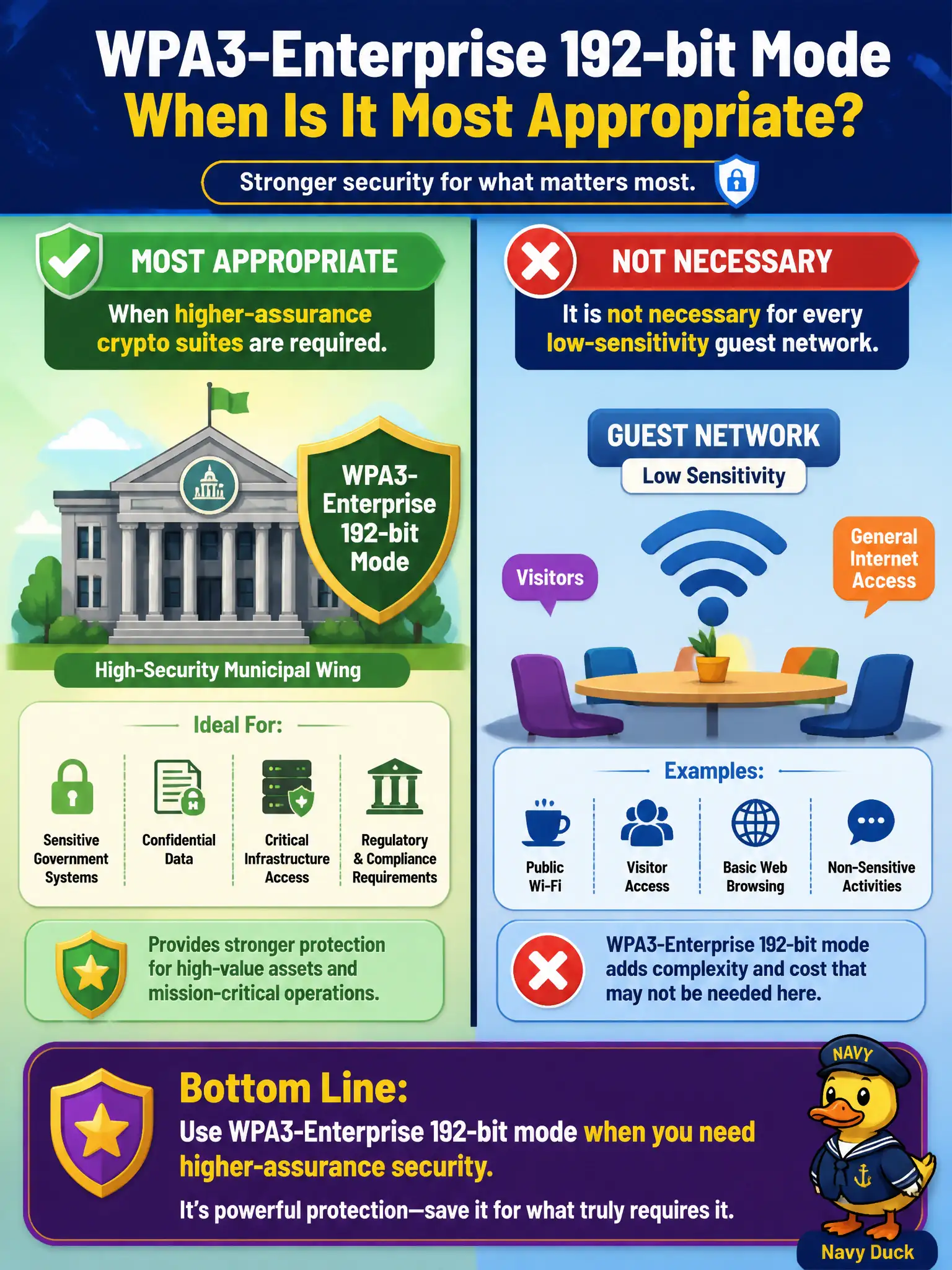
Short Explanation
192-bit mode is the vault door — great for the high-security wing, overkill for the lobby coffee Wi-Fi. Match the suite to the assurance need, not the sales brochure for every SSID.
Full Explanation
WPA3-Enterprise 192-bit mode suites target higher-assurance cryptographic profiles for sensitive municipal wings where policy demands stronger algorithms and related parameters. They are appropriate when risk and compliance require that uplift—not as a mandatory setting for every low-sensitivity café guest SSID. Vendors proposing 192-bit mode should match it to data classification and client capability, not to band support trivia. Claiming 192-bit mode is mandatory on every open guest café SSID misapplies a high-assurance suite. Saying it is only for continuing WEP scanner support contradicts both WEP retirement and Enterprise 192-bit intent. Asserting it whenever an AP supports 2.4 GHz regardless of sensitivity ignores risk-based selection. Exam caveat: Higher suite modes still need sound EAP methods and certificate validation operations. Operational check: Map the wing’s data sensitivity to the proposed suite, verify client support for 192-bit mode in a lab SSID, and reserve simpler WPA3-Enterprise profiles for lower-sensitivity civic networks. In civic WLAN stewardship, keep authorization boundaries explicit, prefer the least disruptive technique class allowed by RoE, and record BSSID, channel, band, and security mode beside every conclusion so another assessor can reproduce the observation.