
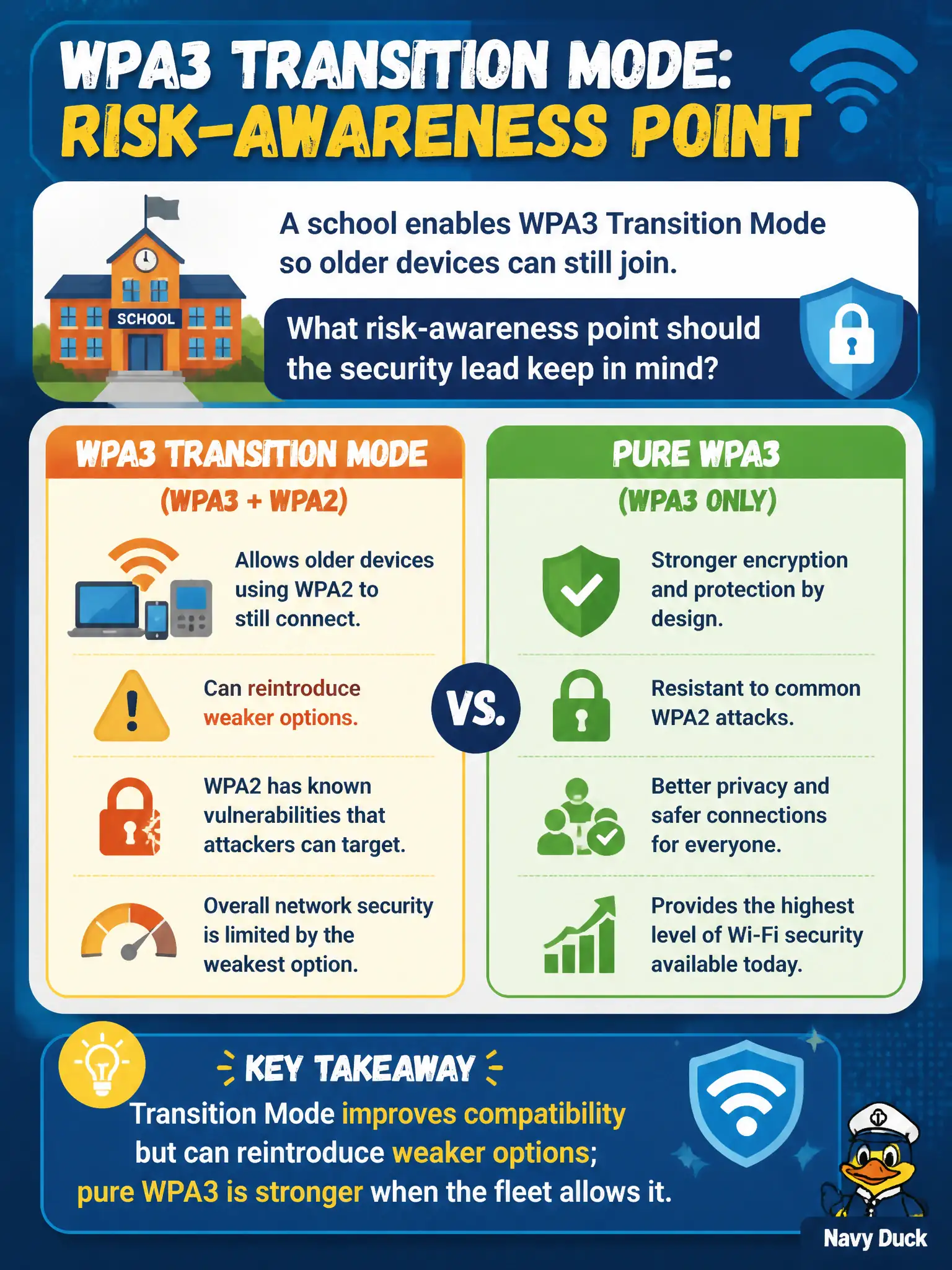
A school enables WPA3 Transition Mode so older devices can still join. What risk-awareness point should the security lead keep in mind?
Select an answer to reveal the explanation.
Short Explanation
Transition Mode is the 'old keys still work' period during a lock upgrade — handy for straggler laptops, but you're keeping a weaker path alive on purpose. When the fleet is ready, pure WPA3 is the tighter front door.
Full Explanation
WPA3 Transition Mode lets older clients continue joining while WPA3-capable devices negotiate stronger options, improving compatibility on school fleets that cannot upgrade overnight. The security lead must still understand that transition can reintroduce weaker WPA2-class options attackers prefer; pure WPA3 is cryptographically preferable when the device inventory allows it. Compatibility is a managed risk, not cryptographic equivalence. Claiming Transition Mode is identical to pure WPA3 and never weakens options understates the tradeoff. Saying it disables all encryption until every client upgrades is false. Asserting it only affects Bluetooth coexistence with no Wi-Fi security impact misses the point of transition AKM choices. Exam caveat: Survey tools may show mixed AKMs; document both and recommend a retirement date for WPA2-only clients. Operational check: Inventory client capability, inspect beacon AKMs in transition, and run an authorized lab comparison of negotiation results for legacy versus modern endpoints. In civic WLAN stewardship, keep authorization boundaries explicit, prefer the least disruptive technique class allowed by RoE, and record BSSID, channel, band, and security mode beside every conclusion so another assessor can reproduce the observation.