
A security intern asks whether names like 802.11n, 802.11ac, and 802.11ax are encryption standards. What should the mentor say?
Select an answer to reveal the explanation.
Short Explanation
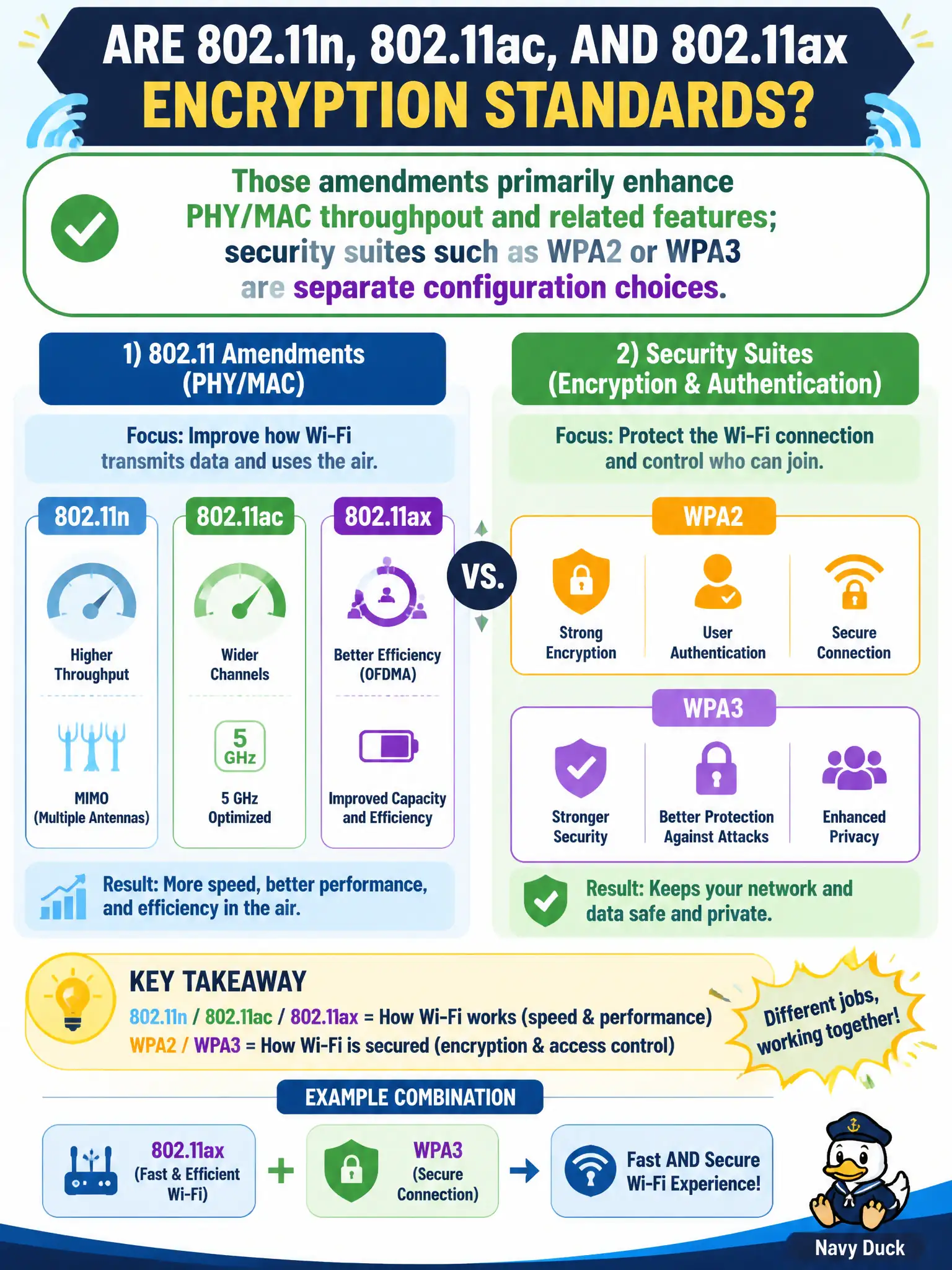
n/ac/ax are engine upgrades—faster radios—not the door locks. WPA2/WPA3 are the locks you still have to pick and set.
Full Explanation
Amendments such as 802.11n, 802.11ac, and 802.11ax primarily enhance PHY and MAC performance—MIMO, wider channels, higher throughput, and efficiency features. Confidentiality and authentication still come from separately configured RSN/WPA-family suites such as WPA2 or WPA3 Personal or Enterprise, open networks, or OWE. Mentors should stop interns from equating a generation letter badge with an encryption posture during municipal assessments of guest or staff SSIDs. Calling 802.11ac another name for WPA3-Enterprise that always implies EAP-TLS conflates PHY generation with authentication and key management. Claiming each lettered amendment replaces AES with a unique proprietary cipher invents non-standard crypto branding that does not appear in RSN advertisements. Saying choosing 802.11ax automatically disables open networks and forces PSK on every SSID is false; open and mixed security profiles still depend on configuration. Exam caveat: Report combinations such as ax-plus-open or ac-plus-WPA2-PSK as independent facts from beacons, not assumptions from marketing stickers. Operational check: For an in-scope AP, record both the PHY generation hints and the RSN/AKM advertisements; ensure findings address the security suite, not only the Wi-Fi 6 label.