
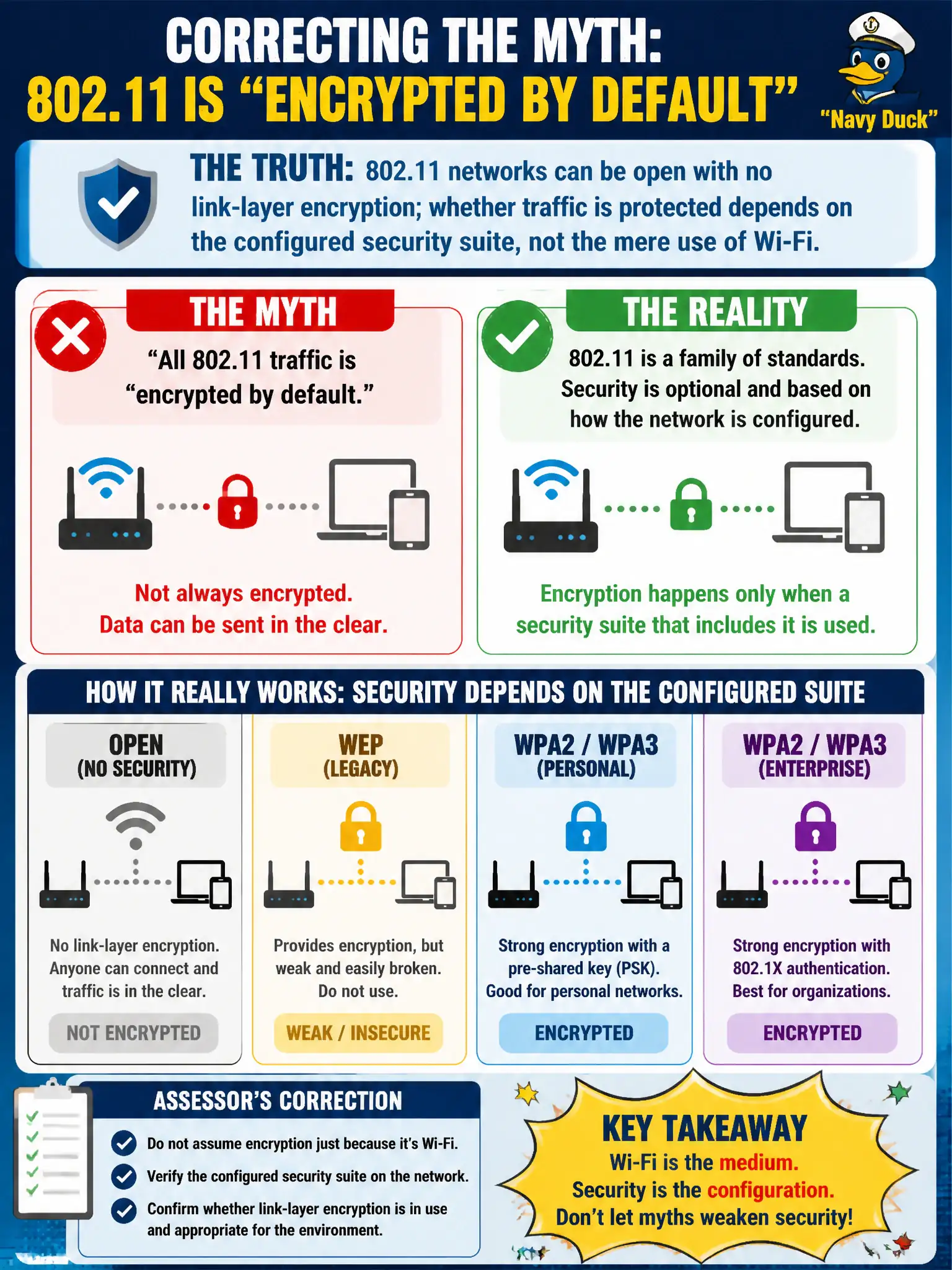
A city Wi-Fi policy draft claims all 802.11 traffic is “encrypted by default.” How should an assessor correct that myth?
Select an answer to reveal the explanation.
Short Explanation
Wi-Fi isn’t a locked briefcase just because it’s radio. Open guest SSIDs still ship clear at the link layer unless you turn on a real security suite.
Full Explanation
Wi-Fi does not magically encrypt merely because 802.11 radios are in use. Municipal networks can be configured as open with no link-layer confidentiality, leaving data frames exposed to passive eavesdropping on the medium. Whether traffic is protected depends on the configured security suite—Open, OWE, WPA2/WPA3 Personal or Enterprise—not on the marketing claim that “all Wi-Fi is encrypted by default.” Assessors must correct policy drafts that assume factory defaults equal confidentiality for every civic SSID. Claiming every 802.11 frame is encrypted with WPA3 the moment an AP ships ignores open and legacy configurations still found in the field. Asserting IEEE forbids open SSIDs so municipal guest networks cannot exist without PSK is false; open guest SSIDs remain common. Saying DHCP automatically supplies encryption on open networks confuses address assignment with cryptographic protection of frames. Exam caveat: Classify the actual RSN or security mode from beacons before selecting an attack surface or reporting risk severity. Operational check: On each in-scope civic SSID, read privacy and RSN advertisements in survey output and record whether link-layer encryption is absent, transitional, or modern before writing findings.