
A county assessor asks what association accomplishes after 802.11 authentication on a municipal WLAN. What is correct?
Select an answer to reveal the explanation.
Short Explanation
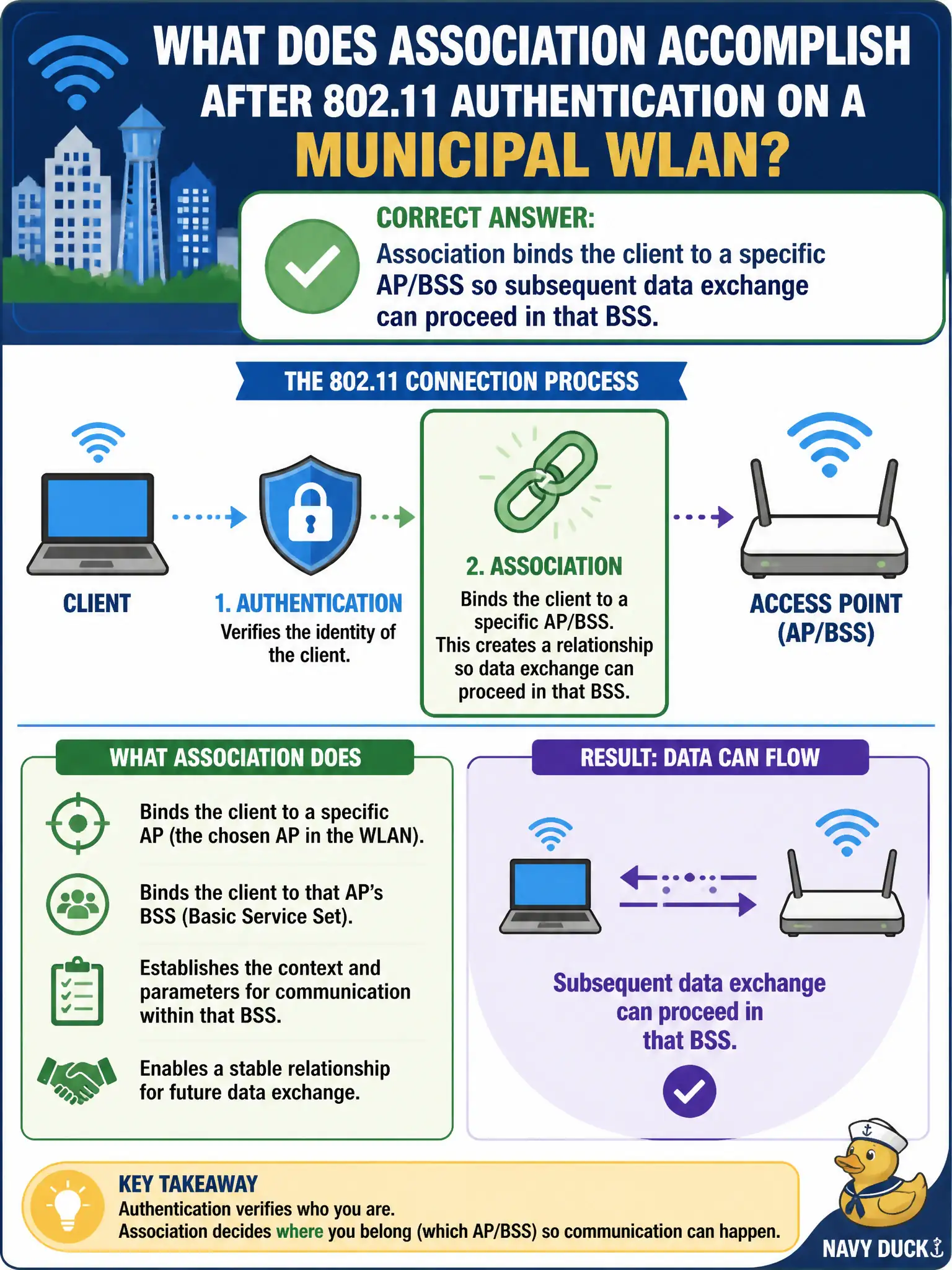
Authentication is showing ID at the door; association is picking which service desk you’re attached to. Until you’re associated to that AP, you’re not really “in” that BSS for data.
Full Explanation
After 802.11 authentication completes, association binds the client station to a specific AP/BSS. That binding establishes the wireless relationship in which subsequent data frames (and often higher-layer addressing) are exchanged within that BSS. On a county municipal WLAN, assessors treat association state as evidence the client is attached to a particular BSSID, which matters for roaming observations and for understanding where encryption and portal gates sit in the stack. Saying association only prints a paper badge ignores the wireless state machine entirely. Claiming association permanently replaces encryption suites or higher-layer login confuses link attachment with confidentiality and application access control. Asserting association assigns a public IPv6 address from the ISP before any 802.11 frames exist reverses the order: 802.11 association is a wireless link step, not ISP address issuance that precedes 802.11. Exam caveat: Open or PSK networks still use authentication/association frame exchanges; do not equate “Open” with “no 802.11 state machine.” Operational check: In an authorized capture, identify Authentication and Association Request/Response sequences to the target BSSID and confirm the client appears as associated before evaluating DHCP, portals, or data protection.