
A city digital-twin lab must run OpenUSD in an air-gapped environment with agency-approved libraries only. What is the right approach?
Select an answer to reveal the explanation.
Short Explanation
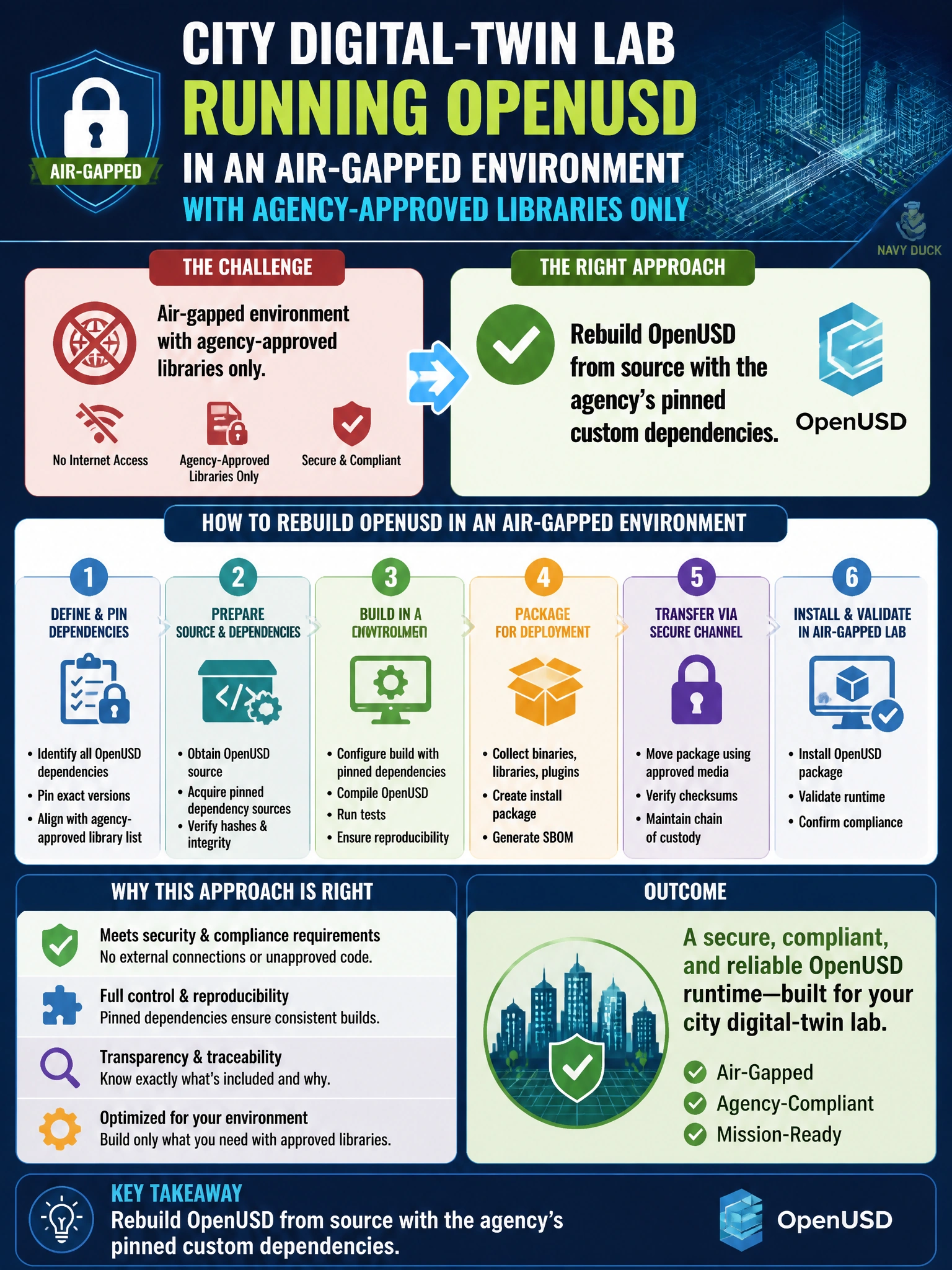
Air-gapped cities cook from approved ingredients. Rebuild OpenUSD from source with the pinned dependencies the agency already blessed.
Full Explanation
A city digital-twin lab running OpenUSD in an air-gapped environment with agency-approved libraries only should rebuild OpenUSD from source with the agency's pinned custom dependencies. Air-gapped civic environments disallow unvetted binaries; source builds against approved dependency pins satisfy security review while producing a USD stack the lab can certify. This is the standard compliance-oriented approach for municipal OpenUSD customization and deployment.
Installing random prebuilt USD binaries from unvetted public mirrors violates air-gap and supply-chain policy and may pull disallowed libraries. Disabling all asset resolvers and loading only anonymous in-memory stages forever is not a security architecture—it cripples asset pipelines and does not address approved-library requirements for the USD runtime itself. Replacing OpenUSD with a proprietary mesh cache outside the certification scope abandons the twin's USD interoperability goals and fails the question's premise.
Exam caveat: air-gapped + approved libraries ⇒ rebuild from source with pins. Distractors often push unvetted binaries or 'disable USD features' as fake security.
Operational check: build OpenUSD in the air-gapped toolchain using the pinned dependency manifest, run agency smoke tests on sample city stages, verify linked libraries match the approved list, and document the resulting USD version for viewer and plug-in teams.