
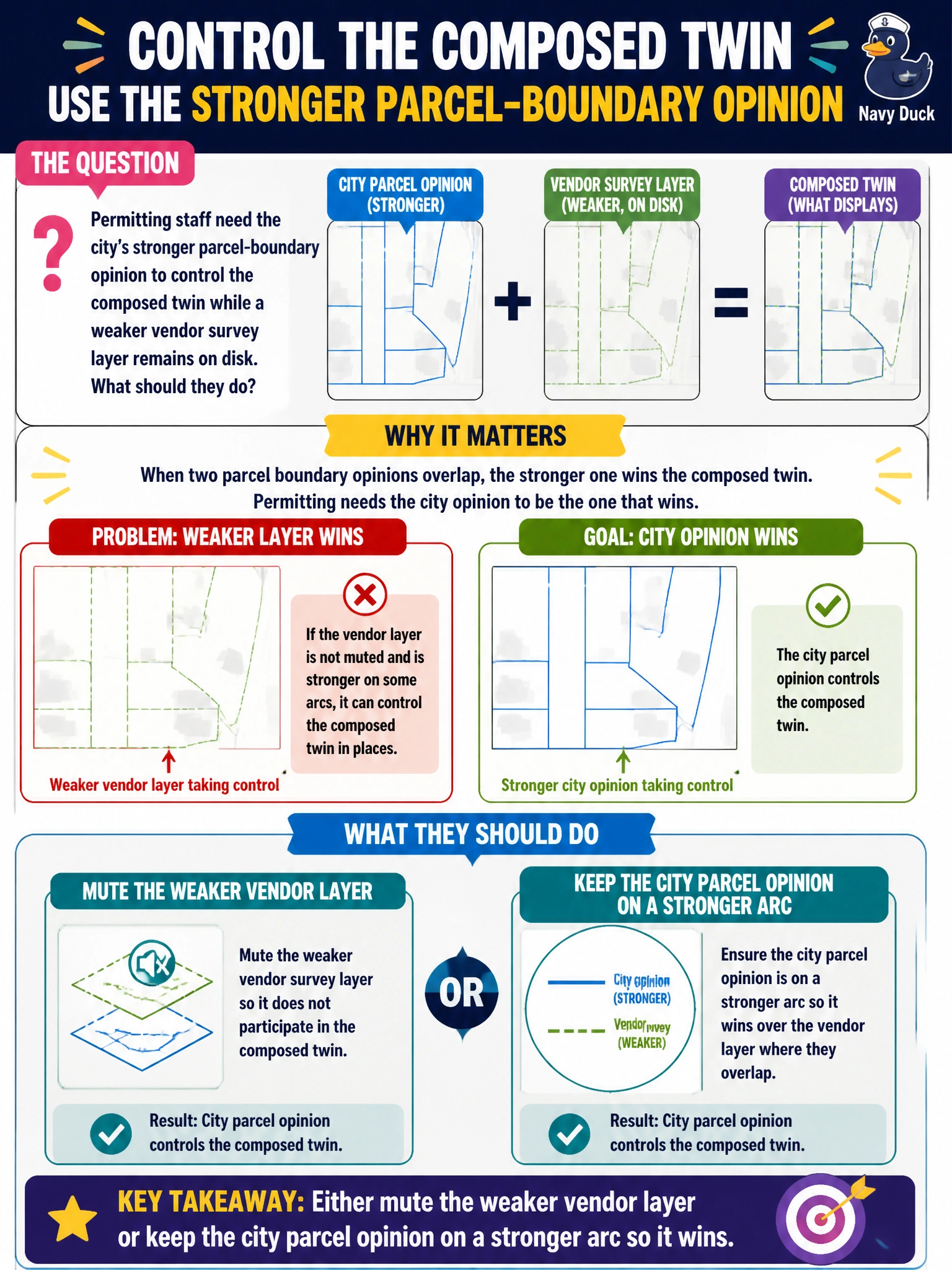
Permitting staff need the city’s stronger parcel-boundary opinion to control the composed twin while a weaker vendor survey layer remains on disk. What should they do?
Select an answer to reveal the explanation.
Short Explanation
You can keep the municipal boundary in control by muting the weaker vendor survey layer or keeping the city parcel opinion on a stronger arc; that’s composition strength at work. Flattening the composed twin or renaming the vendor layer outside the stage doesn’t manage that strength, and duplicating parcel prims won’t make the city’s opinion stronger.
Full Explanation
Composition strength determines which parcel-boundary opinion controls the city’s composed twin. To make the stronger municipal opinion win, mute the weaker vendor survey layer or keep the city parcel opinion on a stronger composition arc. Muting changes which opinions participate, while a stronger arc changes how they rank; either approach can preserve the vendor survey for audit or later re-enablement. This keeps a live permitting twin in which the city’s legal parcel source of truth outranks the weaker survey contribution. Exporting the composed twin as one flattened USDA file fails by concept: flattening bakes opinions into a delivery artifact rather than managing runtime strength, and it undermines ongoing multi-layer collaboration. Renaming the vendor layer with a .bak extension outside the stage is not a first-class OpenUSD strength mechanism and can orphan paths if handled carelessly. Duplicating every parcel prim into a new root also fails: copying prims does not multiply opinion strength under LIVERPS and instead bloats the municipal graph. Exam caveat: removing a file from disk or baking everything is not the same as managing composition strength. Practical check: with the vendor layer muted or the city opinion on the stronger arc, inspect the composed boundary against municipal GIS; unmute the vendor layer to confirm its weaker survey can return, and verify that it remains on disk for permitting history.