
Transit’s long-context schedule LLM uses sequence-parallel attention, but wall time barely improves. What should ops prioritize?
Select an answer to reveal the explanation.
Short Explanation
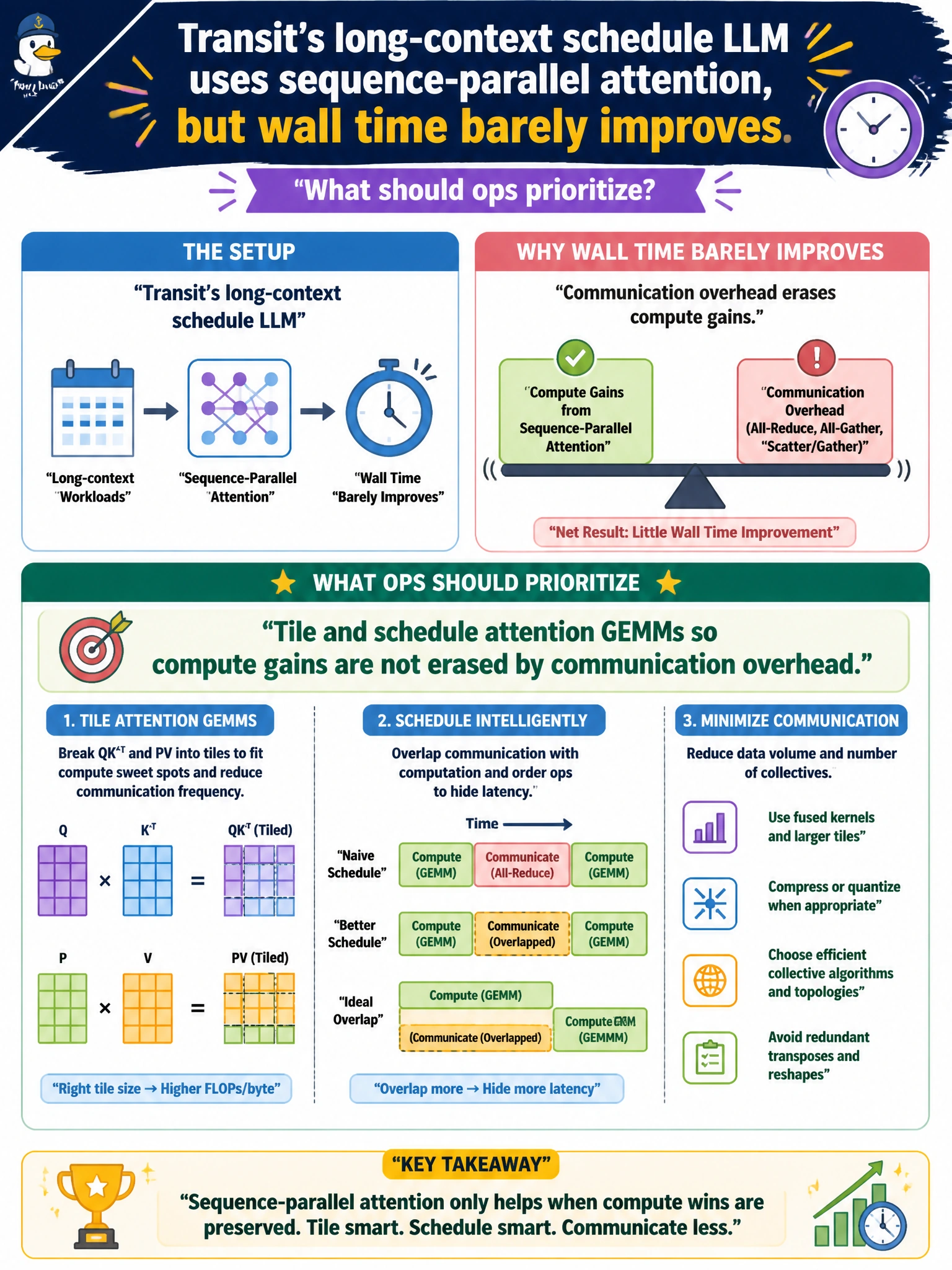
You get better wall time only when each GPU does enough useful attention work between communication exchanges. Tile and schedule the GEMMs so compute gains outweigh the network traffic, rather than letting sequence parallelism burn Transit’s cluster budget.
Full Explanation
Transit’s long-context schedule LLM benefits from sequence-parallel attention only when each GPU’s attention GEMMs perform enough useful work between collective exchanges. Ops should tile and schedule those GEMMs so compute gains are not erased by all-to-all or ring communication overhead; otherwise wall time barely improves even when the parallel plan looks correct. Disabling all collectives and training each GPU on an unrelated corpus abandons synchronized sequence-parallel attention, producing separate, inconsistent schedule models rather than speeding up one shared job. Randomly offloading attention heads to CPUs shifts work to host memory bandwidth and PCIe, and transfer costs can exceed any savings from parallelism. Measuring only host RAM while ignoring GPU kernel timelines cannot show whether GEMMs are compute-bound, memory-bound, or waiting on communication, so it does not guide the needed prioritization. Exam caveat: sequence parallelism can help with long sequences, but communication-aware tiling alone may not resolve a profile dominated by memory-bound Softmax traffic within each shard. Practical check: compare attention GEMM duration with collective wait time in Nsight Systems for a representative schedule sequence length, then iterate tile sizes and confirm compute time exceeds communication wait within the transit SLA window.