
School-district trainers see GPUs idle between steps waiting on data. What host-side fix helps?
Select an answer to reveal the explanation.
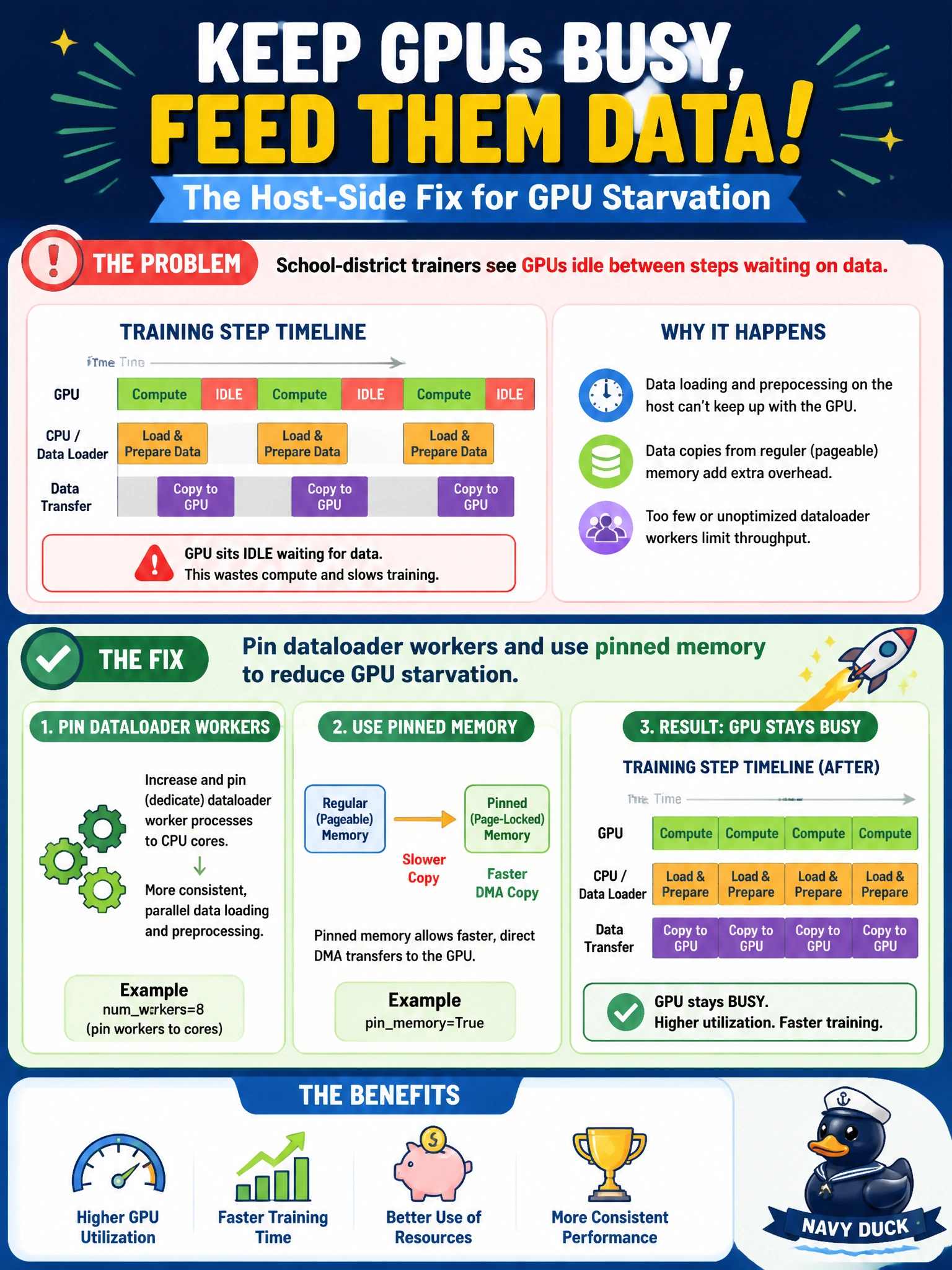
Short Explanation
Your GPUs are waiting for school data, so keep batches moving with pinned dataloader workers. Setting workers to zero or using slower pageable copies only leaves the accelerator waiting longer.
Full Explanation
When GPUs sit idle between steps waiting for data, you need to improve the host-side pipeline: use enough dataloader workers and pinned (page-locked) memory so batches are prepared and transferred without starving the accelerators. Idle gaps between steps, especially with short device kernels, often point to slow host preparation rather than an undersized model. Lowering the worker count to zero and loading samples on the GPU kernel thread serializes preparation with device compute, worsening those gaps. Disabling pinned memory leaves transfers pageable, slowing host-to-device copies and prolonging waits between steps on school training nodes. Pausing training whenever utilization dips adds artificial downtime instead of fixing the pipeline and can make epoch time arbitrarily bad. Exam caveat: low GPU utilization with short kernels often signals a data-pipeline bottleneck, so address workers, pinning, and prefetch before changing model parallelism. Practical check: increase worker count thoughtfully relative to CPU cores, enable pinned memory and non-blocking transfers, prefetch batches, and monitor GPU utilization and dataloader-wait metrics on the school workload. Stop tuning once devices stay busy without oversubscribing host CPUs.