
A 311 intent model already fits on one GPU. How should the city speed fine-tuning with spare accelerators?
Select an answer to reveal the explanation.
Short Explanation
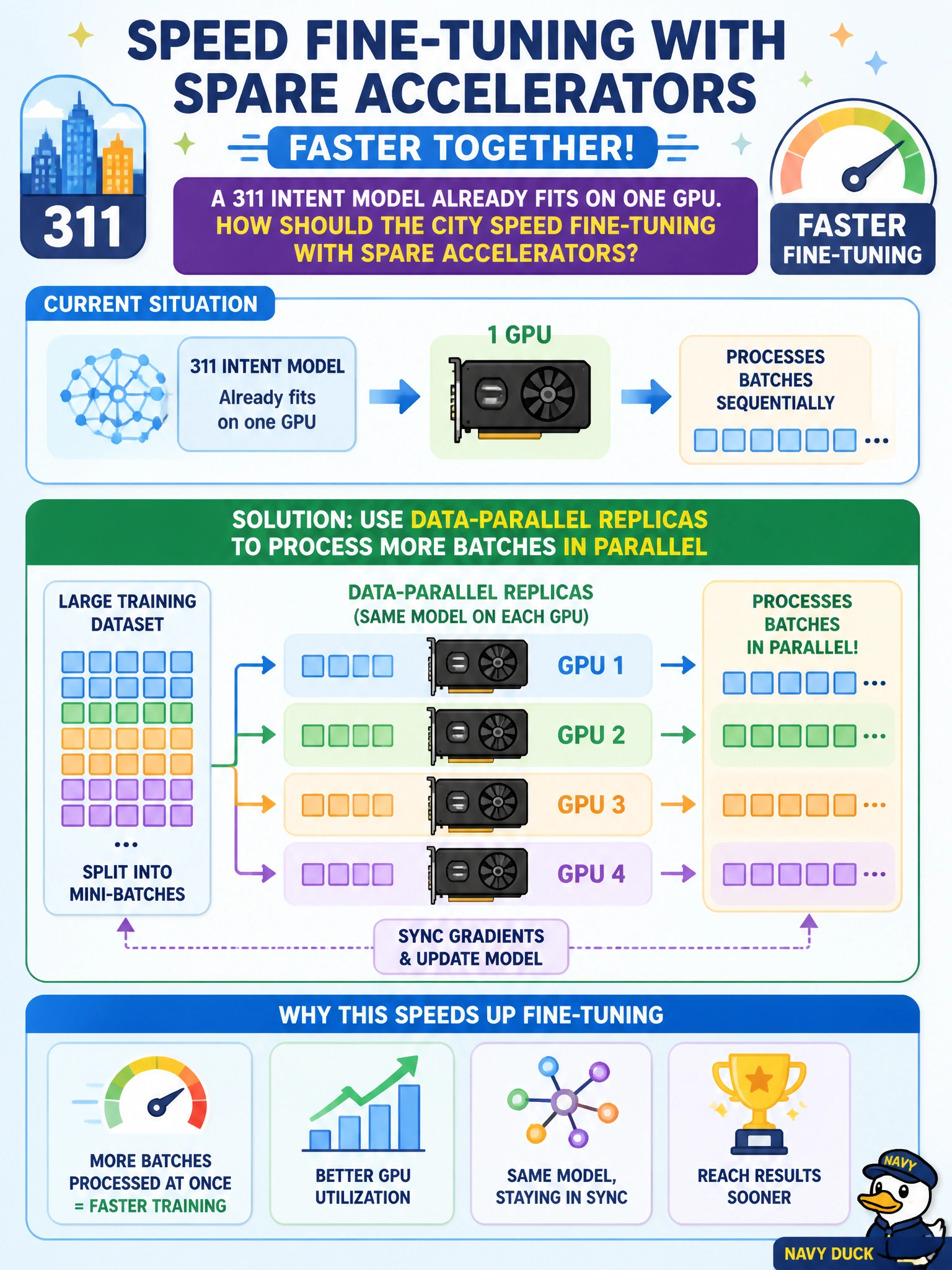
If the 311 model already fits, just copy it to more GPUs and chew through more batches—classic data parallelism. Tensor or pipeline splits are extra ceremony when one card already holds the weights.
Full Explanation
When a 311 intent model already fits on one GPU and the city has spare accelerators, data-parallel replicas are the throughput-oriented choice: each GPU holds a full copy, processes different batches, and synchronizes gradients so more civic utterances are trained per wall-clock minute. That directly increases samples per step without inventing a memory-fit problem that does not exist. Forcing tensor parallelism even though the model fits adds unnecessary collective communication and implementation complexity for little capacity benefit when a single card already holds the weights. Enabling pipeline stages that introduce pipeline bubbles when there is no capacity need similarly adds scheduling overhead without solving a real fit constraint. Serializing all GPUs so only one ever runs a step leaves accelerators idle and defeats the purpose of having spare hardware for faster fine-tuning of the 311 stack. Exam caveat: pick the simplest parallelism that matches the bottleneck—fit problems need model, pipeline, or tensor sharding; pure throughput with a fitting model needs data parallelism. Operational check: replicate the 311 model with DDP-style training across spare GPUs, scale global batch carefully or use gradient accumulation to keep optimization stable, watch scaling efficiency and gradient sync time, and stop adding ranks once communication overhead flattens tokens/sec gains for the municipal intent job.