
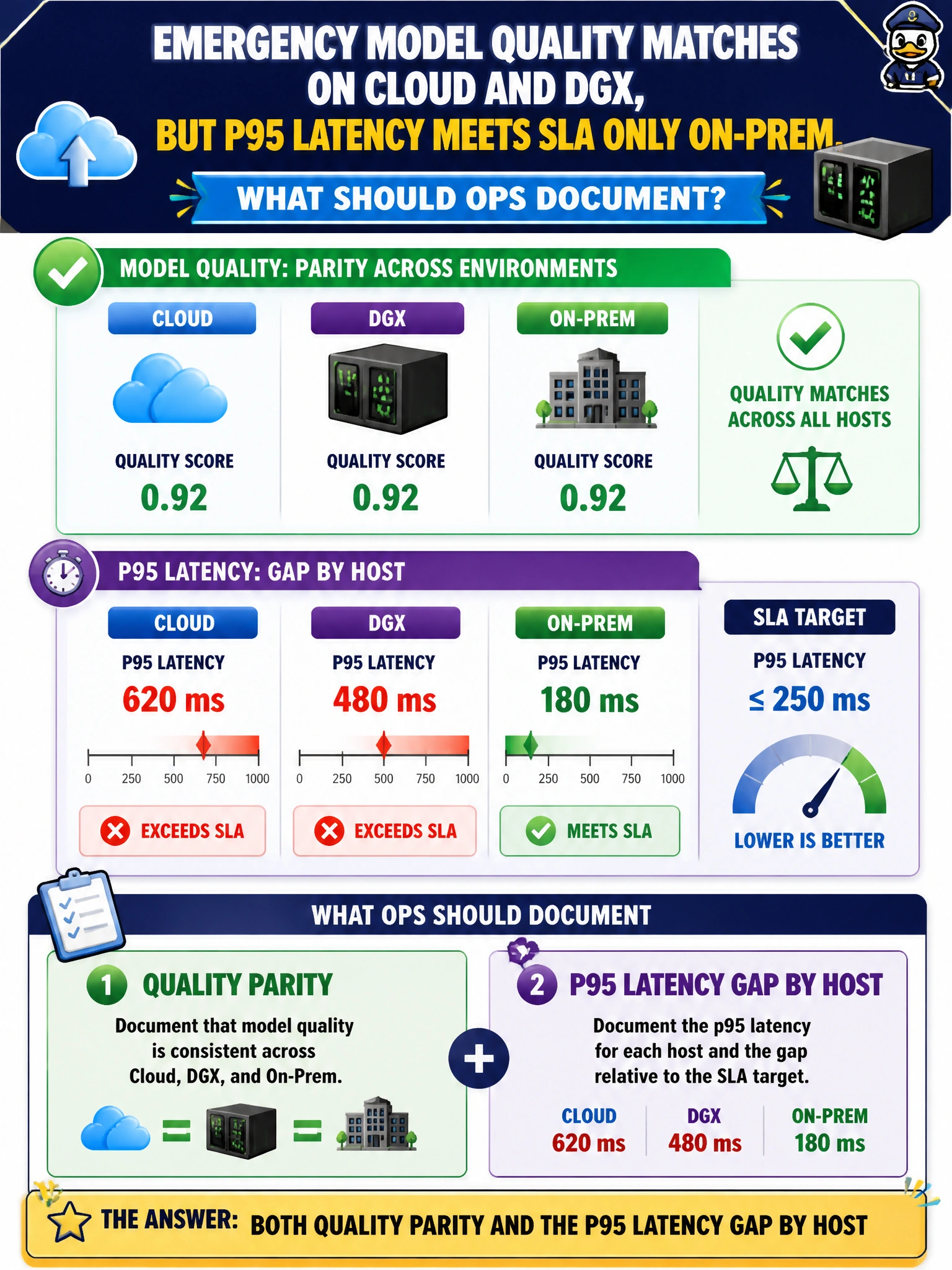
Emergency model quality matches on cloud and DGX, but p95 latency meets SLA only on-prem. What should ops document?
Select an answer to reveal the explanation.
Short Explanation
The answers look equally good, but only the DGX box hits the p95 SLA—write both facts down. Hiding the latency gap in one blended score is how emergency ops get surprised later.
Full Explanation
For municipal emergency LLMs, platform comparison is incomplete unless ops document both quality parity and host-specific latency against the SLA. Matching answer quality on cloud and DGX is necessary but not sufficient when p95 latency meets the emergency threshold only on-prem; responders and dispatch systems care about both correctness and timely delivery. Recording quality only, on the premise that latency is never part of civic evaluation, hides a deployment-blocking gap and invites promotion of a host that will miss alert deadlines under load. Recording latency only and discarding matching quality scores throws away the evidence that the models are equivalently capable, which matters when arguing for capacity investment versus model rework. A single blended score that conceals which host missed p95 is especially harmful: it averages away the SLA breach and prevents capacity planners from choosing the host that actually meets emergency response times. Exam caveat: evaluation reports must separate quality metrics from latency SLAs rather than collapsing them into one opaque number. Operational check: for each host, log quality suite results and p95/p99 latency on the same civic alert workload, annotate SLA pass/fail per host, and store both in the release dossier before any emergency-model cutover.