
County ML runs a distributed learning-rate sweep for LoRA on ordinance QA. What is the primary goal of that search?
Select an answer to reveal the explanation.
Short Explanation
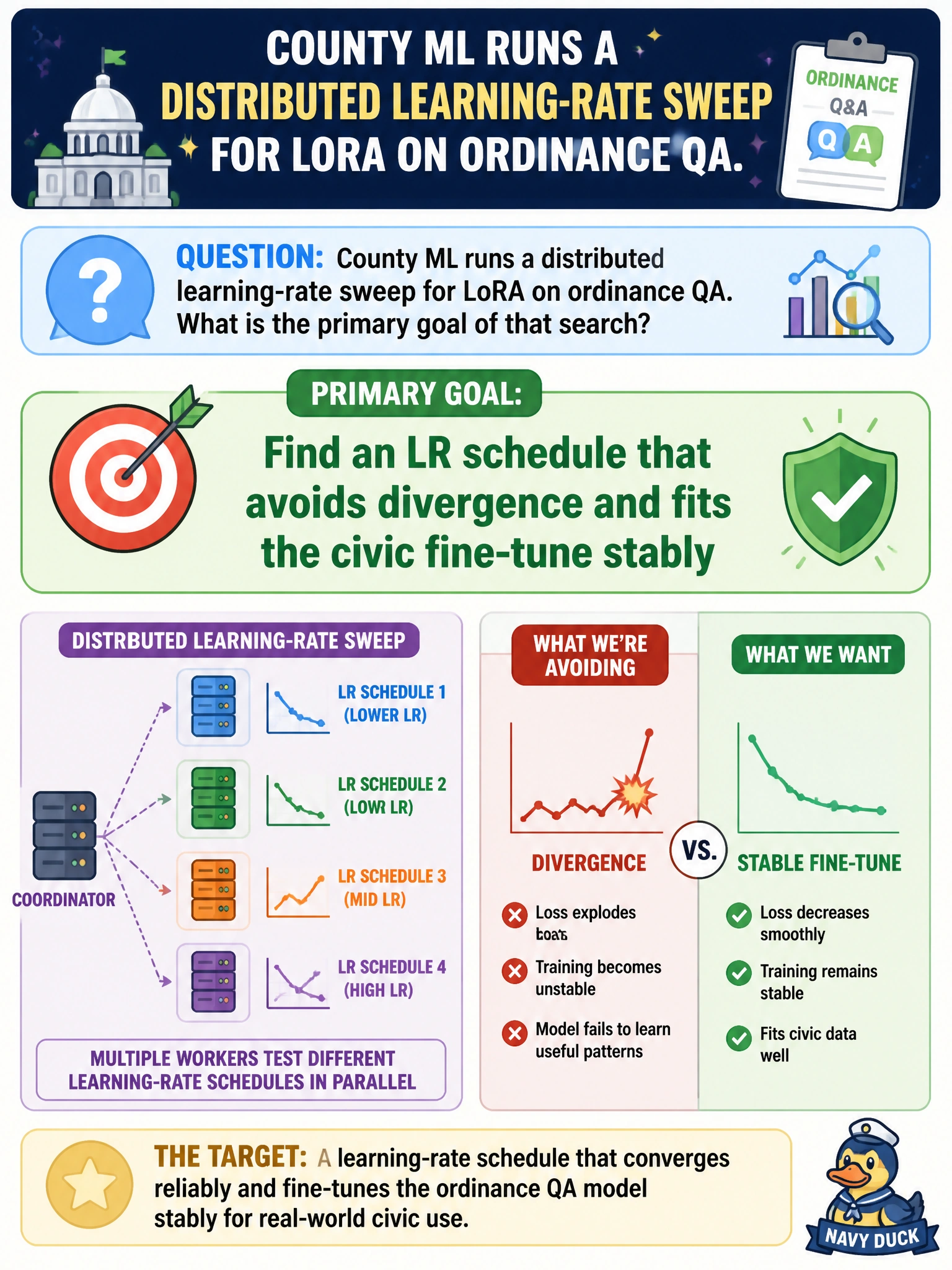
Ordinance LoRA isn’t a drag race—you’re looking for an LR schedule that avoids divergence and keeps the civic fine-tune stable. Sweep systematically, then confirm the run stays steady.
Full Explanation
Distributed learning-rate sweeps for LoRA on ordinance QA aim to find an LR schedule that avoids divergence and fits the civic fine-tune stably. Searching systematically across workers identifies rates and schedules where adapter training converges on municipal ordinance answers without exploding loss; that stability, not raw step speed, is the primary goal. Maximizing GPU fan noise as a proxy for training quality confuses a thermal byproduct with model fitness and provides no ordinance QA signal. Picking the highest LR that always diverges to stress-test logs deliberately selects unstable settings and wastes civic compute without producing a deployable adapter. Disabling validation loss logging during the sweep removes the signal needed to judge stability and generalization on ordinance holds, so you cannot trust the sweep’s results. Exam caveat: the best LR on one ordinance domain slice may not transfer to another, such as zoning versus building; treat sweep winners as starting points and confirm them on each civic task pack before fleet training. Practical check: log train and validation loss curves for every LR trial, reject divergent runs, and lock the schedule that minimizes validation loss without NaNs on the ordinance QA suite before full LoRA training across county GPUs.