
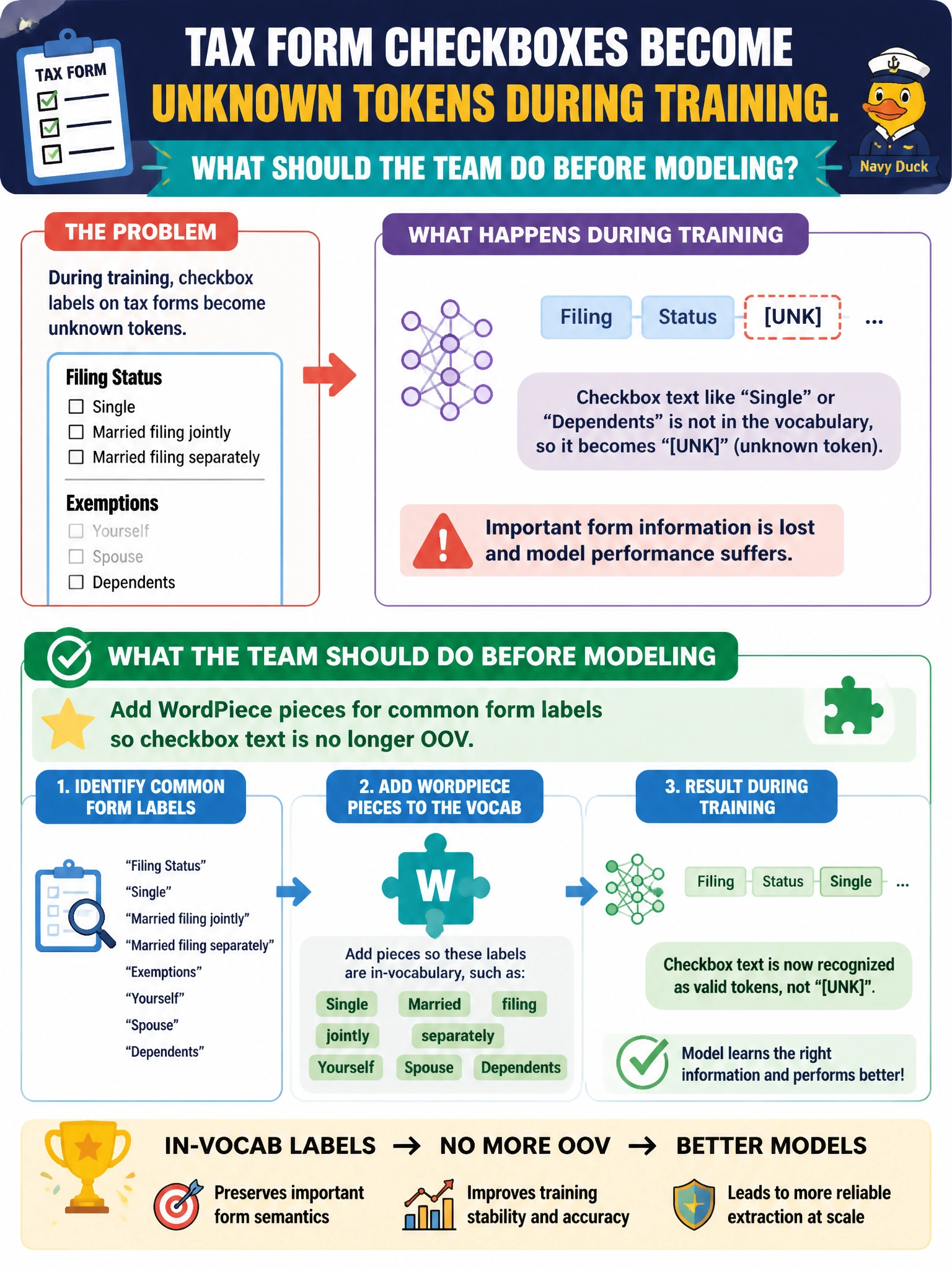
Tax form checkboxes become unknown tokens during training. What should the team do before modeling?
Select an answer to reveal the explanation.
Short Explanation
Unknown checkbox labels are like blank stickers on a tax form—the model can’t read them. Extend WordPiece with those common form labels so they stop being OOV.
Full Explanation
Tax-form checkbox labels are short civic UI strings that become out-of-vocabulary when the tokenizer was trained without municipal form language. Adding WordPiece pieces for common form labels so checkbox text is no longer OOV restores stable tokens for fields such as filing status or exemption elections, which is required before supervised modeling of assessor or revenue workflows. Marking every checkbox as punctuation and dropping it from the corpus discards structured signals that distinguish form completion states and undermines any model of which boxes residents selected. Training only on free-text fields and never tokenizing form UI labels leaves the structured half of the tax artifact unmodeled, so the LLM cannot ground answers in the same labels clerks see. Replacing checkbox labels with random GUIDs each epoch destroys lexical consistency across epochs and prevents the model from learning reusable form semantics. Exam caveat: extending WordPiece for form labels is not a substitute for schema validation—OOV fixes help representation, but production pipelines still need field-level validation against the official tax schema. Operational check: tokenize a gold set of form label strings, assert zero UNK/OOV on those labels after vocab extension, and confirm classification or extraction F1 on checkbox-bearing examples rises versus the pre-fix tokenizer.