
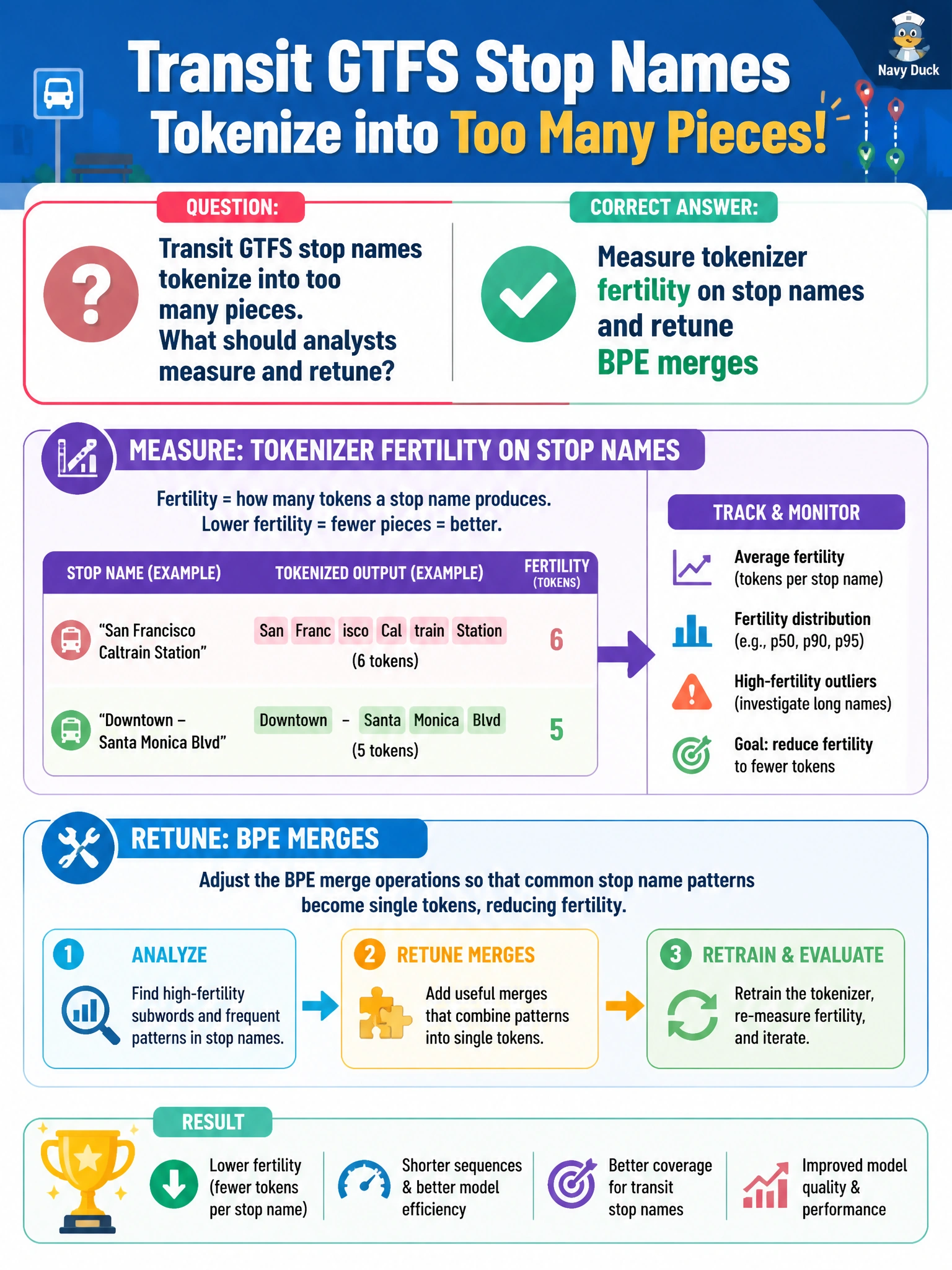
Transit GTFS stop names tokenize into too many pieces. What should analysts measure and retune?
Select an answer to reveal the explanation.
Short Explanation
If ‘Main & 5th’ turns into a dozen scraps, fertility is too high. Measure that on GTFS stop names and retune BPE merges so stations stay recognizable.
Full Explanation
GTFS stop names are municipal named entities that riders and operators treat as atomic (“Main & 5th”, “City Hall Transit Center”). When a generic BPE tokenizer over-segments those strings, fertility rises, sequence length grows, and stop-level retrieval or delay explanation models see unstable pieces instead of stable station identity. Analysts should measure tokenizer fertility specifically on stop names and retune BPE merges so common transit entities compress into fewer, more stable tokens. Measuring only GPU utilization and never inspecting token splits monitors compute, not linguistic fragmentation; a busy GPU can still be training on badly shredded stop text. Retuning the optimizer momentum while leaving the tokenizer unchanged adjusts training dynamics but does not reduce piece counts on GTFS entities. Converting every stop name to a barcode image before modeling abandons text modeling entirely and breaks standard LLM/NLP civic pipelines that expect token sequences aligned to schedules and alerts. Exam caveat: fertility fixes must not overfit a handful of downtown stops—validate merges on feeder routes, bilingual stop aliases, and abbreviated codes used in CAD/AVL feeds. Operational check: sample stop names from the live GTFS feed, report mean pieces per stop before/after merge retune, and confirm delay-explainer exact-match on stop references improves without blowing vocab memory.