
County grant applications arrive as scanned TIFF images that must become modeling text. Which preparation step is appropriate?
Select an answer to reveal the explanation.
Short Explanation
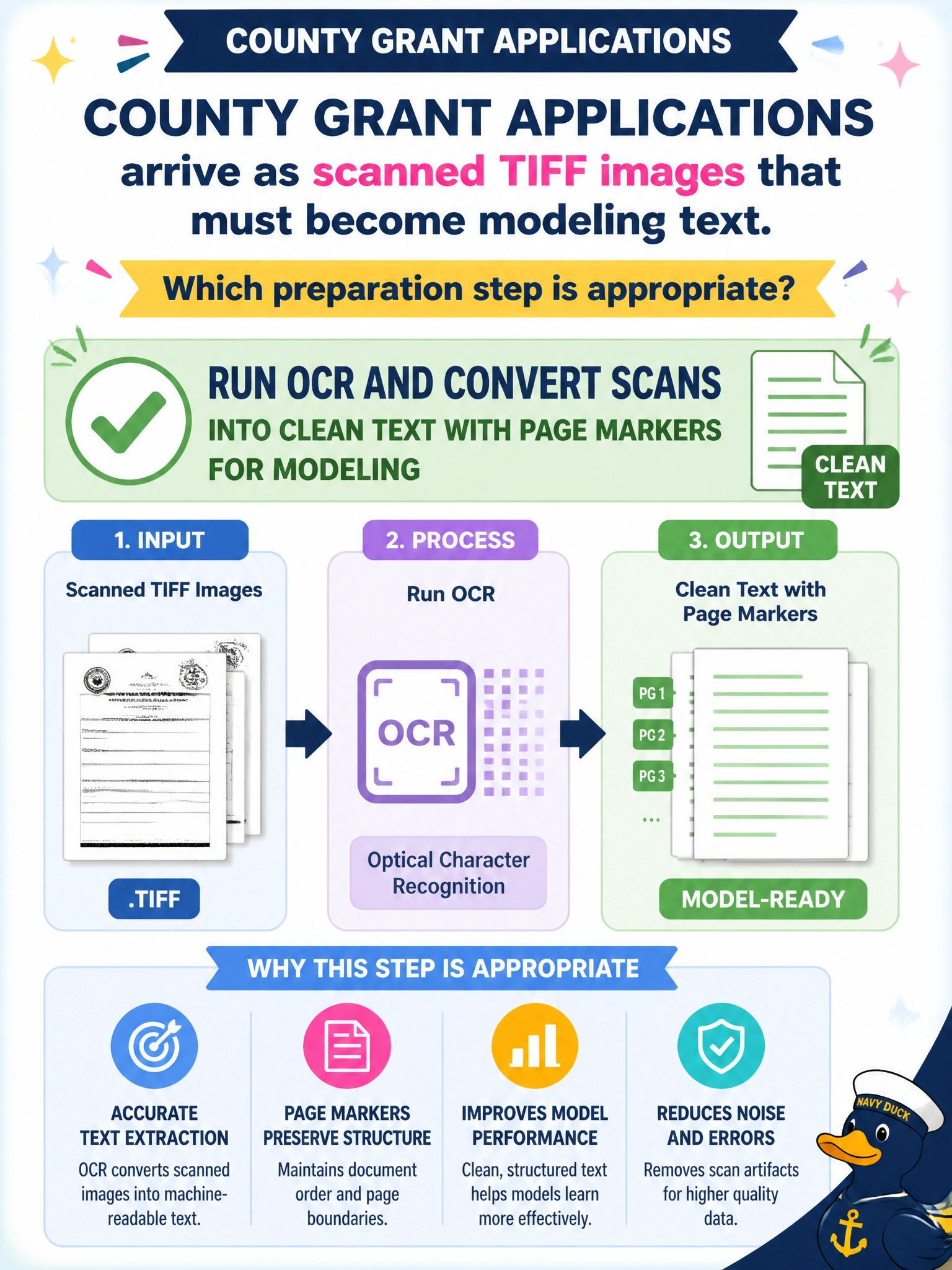
A scanner picture of a grant form isn’t text yet—it’s a photo of paperwork. OCR it into clean text with page markers so the county corpus is actually usable for modeling.
Full Explanation
County grant applications arriving as scanned TIFF images must be prepared by running OCR and converting scans into clean text with page markers for modeling. Tokenizers and text LLM trainers consume language, not raw image binaries; OCR is the bridge from paper scans to a usable municipal text corpus. Page markers preserve structure for citation, chunking, and review of multi-page applications. Feeding raw TIFF bytes directly into the tokenizer without OCR treats image bytes as if they were text and yields nonsensical tokens with no grant-application semantics. Keeping only image thumbnails and discarding recognized text retains a visual stub while throwing away the language needed for modeling. Encrypting TIFFs with a one-time pad and treating ciphertext as tokens maximizes secrecy but produces random-looking tokens with no recoverable application content for legitimate training. Exam caveat: OCR error rates on poor scans can inject label noise—include confidence filtering and human correction for low-confidence pages before high-stakes fine-tuning. Operational check: OCR the TIFF batch to UTF-8 text with page markers, spot-check critical fields (applicant, amounts, program names), measure character error on a gold sample, and only then promote the text corpus into modeling pipelines.