
Library catalog blurbs must be paired with subject headings for supervised tuning. How should the dataset be structured?
Select an answer to reveal the explanation.
Short Explanation
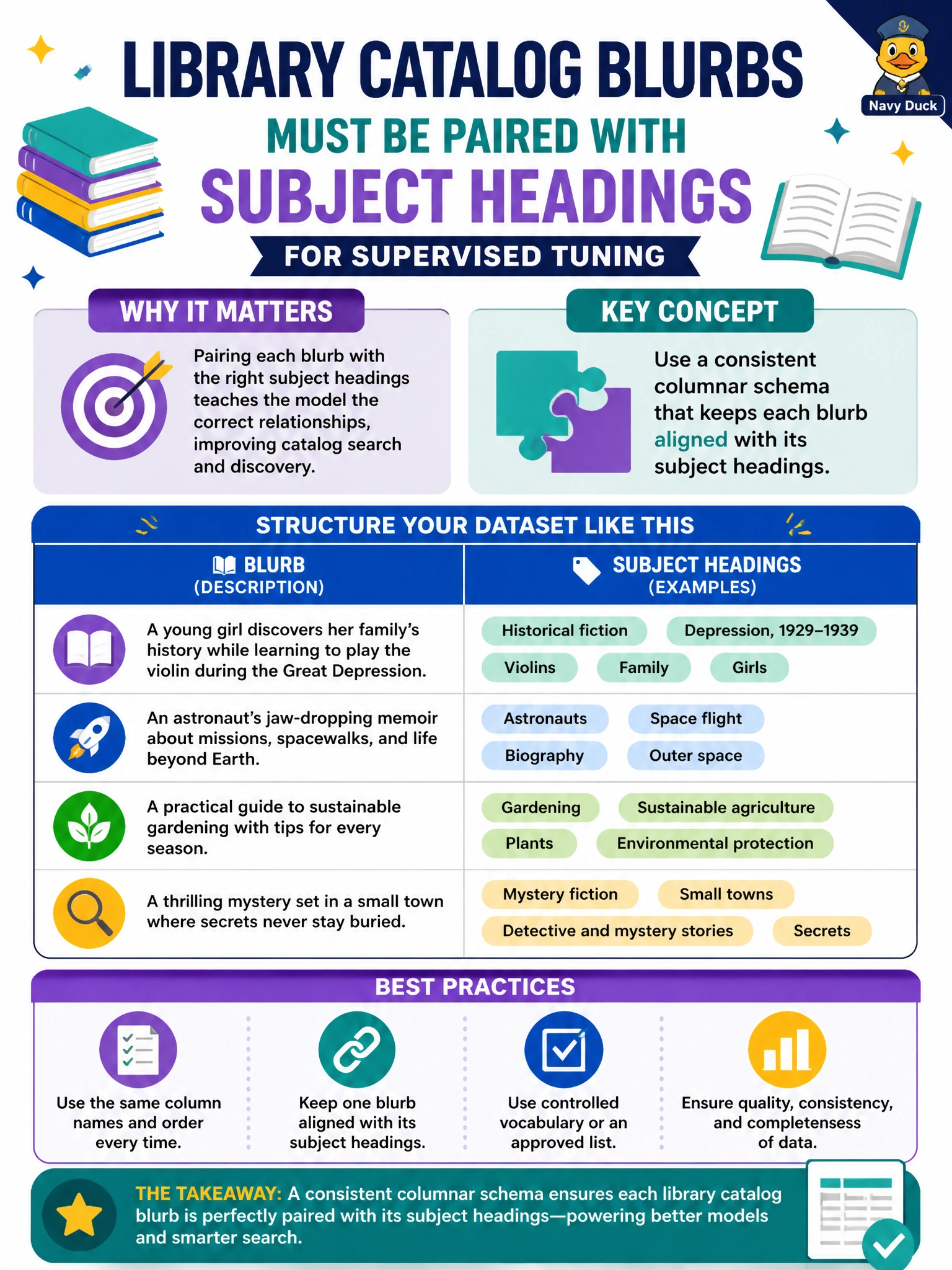
Supervised tuning needs matching pairs, like a catalog card with the blurb on one side and the subject heading on the other. Keep a consistent columnar schema so those fields stay aligned.
Full Explanation
Library catalog blurbs paired with subject headings for supervised tuning should use a consistent columnar schema that keeps each blurb aligned with its subject headings. Supervised learning requires reliable input-target pairs; a columnar table or equivalent structured records preserve that alignment with join keys and consistent field names. Without aligned columns, heading supervision cannot be applied cleanly to each blurb. Putting blurbs and headings in separate unsorted folders with no join keys makes pairing ambiguous and invites train-time mismatches. Concatenating all headings into one global string reused for every blurb destroys per-item supervision and teaches a constant target unrelated to each blurb's content. Storing only ISBNs and discarding textual blurbs removes the language input the LLM must learn from, defeating text-based subject-heading tuning. Exam caveat: columnar alignment should also normalize multi-heading fields (ordered lists vs. delimited strings) so trainers interpret labels consistently across catalog records. Operational check: define a schema with blurb text, subject-heading list, and stable bibliographic ID; run referential checks that every training row has both sides populated; and sample joins to ensure headings belong to the paired title.