
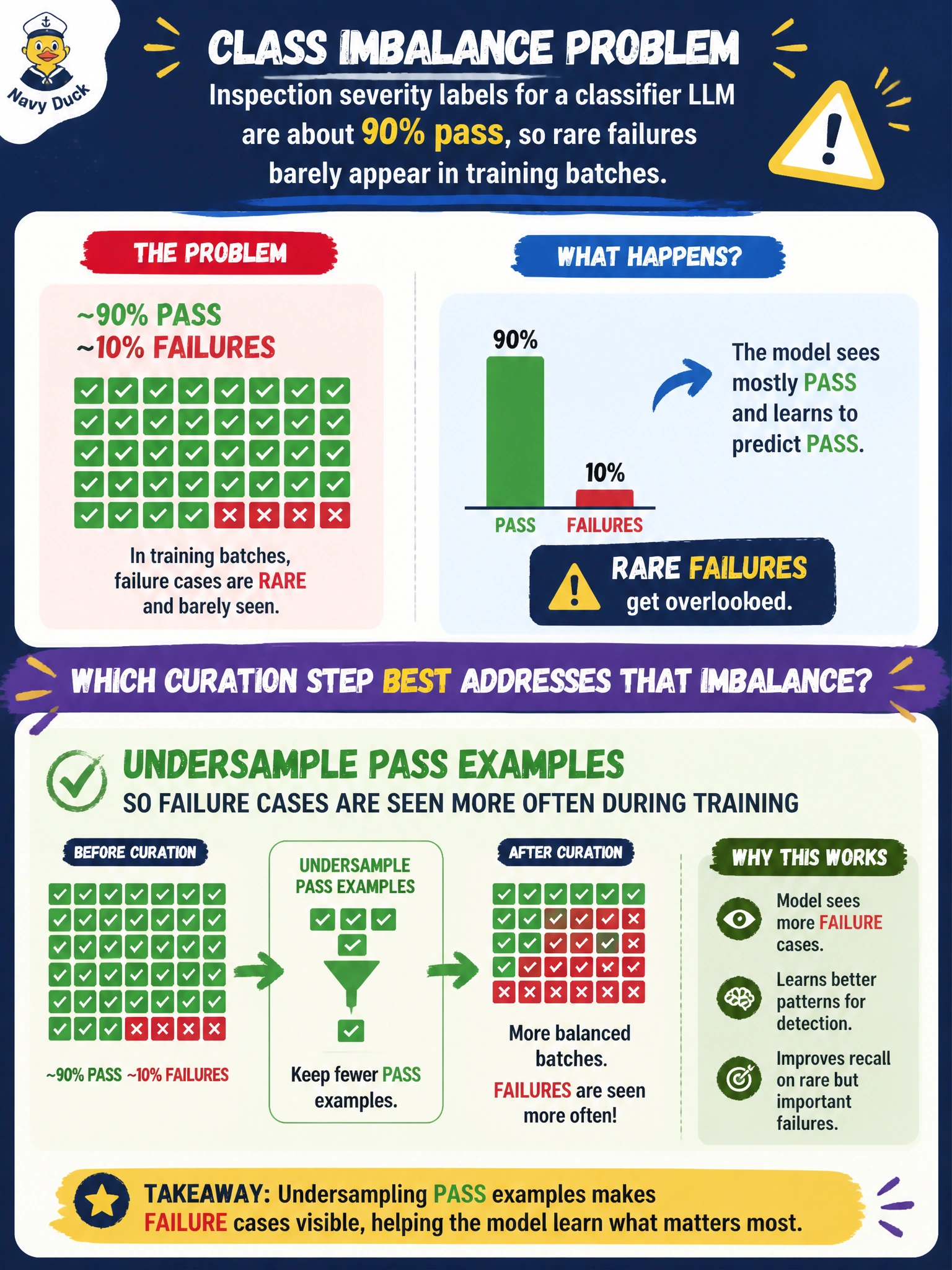
Inspection severity labels for a classifier LLM are about 90% pass, so rare failures barely appear in training batches. Which curation step best addresses that imbalance?
Select an answer to reveal the explanation.
Short Explanation
When nine out of ten labels say pass, your model can miss the rarer failures. Undersampling pass examples gives those failure cases more room in training, so you can help the model learn their cues.
Full Explanation
With about 90% of inspection labels marked pass, undersampling pass examples so failure cases appear more often during training best addresses the imbalance. Failures are operationally important, and batches dominated by passes can leave the model undertrained on failure cues. Reducing the plentiful pass examples makes failures more visible without removing their labels. Deleting every failure label would erase the class the model needs to recognize and leave it predicting only pass, which is unsuitable for inspection enforcement. Duplicating pass rows would make failures an even smaller fraction of the training data and deepen the imbalance. Treating the labels as naturally balanced and skipping resampling ignores the stated 90% pass distribution and prevents a response to the observed skew; municipal inspection data should not be assumed balanced. Exam caveat: undersampling discards some pass examples, so the model may see less variety among passes, and the rebalanced training distribution differs from the production distribution. Practical check: compare class counts before and after undersampling, confirm failures are more prevalent in training, and evaluate failure recall on held-out data that reflects the intended evaluation setting.