
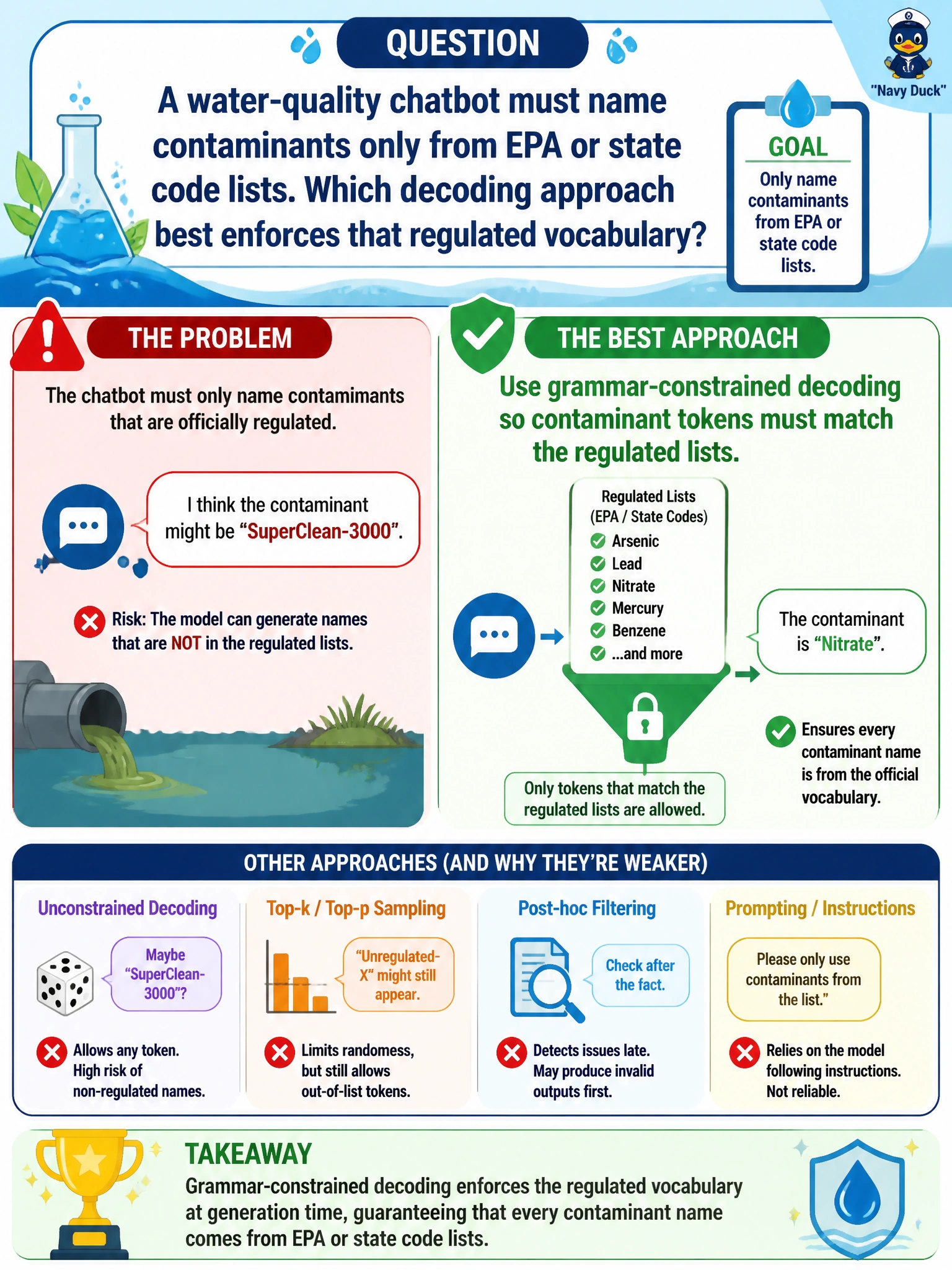
A water-quality chatbot must name contaminants only from EPA or state code lists. Which decoding approach best enforces that regulated vocabulary?
Select an answer to reveal the explanation.
Short Explanation
Regulated contaminant names aren’t a brainstorming session. Grammar-constrained decoding is the filter that only lets EPA or state-list tokens through the water-quality bot.
Full Explanation
Grammar-constrained decoding that forces contaminant tokens to match EPA or state code lists best enforces the water-quality chatbot's regulated vocabulary. Regulated naming is a closed (or tightly governed) set; constrained decoding binds generation to that set so answers cannot freely invent chemical labels residents might misread as official. This keeps chatbot language aligned with compliance and public-health communication standards. Sampling freely from the full open vocabulary and post-editing with a thesaurus leaves a window where unregulated names reach users before edits, and thesaurus swaps can introduce non-standard synonyms that are not on the code lists. Asking residents to spell contaminant names so the model can learn slang variants crowdsources unofficial nomenclature into the channel and does not enforce regulated lists. Translating every chemical name into informal nicknames before answering actively moves away from regulated vocabulary and undermines clarity for compliance-sensitive water-quality guidance. Exam caveat: constrained lists must be updated when EPA or state codes change; a stale grammar will block new regulated names or allow deprecated ones. Operational check: compile the regulated contaminant grammar from the current code lists, test prompts that previously elicited slang or invented chemicals, and verify only list-approved tokens appear in the contaminant field of each answer.