
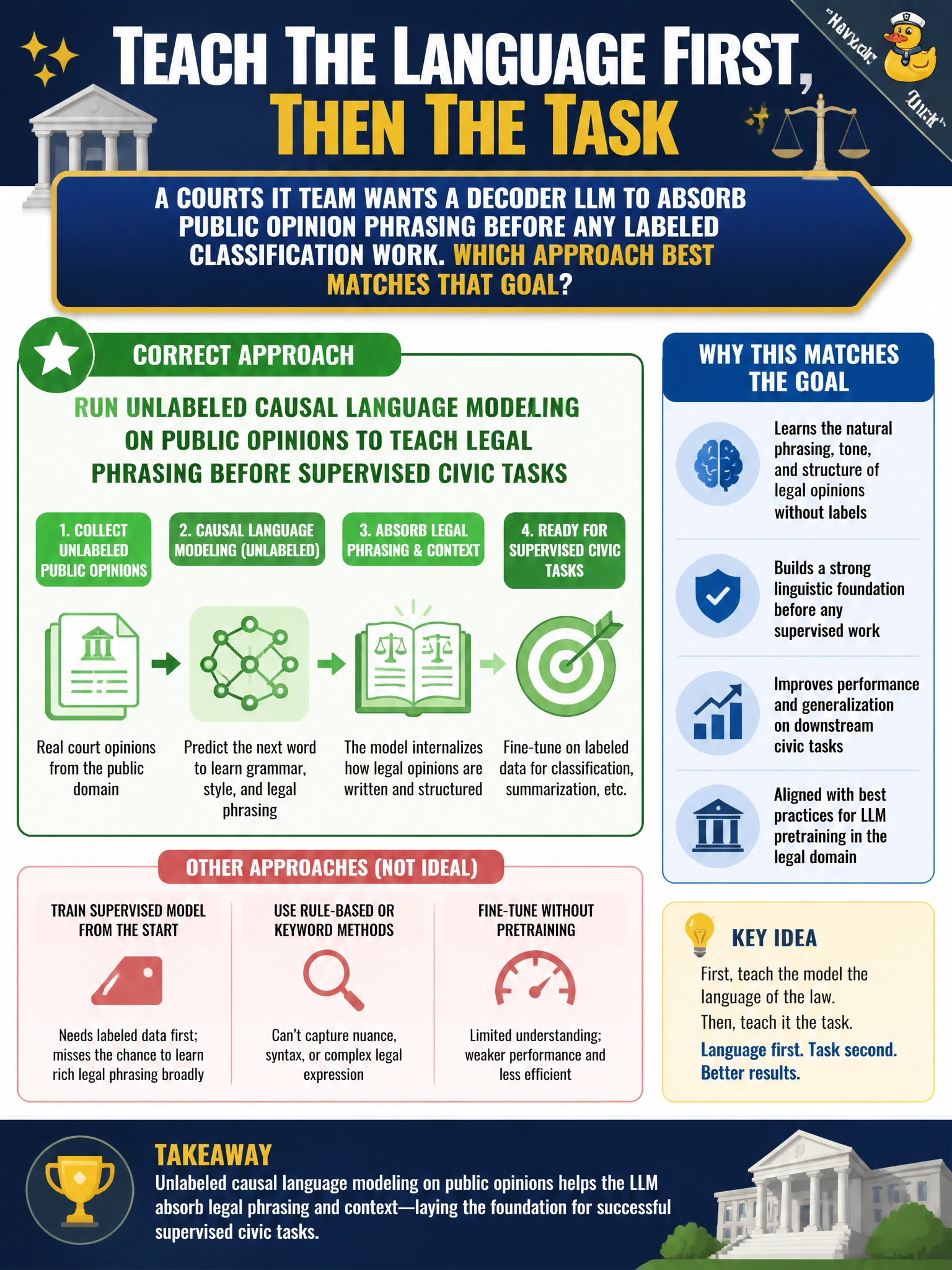
A courts IT team wants a decoder LLM to absorb public opinion phrasing before any labeled classification work. Which approach best matches that goal?
Select an answer to reveal the explanation.
Short Explanation
Let the model read a pile of public opinions the way a new clerk skims old binders—no labels yet, just absorb how the court writes. Causal LM on public text first, supervised tasks later.
Full Explanation
Running unlabeled causal language modeling on public court opinions best matches the courts IT goal of absorbing public opinion phrasing before labeled classification. Unsupervised (or self-supervised) causal LM exposes the decoder to authentic legal diction, citation habits, and opinion structure without requiring affirm/reverse labels yet. That domain adaptation step builds legal language competence that later supervised civic tasks can reuse. Training only on binary affirm/reverse labels jumps straight to classification and never teaches broad opinion phrasing beyond the thin signal in those labels. Skipping domain text and jumping to few-shot prompts with no adaptation leaves the base model without court-specific language exposure, so few-shot examples must carry all legal style burden. Fine-tuning exclusively on sealed juvenile records is both a privacy and policy violation for ordinary public-facing adaptation and fails the stated goal of using public opinions; sealed material must not be the path to 'maximize legal vocabulary.' Exam caveat: unlabeled adaptation on public opinions improves style and fluency but does not authorize use of non-public records; keep sealed and confidential corpora out of continued pretraining unless explicitly lawful and isolated. Operational check: confirm the adaptation corpus is limited to public opinions, that the training objective is causal LM without classification labels at this stage, and that supervised affirm/reverse fine-tuning only starts after the unlabeled phrasing pass completes.