
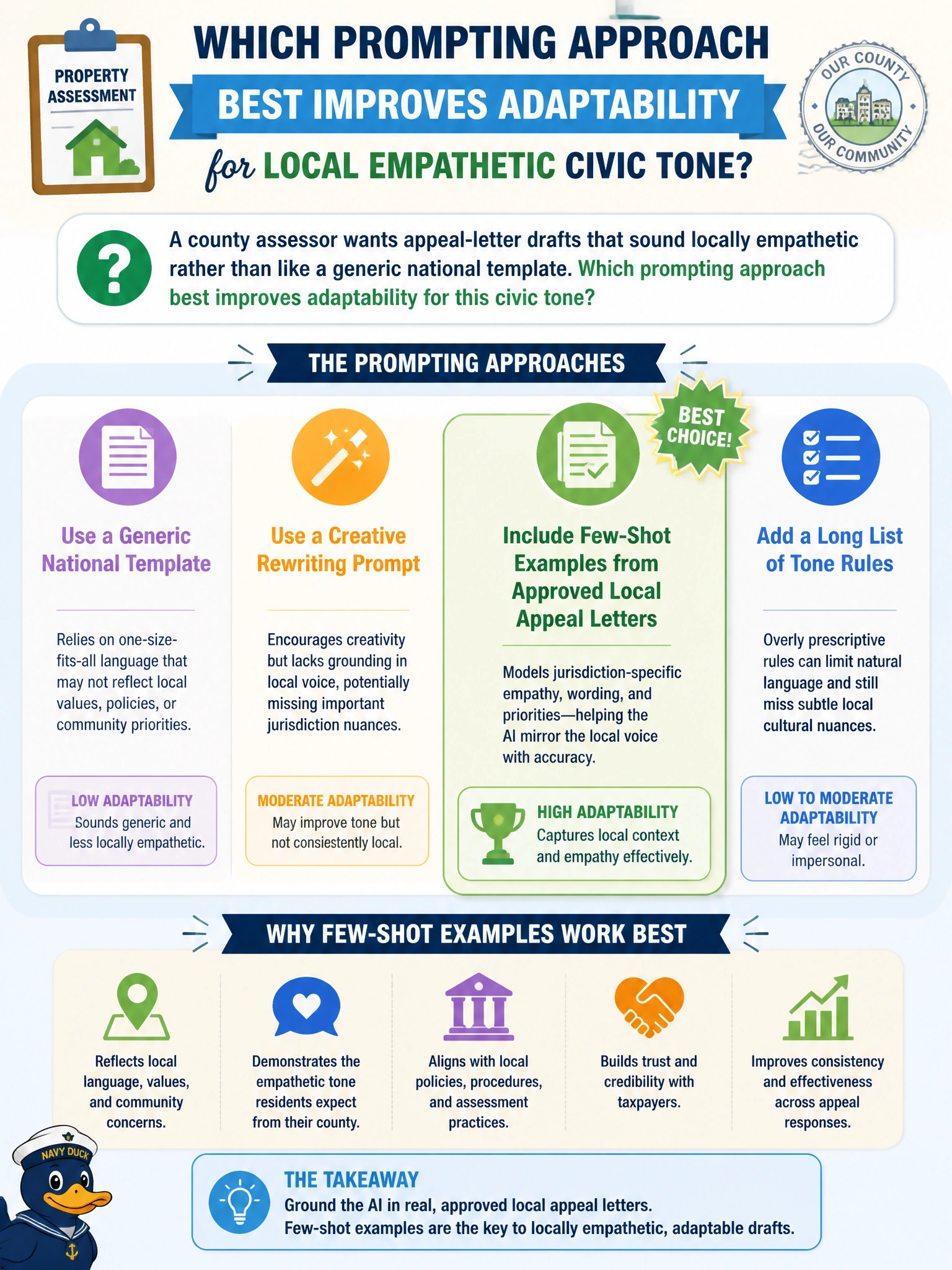
A county assessor wants appeal-letter drafts that sound locally empathetic rather than like a generic national template. Which prompting approach best improves adaptability for this civic tone?
Select an answer to reveal the explanation.
Short Explanation
Generic national copy is like reading a chain-store script at a neighborhood counter—locals notice. Dropping in a few approved county appeal letters as few-shot examples teaches the tone the assessor’s office actually uses.
Full Explanation
Few-shot prompting with approved local appeal letters best improves adaptability for the county assessor's civic tone because jurisdiction-specific empathy is a stylistic and policy-bound pattern, not a generic friendliness knob. Concrete examples of how the office acknowledges hardship programs, local deadlines, and neighborhood context teach the model the assessor's voice far more reliably than a nationwide template. Each few-shot draft anchors phrasing, deference, and program references that residents in that county actually encounter. Keeping a single nationwide boilerplate and raising decoding temperature only increases lexical randomness; it does not inject local policy knowledge or approved empathy patterns, so drafts still read like chain-store scripts with occasional warmer synonyms. Fine-tuning only on federal tax-code embeddings ignores the local appeal corpus that carries county-specific hardship language and misaligns adaptation toward national statute texture rather than constituent-facing letters. Zero-shot prompts that ban mention of county-specific hardship programs actively strip the civic content residents need and cannot teach local tone by prohibition. Exam caveat: few-shot examples must be approved and privacy-cleared; unvetted constituent letters can leak PII or outdated policy. Prefer a curated, rotating set over dumping raw appeals into the prompt. Operational check: A/B compare drafts with and without the local few-shot pack on the same appeal scenarios, score for jurisdiction references and empathy without overpromising relief, and retire examples when county hardship programs change.