
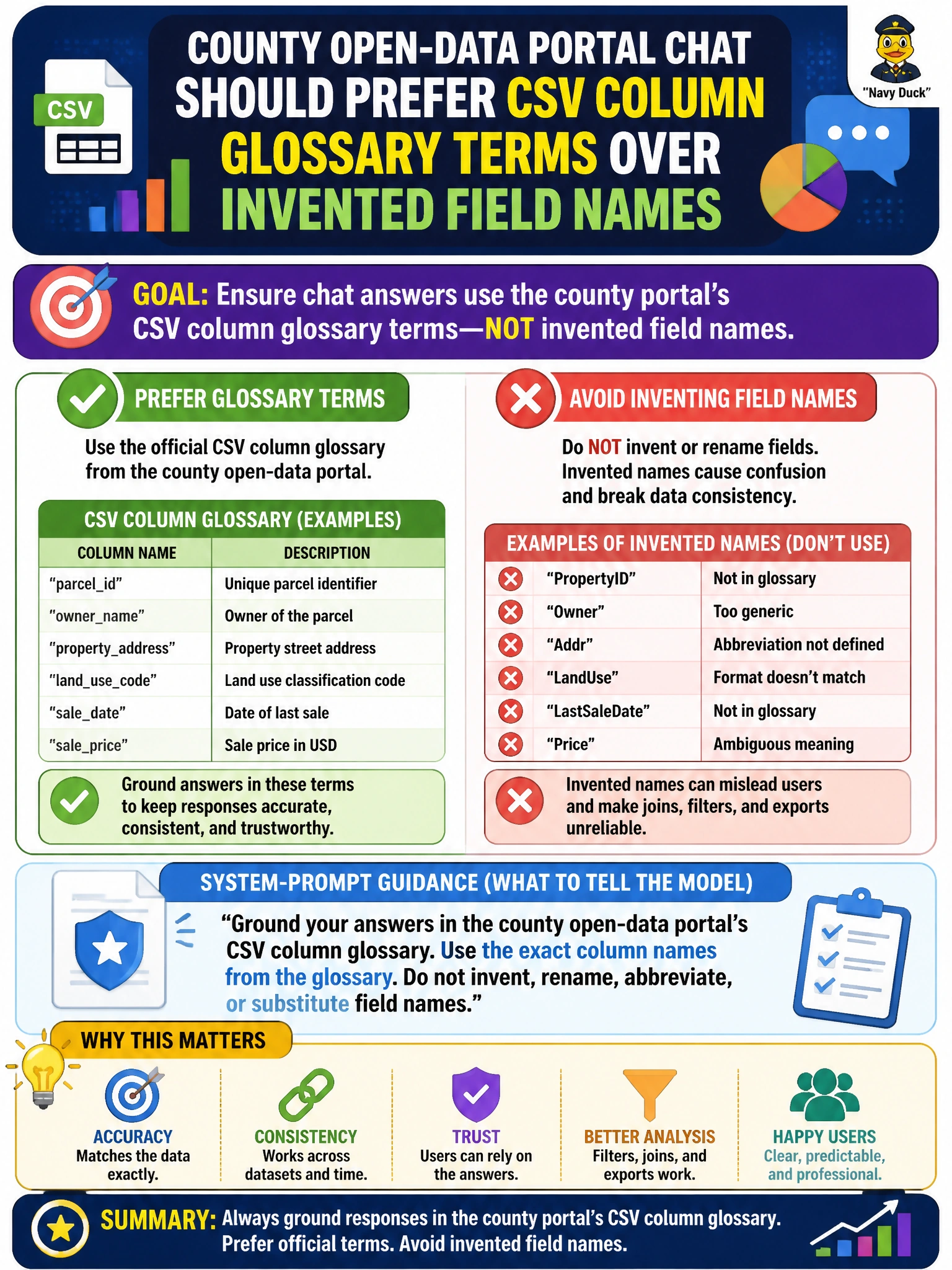
County open-data portal chat should prefer CSV column glossary terms over invented field names. What system-prompt guidance helps?
Select an answer to reveal the explanation.
Short Explanation
Open data falls apart when the bot renames columns on the fly. Tell it in the system prompt: stick to the CSV glossary terms residents and analysts already share. Inventing fields or banning the glossary creates phantom columns nobody can query.
Full Explanation
County open-data portal chat should prefer CSV column glossary terms over invented field names so residents and analysts share a stable schema vocabulary across downloads, notebooks, and dashboards. System-prompt guidance should instruct the model to ground answers in the portal’s CSV column glossary, quote canonical names, and admit gaps rather than minting new fields that break scripts. That glossary grounding is what keeps civic open data interoperable. Fabricating column names when the glossary is incomplete breaks downstream joins and erodes trust in the open-data program. Forbidding glossary use for “creativity” maximizes schema drift and confuses API consumers who rely on published dictionaries. Mapping every question to a single unrelated property-tax column ignores the resident’s actual dataset and returns misleading guidance. Exam caveat: glossaries go stale; pair the instruction with retrieval of the current data dictionary and date-stamp the glossary version in answers when possible. Operational check: compare emitted field names to the glossary automatically, flag unknowns for curator review, measure resident task success on download and filter instructions, and sync glossary updates with dataset republishes on the portal.