
School-district single-node jobs are fine, but multi-node IO is broken. What Magnum IO area should ops troubleshoot?
Select an answer to reveal the explanation.
Short Explanation
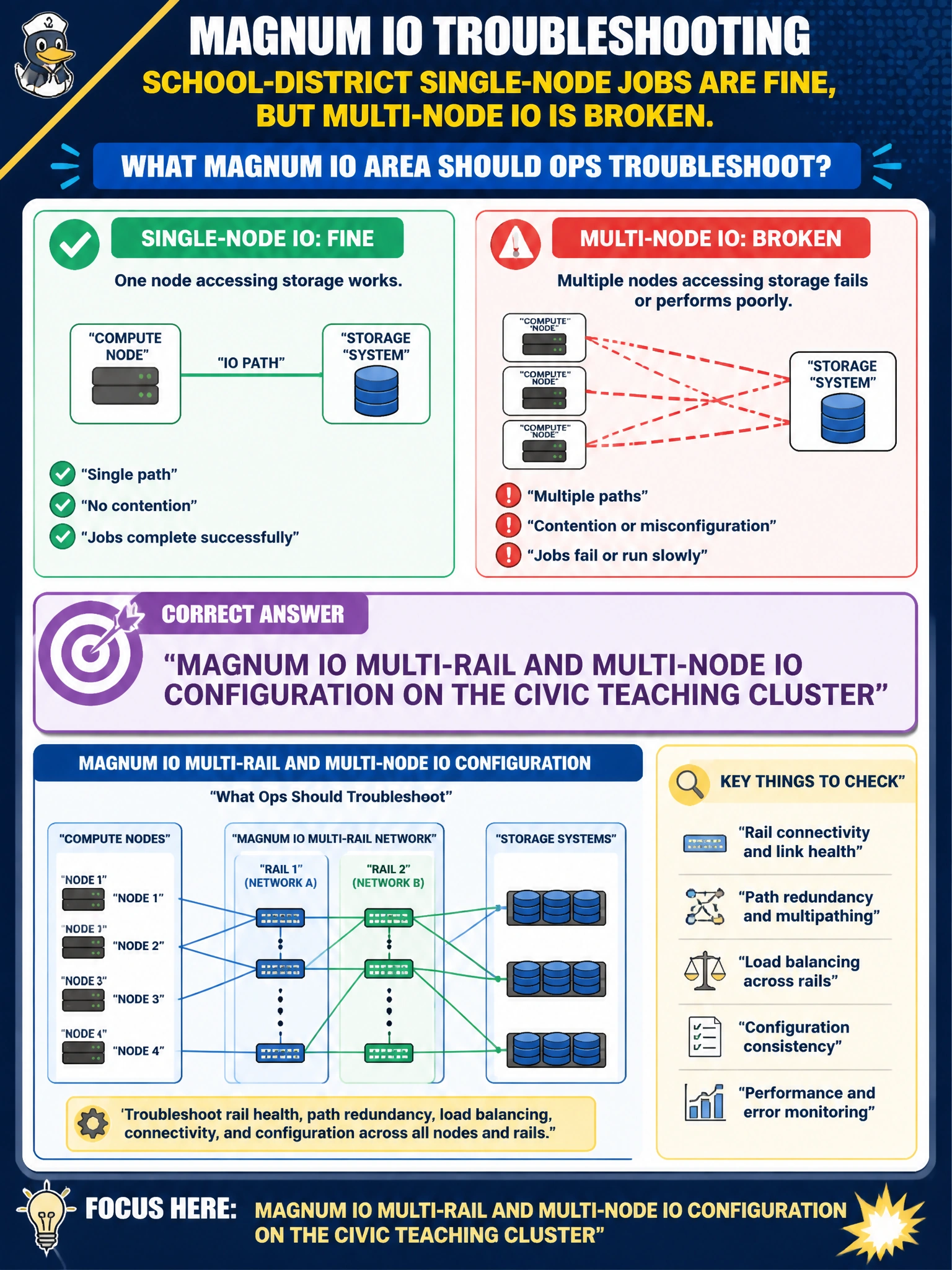
You can treat healthy single-node jobs and failing multi-node IO as a clue to check Magnum IO multi-rail and multi-node configuration on the civic teaching cluster. Classroom projectors and BCM password policies do not connect the cluster’s IO rails, and removing working jobs will not repair them.
Full Explanation
When school-district single-node jobs succeed but multi-node IO fails, the fault domain is the multi-node Magnum IO path: rails, peers, and cross-node configuration, rather than the single-GPU local path. Troubleshooting Magnum IO multi-rail and multi-node IO configuration on the civic teaching cluster targets the layer that only multi-node jobs exercise. Single-node success is useful evidence that local GPU and basic Magnum IO pieces work; it does not prove multi-rail or inter-node IO is correct. Classroom projectors connected to student laptops do not diagnose IO between teaching-cluster nodes, and BCM user password length policies are unrelated to IO path failures. Removing the working single-node jobs may make the dashboard look cleaner, but it removes useful workloads without fixing the broken multi-node configuration. Exam caveat: “works on one node, fails on many” is a classic cue to inspect Magnum IO multi-node and multi-rail settings, not to assume single-node success proves the full IO path is healthy. Practical check: run the same IO benchmark on one teaching node and across multiple nodes, inspect the civic teaching cluster’s Magnum IO configuration for asymmetric or missing rails, correct any issues, and confirm multi-node throughput approaches expected aggregate performance.