
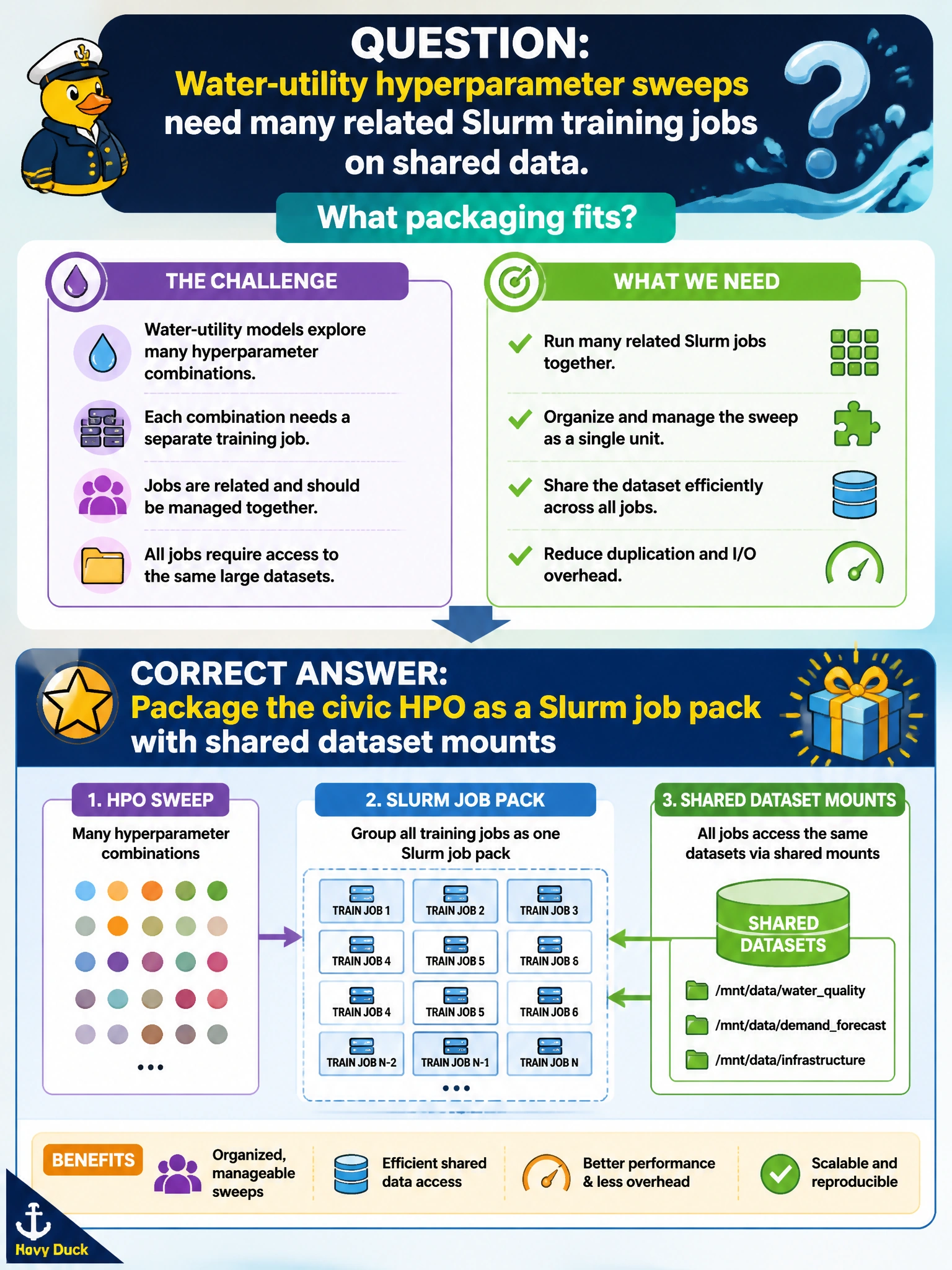
Water-utility hyperparameter sweeps need many related Slurm training jobs on shared data. What packaging fits?
Select an answer to reveal the explanation.
Short Explanation
An HPO job pack with shared mounts is a shared recipe box—many water-utility trials, one dataset kitchen. Desk workstations and month-long serial trials waste civic sweep time.
Full Explanation
Package the water-utility hyperparameter sweep as a Slurm job pack (or tightly coupled array/hetjob pattern) with shared dataset mounts. Related trials share one read-only dataset on networked storage, inherit common env/modules, and fan out parameter combinations without duplicating terabytes onto every local disk. That is efficient civic HPO on a shared cluster.
Launching unrelated one-off jobs with duplicated dataset copies on every local disk wastes space, skews clocks on data versions, and slows startup. Running each trial only on a workstation under someone's desk escapes scheduling, auditing, and parallel capacity. Forbidding parallel trials so sweeps complete one parameter at a time over months ignores why HPO exists—exploration needs concurrency within quota.
Exam caveat: shared mounts must be POSIX-friendly for concurrent readers; watch metadata storms from too many simultaneous opens. Job packs/arrays should cap concurrency to the water project's fairshare. Log each trial's hyperparameters and metrics to a central store so sweeps are reproducible for regulators.
Operational check: mount the shared dataset read-only, launch a small pack of trials with distinct hyperparameter sets, verify no per-node full copies appear, confirm parallel GPU usage within quota, and aggregate results for the utility's model selection review.