
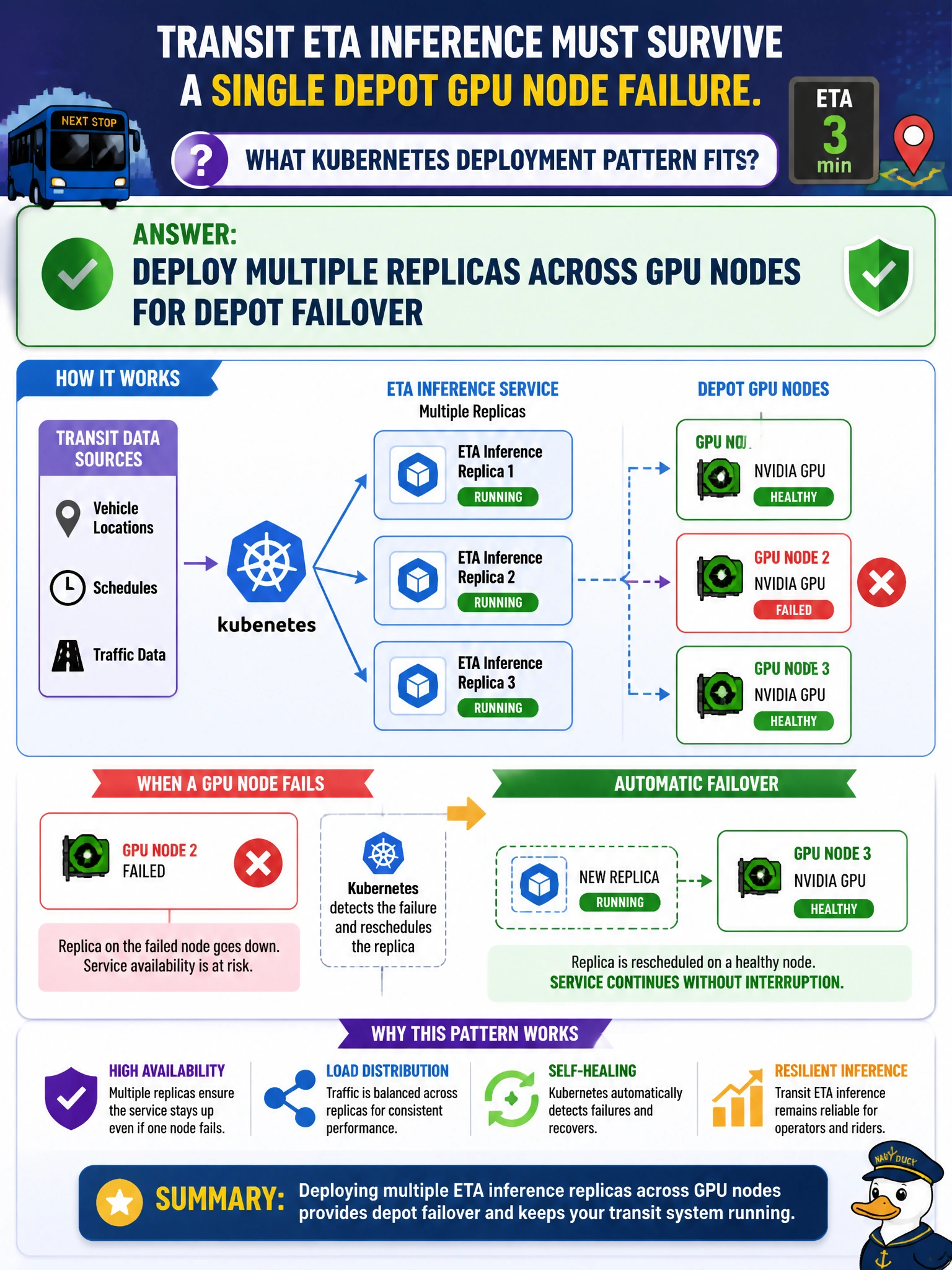
Transit ETA inference must survive a single depot GPU node failure. What Kubernetes deployment pattern fits?
Select an answer to reveal the explanation.
Short Explanation
You keep ETA predictions available by spreading replicas across depot GPU nodes, so one node failure does not stop service. That high availability avoids relying on a single pinned replica or a sole local model copy.
Full Explanation
Deploying multiple ETA inference replicas across GPU nodes is the right pattern because a failure at one depot need not remove all serving capacity. Spread the replicas across distinct nodes, for example with anti-affinity or topology spread constraints, and use a Service to direct requests to available replicas. Keep model artifacts on shared or replicated storage so another node can load them if a GPU node fails. A single replica pinned forever to one depot node is a single point of failure: a node drain, power loss, or GPU fault can stop ETA predictions. Keeping the sole inference model on that node’s local persistent volume ties the only model copy to the same failure domain, so another node may not be able to serve requests after the failure. Disabling replica counts so the Deployment never scales out leaves the service without additional replicas for failover and preserves a fragile topology. Exam caveat: multiple replicas require enough GPU capacity on the remaining nodes; otherwise, they may exist in the Deployment but fail to become ready after a node loss. Practical check: in staging, cordon or terminate one depot GPU node, then verify that remaining replicas serve ETA requests and that the endpoints update. Confirm that replicas were placed on distinct nodes and that requests continue to succeed during the test.