
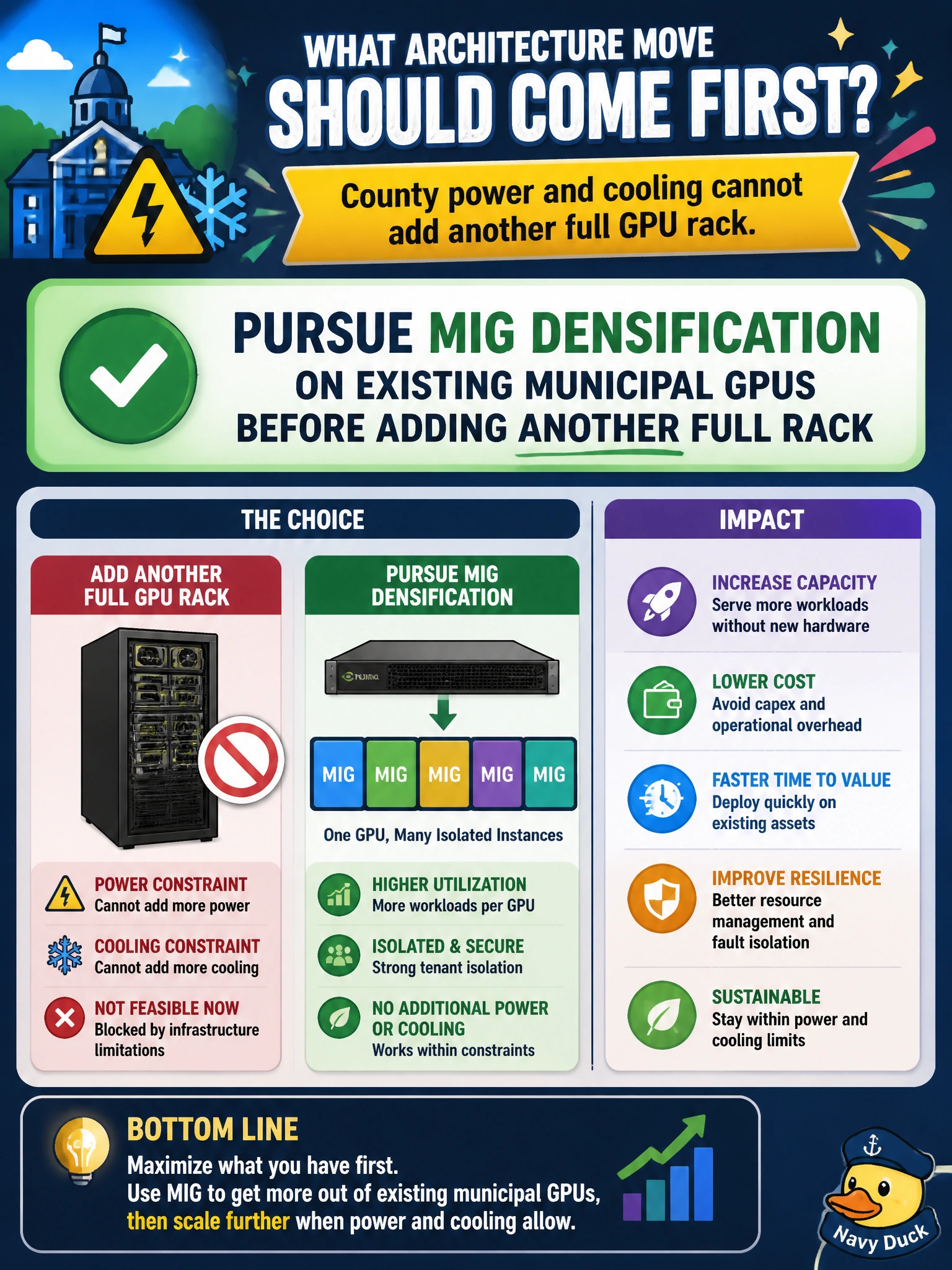
County power and cooling cannot add another full GPU rack. What architecture move should come first?
Select an answer to reveal the explanation.
Short Explanation
When your county cannot support another rack, start by getting more from the GPUs it already powers and cools with MIG densification. You preserve room for essential inference without ordering equipment the building cannot support or abandoning GPU services.
Full Explanation
When county power and cooling cannot support another full GPU rack, pursue MIG densification on existing municipal GPUs first. Partitioning those GPUs into MIG slices can let more inference or light-training workloads share the devices already receiving power and cooling, increasing utilization without adding facility load. Once you have measured the benefit and right-sized workloads, you can revisit whether facility upgrades are needed for another rack. Ordering a second rack before cooling upgrades ignores the facility constraint, risking stranded capital and thermal problems. Shutting down all inference permanently would free headroom but abandon civic services that depend on GPU capacity. Replacing every GPU with a non-accelerated appliance might reduce power use, but would not serve workloads that require accelerators. Exam caveat: MIG supports isolation and denser placement for compatible inference and smaller jobs; it does not make every workload fit, so match the partitioning to workload needs. Practical check: profile current GPU compute and memory utilization, enable MIG for supported workloads, and verify power and cooling remain within facility limits before considering another rack. Document measured headroom and the additional inference replicas or notebook slices it supports, rather than relying on idle-time impressions.