
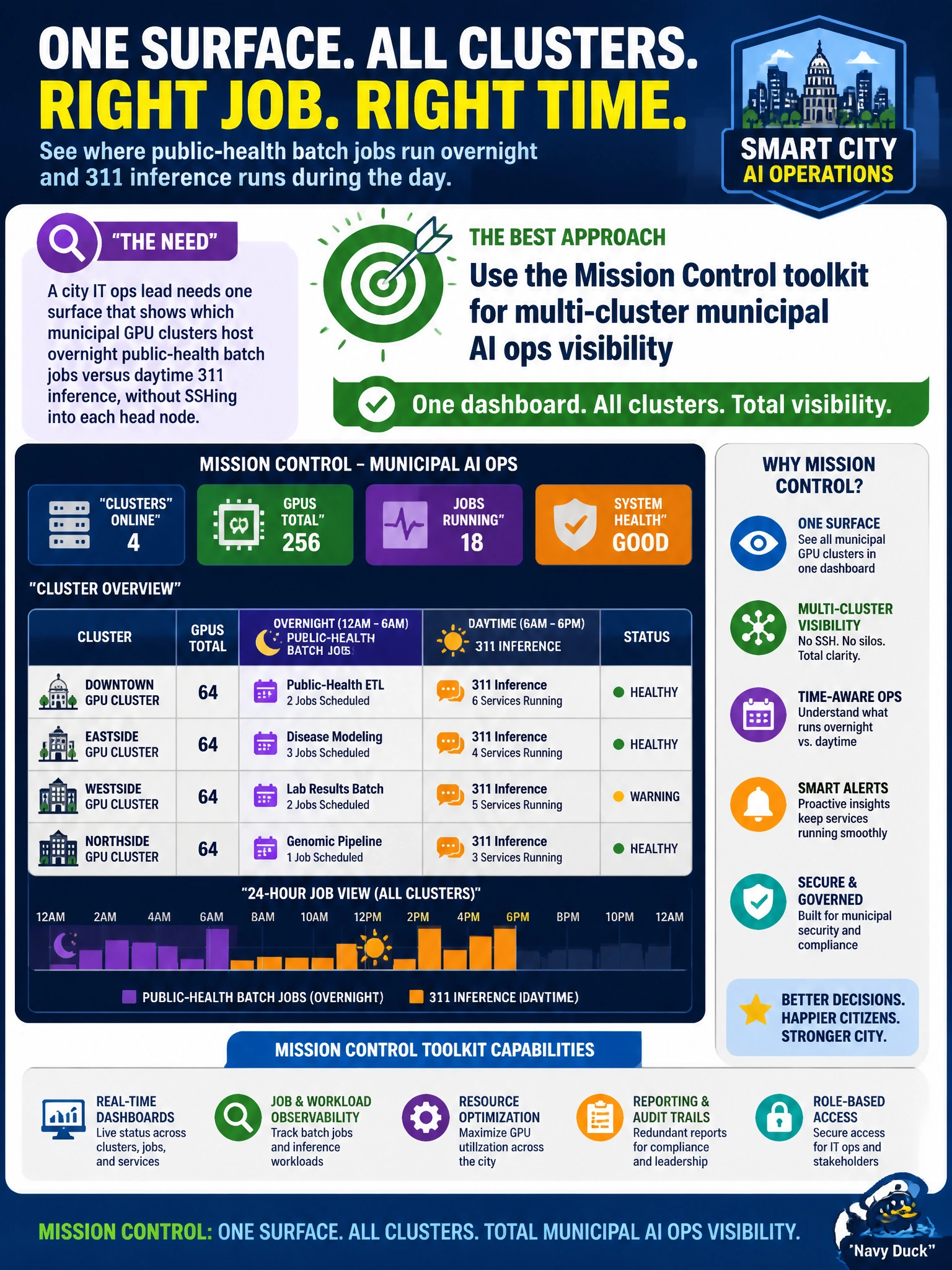
A city IT ops lead needs one surface that shows which municipal GPU clusters host overnight public-health batch jobs versus daytime 311 inference, without SSHing into each head node. Which approach best fits that need?
Select an answer to reveal the explanation.
Short Explanation
Picture a city traffic wall that shows every freeway at once instead of driving to each camera pole. Mission Control is that wall for municipal GPU fleets—one toolkit surface for which cluster is doing public-health batch versus 311 inference. Ad-hoc SSH or a single-node nvidia-smi only ever shows you one intersection.
Full Explanation
Mission Control is the right municipal ops surface when a city IT lead must see, in one place, which GPU clusters are running overnight public-health batch work versus daytime 311 inference—without SSHing into every head node. In the NCP-AIO installation-and-deployment model, Mission Control is oriented to higher-level multi-cluster visibility and toolkit workflows across NVIDIA AI platforms. That matches civic reality: public-health training and 311 classification often live on different sites or categories but must still be operated as one fleet picture for staffing, capacity, and incident response. Opening nvidia-smi on a single training node only ever reflects that host’s devices; extrapolating from one box systematically hides depot, edge, or sibling-cluster pressure and invents false confidence. Disabling Base Command Manager (BCM) and falling back to weekly spreadsheets removes the managed inventory, images, and telemetry Mission Control assumes, so the “one surface” collapses into stale inventory theater. Standing up a separate Slurm controller on every edge box while ignoring fleet views fragments scheduling domains and guarantees you cannot answer which municipal cluster owns which civic workload. Exam caveat: Mission Control does not replace BCM for node provisioning or image sync—do not treat the toolkit as a drop-in cluster manager. Operational check: from Mission Control, confirm each civic cluster’s role (batch vs inference), that BCM remains healthy underneath, and that operators can navigate from fleet view to the responsible site without ad-hoc SSH scavenger hunts.