
Transit ML enablement needs consistent RoCE configuration on Spectrum-X. Which automation approach fits?
Select an answer to reveal the explanation.
Short Explanation
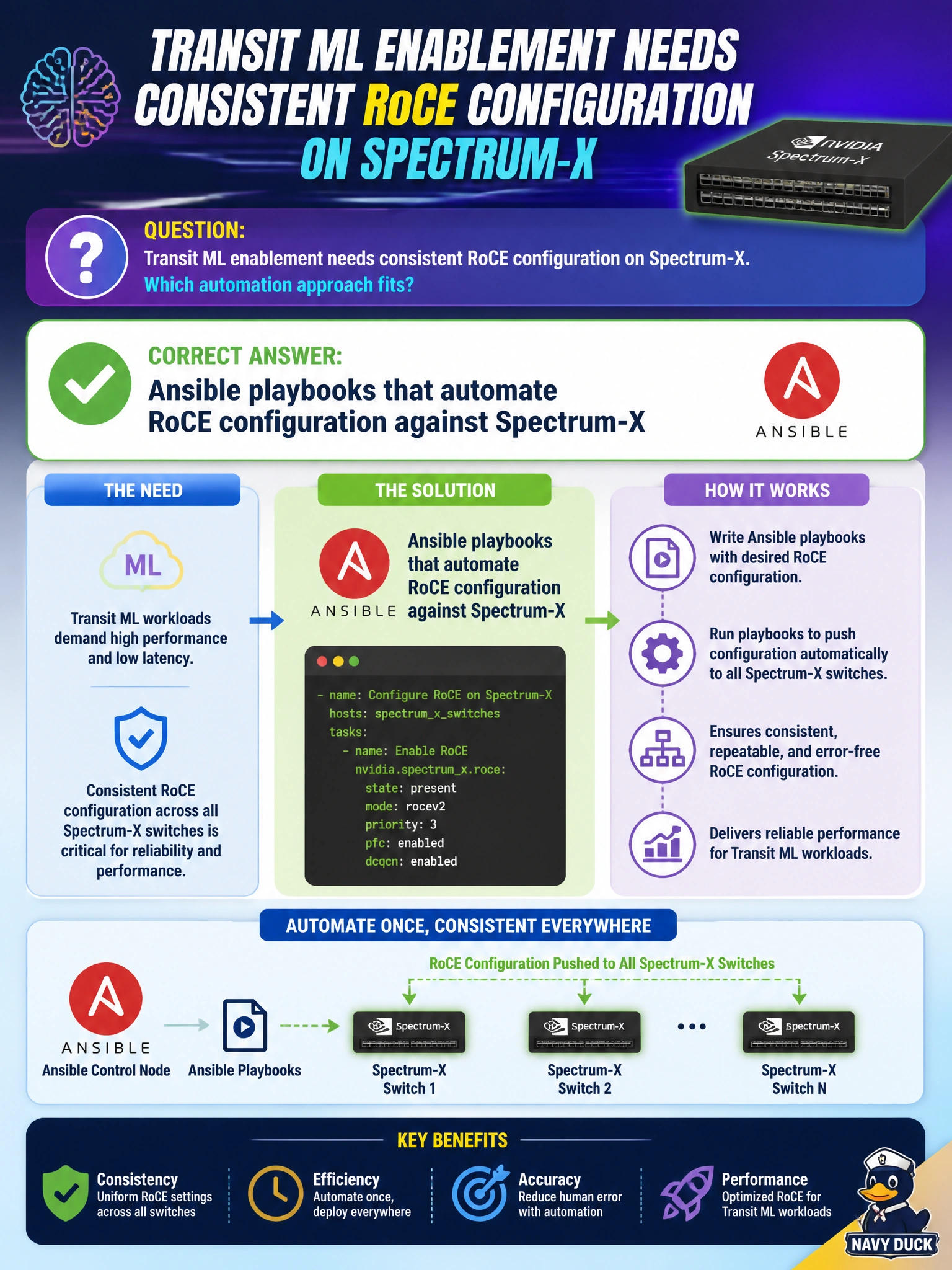
Transit ML wants RoCE done the same way every time. Point Ansible playbooks at Spectrum-X and automate the RoCE setup instead of using Terraform plans for tenant VLAN provisioning, which won't configure RoCE on the fabric.
Full Explanation
Transit ML enablement needs consistent RoCE configuration on Spectrum-X, which is an automation problem suited to Ansible. Ansible playbooks that automate RoCE configuration against Spectrum-X apply PFC, ECN, priorities, and related Ethernet RDMA prerequisites the same way across transit leafs, reducing on-call variance and supporting repeatable civic ML networking. Terraform plans that automate Spectrum-X VLAN provisioning for tenant traffic address VLAN segmentation rather than the consistent RoCE configuration that transit ML enablement requires, leaving PFC, ECN, and priority settings inconsistent across leafs. Ansible playbooks that standardize DCB settings on ESXi hosts for Spectrum-X configure host-side DCB but do not apply consistent RoCE settings on the Spectrum-X fabric itself, so they cannot ensure the switch-side RoCE consistency transit ML needs. Using InfiniBand ibstat output to configure Ethernet RoCE confuses host IB diagnostics with Spectrum Ethernet RoCE configuration and cannot correctly drive Spectrum-X settings. Exam caveat: RoCE playbooks must align with NVUE or supported Spectrum automation interfaces and with host-side RDMA settings; switch-only automation is incomplete if NICs remain misconfigured. Operational check: run the Ansible RoCE playbooks against transit Spectrum-X inventory, verify priority/PFC/ECN settings, and validate RoCE test traffic for the ML enablement VLAN before production ML jobs scale up.