
Housing-authority Spectrum onboarding requires switches to match the civic standard. What should the gate enforce?
Select an answer to reveal the explanation.
Short Explanation
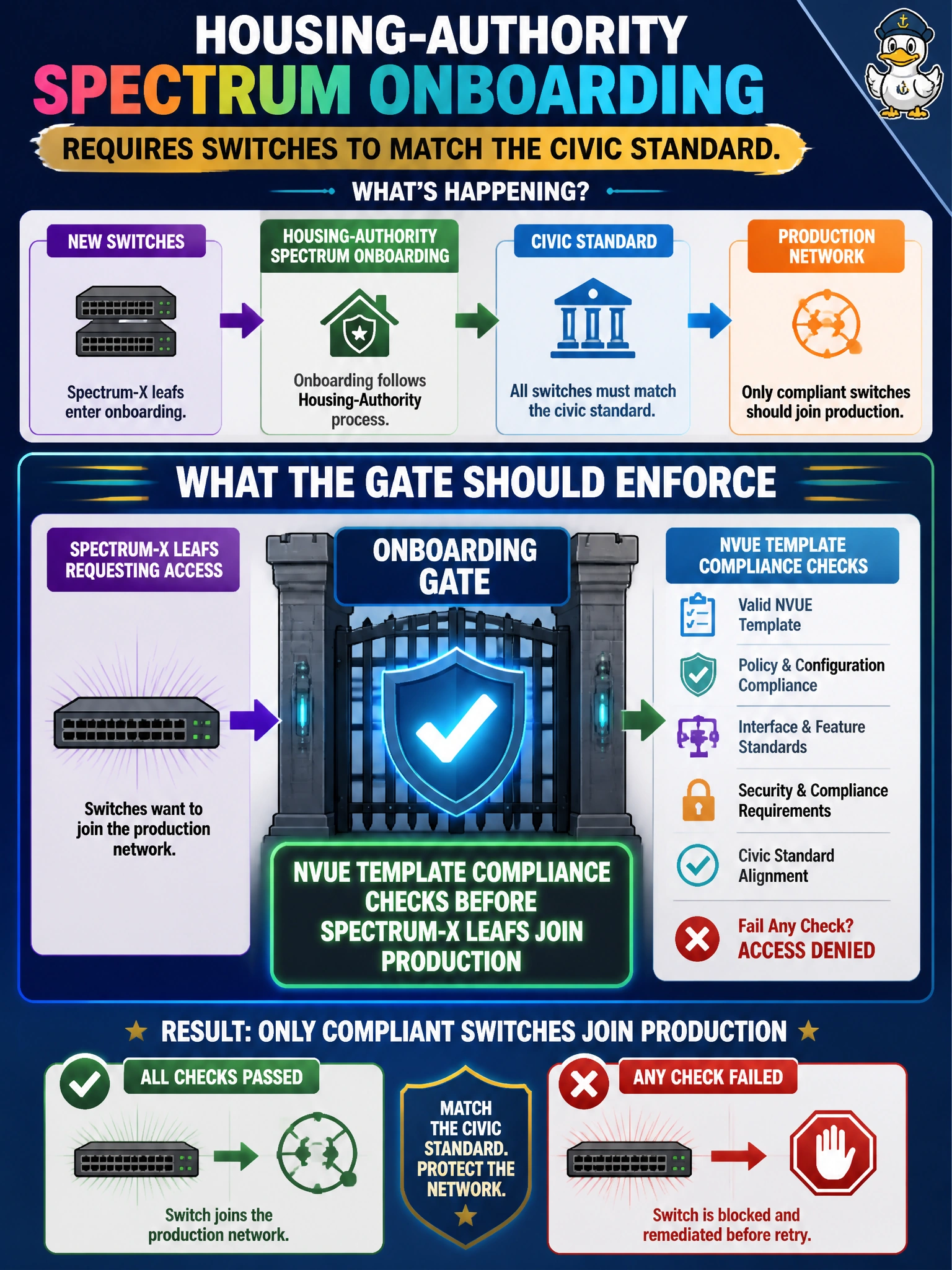
New housing-authority leafs shouldn’t waltz into production looking unique. Gate onboarding with NVUE template compliance checks so Spectrum-X matches the civic standard.
Full Explanation
Housing-authority Spectrum onboarding must keep new leafs aligned with the civic standard before they join production. Enforcing NVUE template compliance checks at the gate verifies that Spectrum-X configuration—interfaces, EVPN, RoCE, QoS—matches approved templates rather than relying on informal assurances. That prevents unique or incomplete leafs from entering the municipal fabric and keeps housing-authority AI networking predictable under audit. Relying on manual CLI audit approval before Spectrum-X leafs join production checks a person's sign-off rather than automated template compliance, and it can still let drifted RoCE or EVPN settings slip into production. ONIE install validation before Spectrum-X leafs join production only proves the installer finished; it provides no technical gate that the running config matches approved NVUE templates and creates false confidence during onboarding. Periodic RoCE ECN threshold review after Spectrum-X leafs join production happens after the leaf is already in production, so it does not enforce the civic Spectrum baseline at the gate and can allow long-lived misconfigurations to persist. Exam caveat: compliance checks should be automated against rendered or running config and tied to inventory role (border vs AI leaf), not a one-size checklist that ignores role differences. Operational check: before production join, run NVUE template compliance validation on the housing-authority leaf, remediate deviations, re-check, then only then advertise the leaf into the production Spectrum-X fabric.