
A county clinic must declare the Kubernetes fabric ready after Network Operator install. What health check should come first?
Select an answer to reveal the explanation.
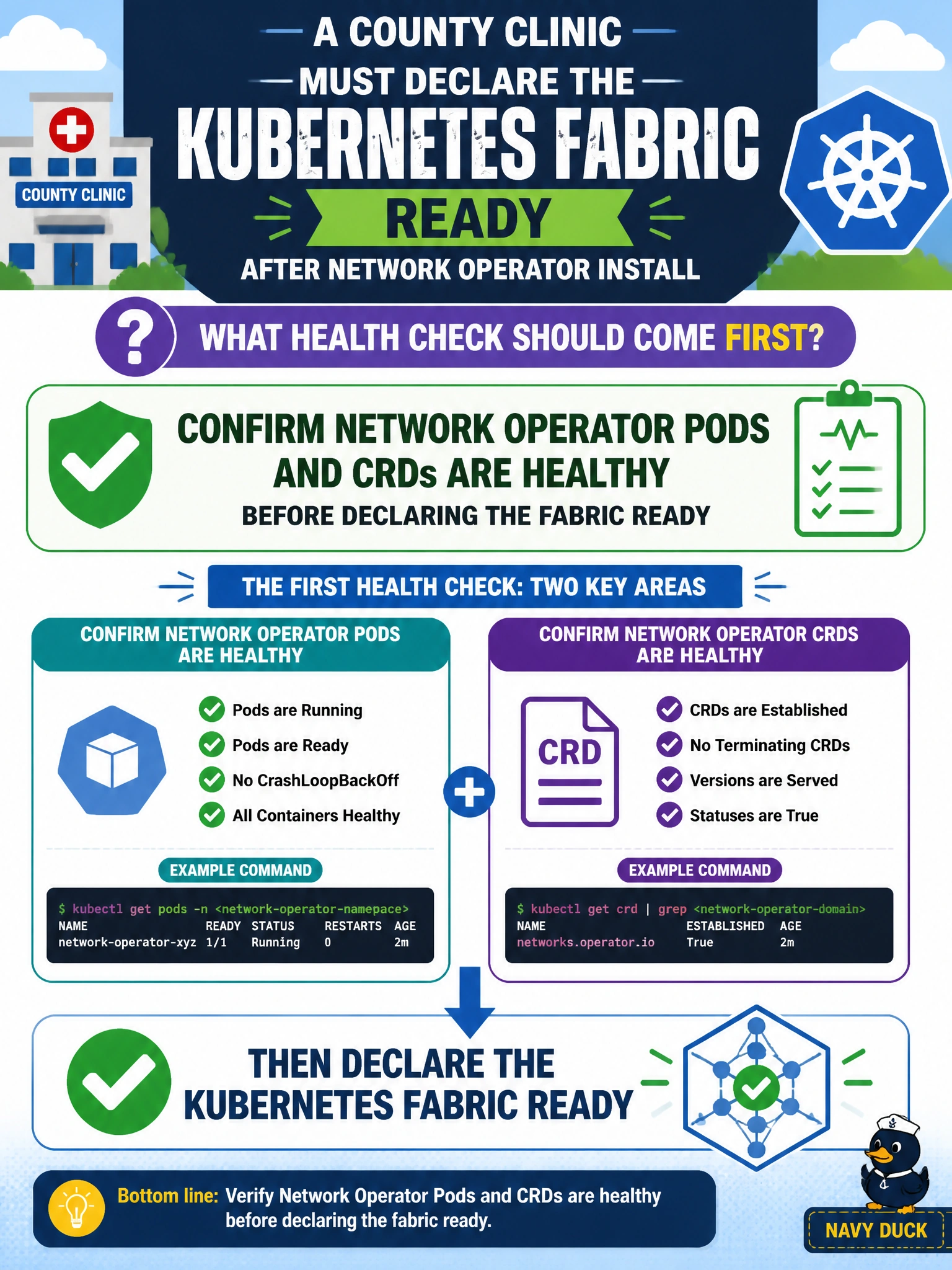
Short Explanation
Don't declare the fabric ready just because GPU daemonsets or a load-balancer IP look fine — those are downstream checks. Confirm the Network Operator's own pods and CRDs are healthy first, so you know the gate everything else depends on is actually solid.
Full Explanation
A county clinic declaring the Kubernetes fabric ready after Network Operator install should first confirm Network Operator pods and CRDs are healthy. Control-plane health—Running/Ready operator pods, installed CRDs, and absence of CrashLoops—is the prerequisite before civic workloads are told the fabric is ready. Skipping that check risks launching RDMA jobs against an operator that never finished reconciling device and network state.
Validating GPU Operator daemonset status and device plugin resources across worker nodes fails as a first gate because GPU device-plugin status is a downstream workload concern and does not confirm that Network Operator pods and CRDs are healthy. Confirming Multus CNI configuration and secondary interface attachment on worker nodes fails as the first check because CNI attachment details are secondary to verifying that the Network Operator pods and CRDs themselves are running and installed. Verifying LoadBalancer service external IP assignment and ingress endpoint reachability status fails as the initial readiness check because external endpoint reachability does not affirm that Network Operator pods and CRDs are healthy or that the operator has reconciled network state.
Exam caveat: Healthy pods and CRDs are the first fabric-readiness gate for the operator, not the last. Municipal readiness declarations should still include RDMA resource visibility and, where required, a sample workload test.
Operational check: At the county clinic cluster, verify Network Operator Deployments/DaemonSets are Ready, CRDs for the operator networking objects exist, review recent operator events for reconcile errors, and only then update the fabric readiness status for clinic AI namespaces.