
After NVIDIA Network Operator install, public-health admins must prove RDMA/IB is ready. What should they verify?
Select an answer to reveal the explanation.
Short Explanation
Install isn’t done until the cluster shows the RDMA toys. Verify device plugins and InfiniBand networks actually appear in the public-health Kubernetes after Network Operator install. Don’t be fooled by SR-IOV Virtual Functions and Mellanox NICs reporting ready on host nodes, Node Feature Discovery labels listing RDMA-capable NICs on worker nodes, or Multus network attachments and IP address pools showing active for pod traffic—those don’t prove RDMA device plugins and InfiniBand networks exist in Kubernetes.
Full Explanation
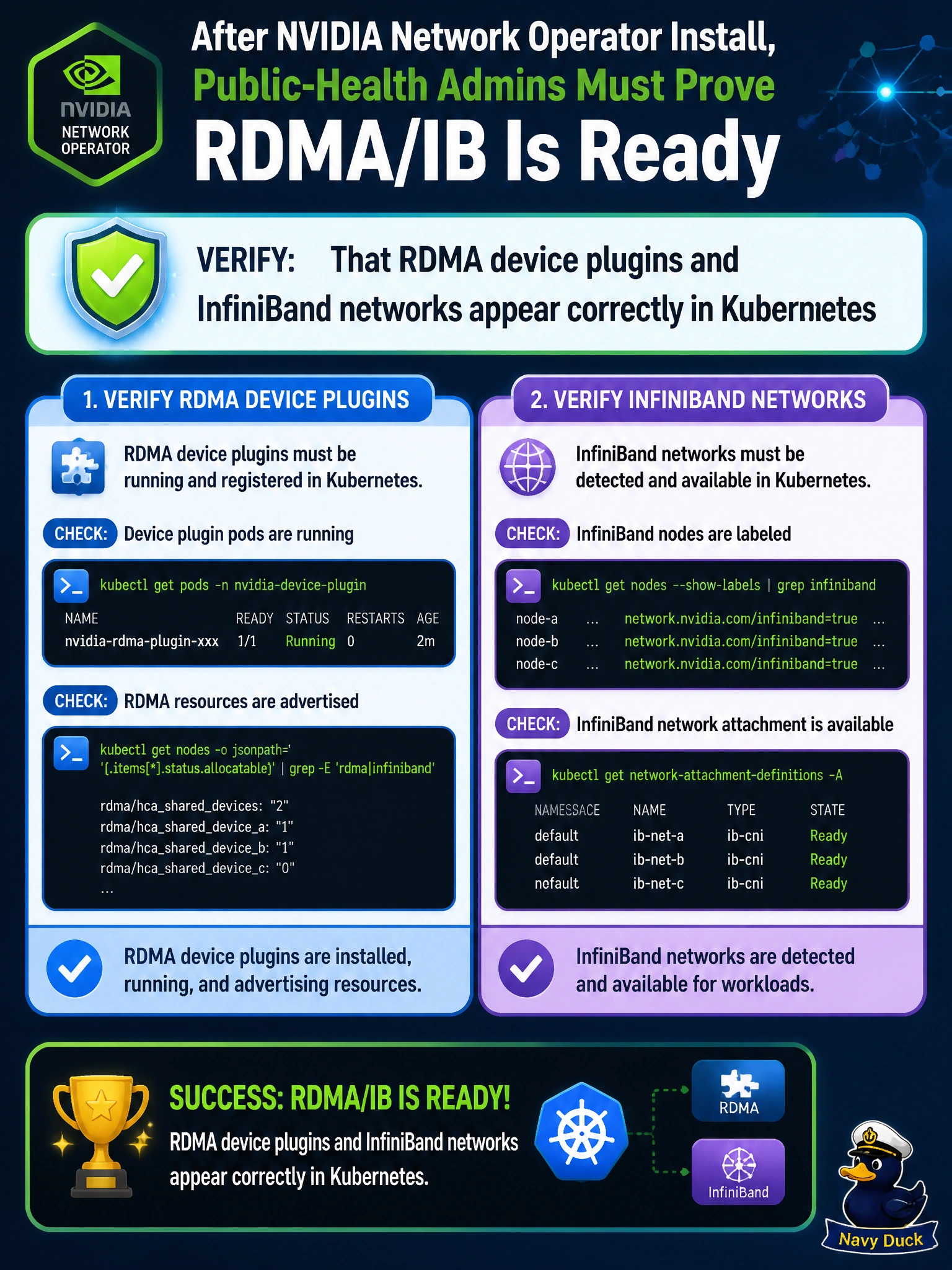
After NVIDIA Network Operator install, public-health admins must prove RDMA/IB readiness by verifying that RDMA device plugins and InfiniBand networks appear correctly in Kubernetes. Post-deploy verification is about observable cluster state: device plugin DaemonSets or pods running, RDMA resources advertised on nodes, and InfiniBand/secondary network definitions present for workloads to attach. That proof separates a successful Helm transaction from a functional civic inference platform.
Believing SR-IOV Virtual Functions and Mellanox NICs report ready on host nodes fails because RDMA readiness in Kubernetes requires device plugins and InfiniBand networks to appear in the cluster, not just host-level NIC status. Believing Node Feature Discovery labels list RDMA-capable NICs on worker nodes fails because NFD labels are a discovery mechanism, not a verification of RDMA device plugin and InfiniBand network installation in Kubernetes. Checking only that Multus network attachments and IP address pools show active for pod traffic fails because active pod traffic doesn't confirm that RDMA device plugins and InfiniBand networks are properly configured and advertised in Kubernetes.
Exam caveat: Appearance of plugins and networks is necessary verification, not sufficient alone for production. Follow with a sample RDMA pod test when the scenario requires usability proof beyond control-plane objects.
Operational check: On the public-health cluster, list Network Operator pods, confirm RDMA device plugin components are Ready, inspect nodes for RDMA resource capacity, verify InfiniBand/secondary network attachments or NADs exist, and record the evidence before marking the install complete.